
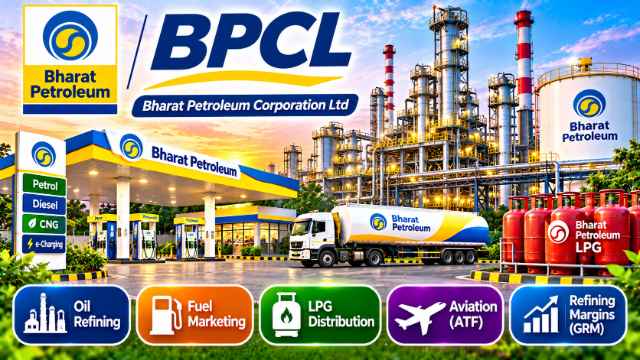
Explore BPCL's refining and fuel marketing business, Q2 FY27 results, GRM recovery, marketing margins and key investment risks.
- Bharat Petroleum Corporation Ltd (BPCL) is a state-owned oil refining and marketing company.
- BPCL earns revenue by selling refined petroleum products through its retail fuel network, LPG distribution operations and industrial and aviation sales.
- Refining performance is a central driver of BPCL’s earnings.
What BPCL Does
Bharat Petroleum Corporation Ltd (BPCL) is a state-owned oil refining and marketing company. Its business covers two connected activities: refining crude oil into petroleum products and selling those products to customers through different distribution channels.
The company processes crude oil to produce petrol, diesel, liquefied petroleum gas (LPG), aviation turbine fuel (ATF) and other petroleum products. These products serve everyday transportation needs as well as industrial and aviation customers.
BPCL’s refining business converts crude oil into finished fuels and other products. The profitability of this activity is influenced by refining margins, commonly measured through gross refining margin (GRM). GRM reflects the economics of processing crude oil into petroleum products and is an important indicator of refining performance.
The company’s marketing business takes those products to customers. It sells fuel through its retail network, distributes LPG and supplies industrial and aviation customers. This gives BPCL exposure to several areas of petroleum consumption rather than relying on a single product or customer category.
Also Read: Vedanta: How Commodity Prices, Higher Volumes and Debt Reduction Drive Its Business
The combination of refining and marketing makes BPCL an integrated oil business. Its financial performance depends on both the profitability of refining crude oil and the margins earned from selling petroleum products.
Customers and How BPCL Makes Money
BPCL earns revenue by selling refined petroleum products through its retail fuel network, LPG distribution operations and industrial and aviation sales. Its customers include fuel consumers, LPG users, industrial buyers and aviation customers.
The company’s profitability comes primarily from two important sources: refining margins and marketing margins.
Refining margins reflect the economics of converting crude oil into products such as petrol, diesel, LPG and ATF. When refining margins improve, the refining business can contribute more strongly to overall profitability. When they weaken, the benefit from processing crude oil can decline.

Marketing margins arise from selling petroleum products to customers. The relationship between the cost of petroleum products and the prices at which they are sold influences the profitability of this activity.
Unlike refining margins, marketing margins are also influenced by the domestic fuel retail price environment and government policy. Changes in fuel prices and policy decisions can affect how much of the underlying cost movement is passed through to customers.
This distinction is important when analysing BPCL’s results. A quarter with strong refining margins may still face pressure from fuel marketing economics, while changes in retail prices can improve marketing margins and support profitability.
For investors, BPCL’s earnings need to be understood through both sides of the business. Refining performance and marketing margins can move differently, making it important to examine them separately rather than relying only on consolidated profit.
Growth Drivers
Marketing margins are another important driver. Price increases improved marketing margins during the September quarter and supported the company’s return to profit. The domestic fuel retail price environment and government policy will continue to influence this part of the business.
Demand across the company’s product channels is relevant as well. Petrol, diesel and LPG serve different consumer requirements, while industrial and aviation sales provide additional outlets for refined products.
The company’s integrated refining and marketing structure allows it to participate in both stages of the petroleum business. The overall growth opportunity depends on how effectively it manages refining economics and marketing profitability together.
Competition and Risks
Crude oil price volatility is a major risk for BPCL. Changes in crude prices can affect the cost of inputs and the economics of refining and marketing. The impact on profitability depends on refining margins, product prices and the timing of cost changes.
Government influence over fuel pricing is another important consideration. If retail prices do not adjust in line with underlying costs, marketing margins can come under pressure. This can affect profitability even when refining performance is favourable.
Also Read: REC: How Power and Infrastructure Financing Drive Its Business
Refining margins are cyclical. They can change with the relationship between crude oil costs and the prices of petroleum products. A strong refining quarter does not necessarily mean that the same level of profitability will continue.
High capital expenditure is another risk for the business. Investment requirements can influence cash needs and financial performance, making it important to assess spending alongside the returns generated by operations.
The energy transition presents a longer-term challenge. Changes in the energy landscape could influence the future role of conventional petroleum products and the business environment in which BPCL operates.
What Investors Should Watch
Also Read: Punjab National Bank: How Deposits, Lending and Improving Asset Quality Drive Its Business
The relationship between refining and marketing performance is particularly important. Strong GRMs can support earnings, but weaker marketing margins may offset part of that benefit. Looking at both activities together provides a more complete picture of BPCL’s operating performance.
Refinery throughput and capacity utilisation are useful indicators of operating activity. Investors should also follow revenue, profit and EPS to understand whether improvements in operating conditions are translating into sustainable earnings.
Finally, the impact of crude oil volatility, export duty changes, government pricing decisions and capital expenditure should be considered alongside the company’s energy transition exposure. These factors can influence both near-term profitability and the longer-term business outlook.
Also Read: PFC: How Power Sector Financing and Renewable Energy Loans Drive Its Business
Conclusion
Financial Disclaimer: This article is for educational and informational purposes only. It is not investment advice or a recommendation to buy or sell BPCL shares. Investors should conduct independent research before making financial decisions.
Also Read: Muthoot Finance: How Gold Loans, Rising Gold Prices and Lending Growth Drive Its Business





Keep learning with OneTrader
Explore structured lessons and practical guides to build your market knowledge.

Need a laugh after all that money talk?
Paisa LOL: India's funniest finance page, with memes, comics, jokes and long funny stories.
