
Understand Bajaj Holdings' investment model, associate earnings, Q2 FY27 results and its exposure to Bajaj Auto and Bajaj Finserv.
- Bajaj Holdings & Investment Ltd (BHIL) is the investment arm of the Bajaj Group.
- Bajaj Holdings does not operate like a typical company selling products or services to customers.
- The main growth driver for Bajaj Holdings is the earnings performance of its major associate companies.
What Bajaj Holdings Does
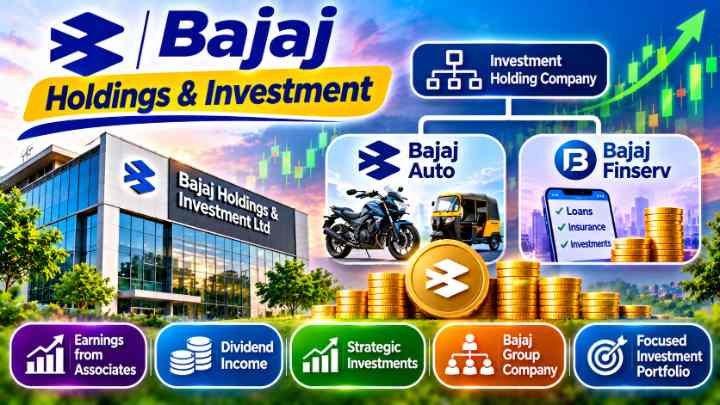
Bajaj Holdings & Investment Ltd (BHIL) is the investment arm of the Bajaj Group. Unlike a conventional manufacturing or consumer business, it does not primarily earn money by producing and selling products. Instead, it holds strategic investments in other companies and earns through dividends and its share of the profits generated by businesses in which it has significant ownership.
Its two major investments are Bajaj Auto and Bajaj Finserv, both accounted for as associates. BHIL holds a 37.29% stake in Bajaj Auto and a 40.75% stake in Bajaj Finserv. These investments connect its financial performance to the businesses and profitability of the two companies.
The company also holds other strategic equity investments and has a 51%-owned subsidiary, Bajaj Nivesh. Its overall business is therefore centred on managing investments rather than running a large portfolio of directly operated consumer or industrial businesses.
This distinction is important when evaluating BHIL. Its earnings depend substantially on the financial performance of its associate companies, the dividends it receives and the value and performance of its investment portfolio. Investors are effectively assessing the underlying businesses through an investment holding company.
Also Read: Vedanta: How Commodity Prices, Higher Volumes and Debt Reduction Drive Its Business
Customers and How Bajaj Holdings Makes Money
Bajaj Holdings does not operate like a typical company selling products or services to customers. Its principal economic relationship is with the companies in which it invests. It earns through two important channels: dividends received from investments and its share of profits from associate companies.
Dividends are relatively straightforward. When an investee company distributes a portion of its profits to shareholders, BHIL receives its share based on its ownership. This provides income from its investment portfolio.
The second source is its share of associates’ profits. In simple terms, because BHIL owns significant stakes in Bajaj Auto and Bajaj Finserv, it recognises its proportionate share of their profits in its consolidated financial statements. This accounting treatment is known as the equity method.
For example, when Bajaj Auto or Bajaj Finserv reports a higher profit, BHIL’s share of the associates’ earnings can also increase. This does not mean BHIL has sold more products or received that entire amount as cash. It represents its accounting share of the profits generated by those businesses.

This is why the company’s total income and its share of associates’ profits need to be examined separately. Total income includes income from its own investment activities, while the share of associates’ profits reflects the contribution from its major investments.
For investors, understanding this structure is essential. BHIL’s performance is closely linked to the profitability and dividend decisions of Bajaj Auto and Bajaj Finserv rather than direct sales growth.
Growth Drivers
The main growth driver for Bajaj Holdings is the earnings performance of its major associate companies. Since Bajaj Auto and Bajaj Finserv account for significant investments, improvements in their profitability can increase BHIL’s share of associates’ profits.
Also Read: Shree Cement: How Premium Products, Sales Growth and Cost Management Drive Its Business
The company’s other strategic equity investments and its subsidiary, Bajaj Nivesh, also form part of its wider investment structure. However, the performance of its major associates remains central to understanding its earnings.
For BHIL, growth is therefore less about expanding product sales or opening new operating facilities and more about the profitability, dividend distributions and long-term performance of the companies in which it holds investments.
Competition and Risks
Bajaj Holdings has a different risk profile from a conventional operating company. Its earnings depend heavily on the performance of Bajaj Auto and Bajaj Finserv. If either business experiences weaker profitability, BHIL’s share of associates’ earnings could also be affected.
This creates exposure to financial services and automobile sector cycles. Changes in conditions affecting these industries can influence the earnings of its major investments and, consequently, BHIL’s reported performance.
A holding-company discount is another consideration. Investment holding companies may be valued differently from the combined market value of their underlying investments. Investors need to assess whether the value attributed to BHIL adequately reflects its stakes in associate companies and other investments.
Market-value fluctuations in its investment portfolio can also affect how investors view the company. Changes in the value of its holdings may influence its perceived investment worth, even when the underlying businesses continue to report profits.
The company also has minimal direct operating activity compared with businesses that manufacture and sell products themselves. This means investors have limited direct operating diversification within BHIL and remain substantially exposed to the performance of its investment holdings.
What Investors Should Watch
The first priority is the financial performance of Bajaj Auto and Bajaj Finserv. Their profitability directly influences BHIL’s share of associates’ profits, making their quarterly and half-yearly results important indicators for assessing the holding company.
Also Read: REC: How Power and Infrastructure Financing Drive Its Business
Investors should also monitor dividend income. Growth in dividends received from its investments can provide a clearer indication of cash income generated by the portfolio, alongside the accounting contribution from associate profits.
The difference between total income and the share of associates’ profits deserves attention when reading BHIL’s results. A fall in total income does not necessarily indicate weaker underlying investment performance, particularly when the previous-year comparison includes a one-time gain from selling shares.
Another important consideration is the holding-company discount. Investors should evaluate the company’s underlying investments and consider how the market values the holding company relative to those assets.
Finally, the performance of the automobile and financial services sectors will remain important. Changes in these sectors can influence the earnings of BHIL’s largest investments, making the financial health of its associates central to the investment case.
Also Read: Punjab National Bank: How Deposits, Lending and Improving Asset Quality Drive Its Business
Conclusion
Bajaj Holdings & Investment is an investment holding company rather than a conventional product-selling business. Its earnings are driven primarily by dividends and its share of profits from major investments in Bajaj Auto and Bajaj Finserv.
Financial Disclaimer: This article is for educational and informational purposes only. It is not investment advice or a recommendation to buy or sell Bajaj Holdings & Investment shares. Investors should conduct independent research before making financial decisions.
Also Read: PFC: How Power Sector Financing and Renewable Energy Loans Drive Its Business








Keep learning with OneTrader
Explore structured lessons and practical guides to build your market knowledge.

Need a laugh after all that money talk?
Paisa LOL: India's funniest finance page, with memes, comics, jokes and long funny stories.
