
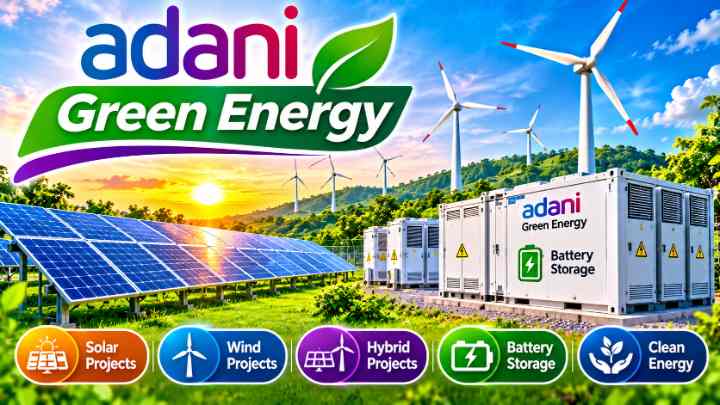
Explore Adani Green Energy's renewable portfolio, Q2 FY27 results, Khavda expansion, battery storage plans and key investment risks.
- Adani Green Energy (AGEL) is described as India’s largest pure-play renewable energy company.
- Adani Green Energy generates revenue primarily by selling electricity produced by its renewable energy projects.
- Expansion of renewable energy capacity is the central growth driver for Adani Green Energy.
What Adani Green Energy Does
Adani Green Energy (AGEL) is described as India’s largest pure-play renewable energy company. Its business focuses on developing, owning and operating renewable power projects across solar, wind and hybrid energy, alongside battery storage.
The company operates across different renewable technologies rather than depending on a single source of generation. Solar and wind projects form part of its generation portfolio, while hybrid projects combine renewable energy sources. Battery storage adds another component to its platform by providing a way to store electricity generated by renewable projects.
At the end of September 2026, AGEL had an operational renewable energy capacity of 20.8 GW, representing year-on-year growth of 24%. This capacity reflects the scale of its operating portfolio and the expansion of its renewable energy business.
Also Read: Vedanta: How Commodity Prices, Higher Volumes and Debt Reduction Drive Its Business
AGEL’s long-term ambition is to reach 50 GW of renewable energy capacity by 2030. Achieving this objective will require continued project development, investment and execution across its renewable energy and storage portfolio.
Customers and How Adani Green Energy Makes Money
Adani Green Energy generates revenue primarily by selling electricity produced by its renewable energy projects. Its revenue model is based on long-term power purchase agreements with government-backed and other power buyers.
These agreements provide the commercial arrangement through which electricity generated by the company’s projects is sold. Once renewable capacity becomes operational, the company supplies power under these arrangements and earns revenue from electricity sales.
This model makes operational capacity and energy generation important measures of business performance. Capacity indicates the scale of the company’s installed operating portfolio, while energy sales show how much electricity its projects actually generate and supply.
Battery storage adds another dimension to the business. Alongside solar, wind and hybrid generation, storage forms part of the company’s energy platform. Its expansion at Khavda represents the growing role of battery storage within AGEL’s renewable energy operations.
The business is capital-intensive because renewable projects and storage facilities require investment before they can contribute to operating revenue. Project development, commissioning and the ability to supply electricity under power purchase agreements are therefore central to the company’s financial performance.

For investors, the distinction between installed capacity and actual energy sales is important. A growing renewable portfolio needs to translate into electricity generation and revenue, while the commercial arrangements with power buyers influence the realisation of that output.
Growth Drivers
Expansion of renewable energy capacity is the central growth driver for Adani Green Energy. The company continues to develop solar, wind and hybrid projects, increasing the scale of its operating portfolio. The growth in operational capacity provides the foundation for higher electricity generation and power supply revenue.
Khavda is an important part of this expansion. Its operational capacity of approximately 10.8 GW makes it a major contributor to the company’s renewable energy platform. Further development at the location, including battery storage, adds to the range of infrastructure supporting its renewable operations.
Battery storage is another area to watch. The commissioning of additional storage capacity at Khavda has expanded the company’s installed battery storage base. Storage is now an important component of AGEL’s broader platform alongside renewable generation.
Also Read: Shree Cement: How Premium Products, Sales Growth and Cost Management Drive Its Business
The company’s 2030 capacity ambition provides the longer-term direction for its expansion programme. Progress towards that target will depend on developing projects, commissioning new capacity and building the associated infrastructure required to supply electricity.
Competition and Risks
Adani Green Energy’s expansion requires substantial capital investment. High debt and finance costs are important risks because renewable projects and battery storage facilities require significant funding. The company must balance its expansion plans with the financial commitments associated with developing and operating its portfolio.
Large capital expenditure also creates execution challenges. Projects must progress through development and commissioning before they contribute to operational capacity and revenue. Delays can affect the pace at which planned capacity becomes productive.
Power offtake and payment risk is another important consideration. The company’s revenue depends on selling electricity to government-backed and other power buyers under long-term agreements. Payment-related issues involving distribution companies could affect cash flows.
Transmission infrastructure and land availability can also constrain renewable project development. Even when generation capacity is developed, the company needs the necessary transmission arrangements and land to bring projects into operation and supply electricity.
Renewable energy output is also weather-dependent. Changes in weather conditions can influence the generation of solar and wind projects, making actual energy production an important measure to monitor alongside installed capacity.
Finally, group-level sentiment can influence investor perceptions of AGEL. As part of the Adani portfolio, the company may be affected by market sentiment towards the wider group, in addition to developments specific to its renewable energy operations.
Also Read: REC: How Power and Infrastructure Financing Drive Its Business
What Investors Should Watch
Investors should monitor the growth in operational renewable capacity and how effectively new projects are commissioned. Capacity expansion is central to the company’s strategy, but the financial benefit depends on translating new infrastructure into electricity generation and sales.
Energy sales are another key indicator. They provide a view of actual power supplied by the operating portfolio, complementing the reported capacity figures. Investors should assess whether energy sales continue to grow alongside the company’s expansion.
Battery storage development deserves attention as well. The commissioning of additional capacity at Khavda shows the growing role of storage in AGEL’s operations. Further progress in this area will be relevant when assessing the company’s broader renewable energy platform.
The financial performance requires equal attention. Revenue, EBITDA and cash profit have recorded strong growth, but profit attributable to owners has grown more slowly. Investors should track whether this difference persists and how debt and finance costs affect the company’s bottom line.
Also Read: Punjab National Bank: How Deposits, Lending and Improving Asset Quality Drive Its Business
The other important factors are the progress of transmission and land arrangements, power offtake and payments from distribution companies, and the capital required to support expansion. These will influence the company’s ability to execute its long-term capacity ambition while managing financial risks.
Conclusion
However, operating growth needs to translate into sustainable profit and cash generation. High debt, finance costs, large capital requirements, power offtake risks and project execution remain important considerations. For investors, the key areas to follow are capacity commissioning, energy sales, battery storage expansion and the company’s ability to manage its financial commitments while pursuing its 2030 ambition.
Financial Disclaimer: This article is for educational and informational purposes only. It is not investment advice or a recommendation to buy or sell Adani Green Energy shares. Investors should conduct independent research before making financial decisions.
Also Read: PFC: How Power Sector Financing and Renewable Energy Loans Drive Its Business





Keep learning with OneTrader
Explore structured lessons and practical guides to build your market knowledge.

Need a laugh after all that money talk?
Paisa LOL: India's funniest finance page, with memes, comics, jokes and long funny stories.
