
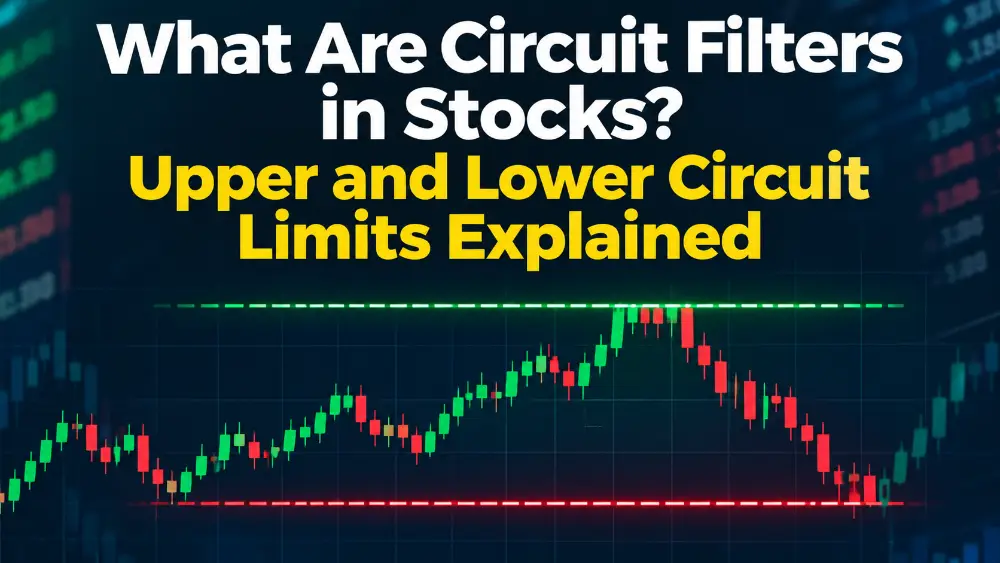
Stock prices can rise or fall sharply in response to company announcements, market sentiment, economic developments and sudden changes in demand and supply. To prevent excessive price movements within a single trading session, Indian stock exchanges use a mechanism called circuit filters or price bands.
Circuit filters define the maximum percentage by which an individual stock can rise or fall during a trading day. These limits help maintain orderly trading, reduce extreme volatility and give market participants time to assess changing information before prices move further.
In simple words
A circuit filter is a daily price limit set by the stock exchange. The upper circuit is the maximum permitted price for the day, while the lower circuit is the minimum. Once a stock reaches either limit, it cannot trade beyond that price during the applicable trading session.
Also Read: What Is Margin Trading Facility (MTF) in the Stock Market? How It Works, Charges and Risks
1. What Are Upper and Lower Circuit Limits?
An upper circuit is the highest price a stock can reach during a trading session under its assigned price band. When buying demand is strong and sellers are unavailable at that price, the stock may remain locked at the upper circuit.
A lower circuit is the lowest permitted price for the day. It can occur when selling pressure is overwhelming and there are insufficient buyers to absorb the available shares.
Both limits are calculated using the stock’s previous trading day’s closing price.
2. What Are the Different Circuit Filter Percentages?
Indian stock exchanges generally use four fixed price bands for eligible individual stocks: 2%, 5%, 10% and 20%.
Also Read: Stop-Loss Order in Stock Market: What Is It and How Does It Work?
The applicable band depends on the security and exchange surveillance requirements. Exchanges can review and revise individual stock price bands.
| Price band | Maximum rise | Maximum fall |
|---|---|---|
| 2% | +2% | -2% |
| 5% | +5% | -5% |
| 10% | +10% | -10% |
| 20% | +20% | -20% |
For example, a stock with a previous closing price of ₹500 and a 5% price band will have an upper circuit of ₹525 and a lower circuit of ₹475.
The calculation is straightforward:
| Particulars | Price |
|---|---|
| Previous closing price | ₹500 |
| Price band | 5% |
| Upper circuit | ₹525 |
| Lower circuit | ₹475 |
3. How Are Circuit Limits Calculated?
Stock exchanges calculate the upper and lower price limits using the previous trading session’s closing price.
Also Read: Option Buying vs Option Selling: Key Differences, Risks and Examples
The formulas are:

- Upper circuit = Previous close × (1 + Price band %)
- Lower circuit = Previous close × (1 – Price band %)
For a stock closing at ₹1,000 with a 10% price band:
| Particulars | Price |
|---|---|
| Previous close | ₹1,000 |
| Upper circuit | ₹1,100 |
| Lower circuit | ₹900 |
These limits are applicable for that trading session. The next session’s limits are recalculated using the latest applicable closing price and price band.
4. Do F&O Stocks Have Circuit Limits?
Stocks available for trading in the Futures and Options (F&O) segment generally do not have fixed daily price bands like ordinary cash-market stocks.
Also Read: Options Trading for Beginners in India: Complete Guide to Calls, Puts, Premiums and Risks
Instead, exchanges apply dynamic price bands, also known as operating ranges.
The initial dynamic operating range is generally 10% on either side of the previous closing price. If the stock continues moving towards either boundary and meets the exchange’s specified conditions, the operating range can be relaxed in stages after cooling-off periods.
This mechanism allows substantial price movements while maintaining safeguards against disorderly trading.
5. What Happens When a Stock Hits Upper Circuit?
When a stock reaches its upper circuit, trading cannot take place above the permitted maximum price.
Also Read: Support and Resistance Trading Strategy: A Complete Beginner’s Guide
However, trading does not automatically stop. Buyers can continue placing orders at the upper circuit price, while existing sellers may execute their orders against those buyers.
A stock is described as locked in upper circuit when there are substantial pending buy orders but insufficient sellers.
For investors, this can create difficulty in entering a position at the desired price.
6. What Happens When a Stock Hits Lower Circuit?
When a stock reaches its lower circuit, it cannot trade below the permitted minimum price.
Also Read: Intraday vs Delivery Trading: What Is the Difference?
If selling pressure is significantly higher than buying demand, sell orders may remain pending without execution.
This creates a liquidity problem for existing shareholders who want to exit their positions.
Even if an investor places a sell order at the lower circuit price, execution is not guaranteed. It depends on available buyers and order priority.
| Situation | Market condition | Possible outcome |
|---|---|---|
| Upper circuit | Buyers exceed sellers | Buy orders may remain pending |
| Lower circuit | Sellers exceed buyers | Sell orders may remain pending |
7. What Are Market-Wide Circuit Breakers?
Individual stock price bands should not be confused with market-wide circuit breakers.
Also Read: How to Sell Shares in India
Market-wide circuit breakers are triggered when either the Nifty 50 or Sensex moves by 10%, 15% or 20% in either direction compared with its previous closing level.
When triggered, trading across equity and equity derivatives markets is halted according to the applicable time-based rules.
| Index movement | Trading halt |
|---|---|
| 10% before 1 PM | 45 minutes |
| 10% between 1 PM and 2:30 PM | 15 minutes |
| 10% at or after 2:30 PM | No halt |
| 15% before 1 PM | 1 hour 45 minutes |
| 15% between 1 PM and 2 PM | 45 minutes |
| 15% at or after 2 PM | Remainder of the day |
| 20% at any time | Remainder of the day |
After a temporary market-wide halt, trading resumes with a 15-minute pre-open call auction session. A 20% movement results in a trading halt for the remainder of the day. NSE India
8. How Can Investors Check a Stock’s Circuit Limit?
Investors can check the applicable upper and lower circuit prices through their broker’s trading platform or the stock exchange website.
Also Read: What Are Futures and Options?
Before placing an order, check:
- The stock’s previous closing price.
- Its applicable daily price band.
- The displayed upper and lower circuit prices.
- Available buy and sell quantities in market depth.
- Whether the stock is locked in an upper or lower circuit.
The applicable price band can change when exchanges revise their surveillance requirements. Investors should check the latest limits rather than rely on an old percentage.
9. Do Circuit Filters Guarantee Investor Protection?
Circuit filters help control extreme price movements within a trading session, but they do not guarantee protection against investment losses.
A stock falling 20% may continue declining over subsequent sessions if selling pressure persists. Similarly, a stock hitting upper circuits repeatedly is not necessarily fundamentally strong or fairly valued.
Also Read: Stock Market Traps: How Retail Traders Get Fooled Every Day – Onetrader Guide
Investors should examine company fundamentals, liquidity, trading volumes and the reasons behind unusual price movements before making investment decisions.
Key Takeaways
- Circuit filters restrict how far an individual stock can rise or fall during a trading session.
- Common fixed price bands are 2%, 5%, 10% and 20%.
- Upper circuit represents the maximum permitted price, while lower circuit represents the minimum.
- F&O stocks generally operate under dynamic price bands instead of fixed daily circuits.
- Market-wide circuit breakers are triggered at 10%, 15% and 20% movements in the Nifty 50 or Sensex.
- Reaching a circuit limit does not guarantee order execution.
- Circuit filters manage short-term volatility but do not eliminate investment risk.
Financial Disclaimer
This article is intended for educational and informational purposes only. It should not be considered investment advice or a recommendation to buy or sell any security. Stock market investments are subject to market risks. Investors should conduct independent research and consult a qualified financial adviser before making investment decisions.






Keep learning with OneTrader
Explore structured lessons and practical guides to build your market knowledge.

Need a laugh after all that money talk?
Paisa LOL: India's funniest finance page, with memes, comics, jokes and long funny stories.
