
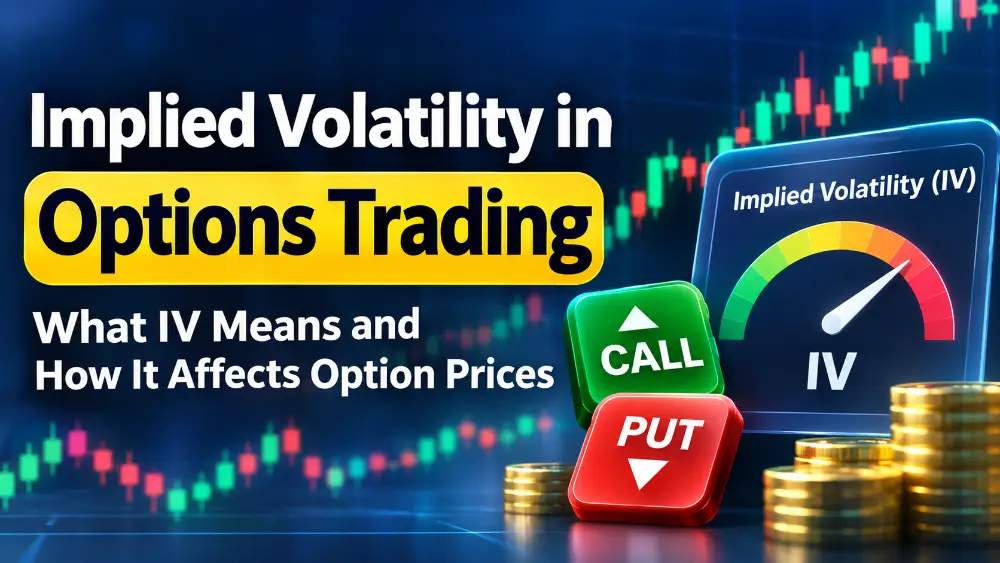
Implied Volatility (IV) is one of the most important factors influencing option prices. While traders often focus on whether a stock or index will move up or down, the expected size of that movement also plays a major role in determining how much an option costs.
In options trading, implied volatility reflects the market’s expectations of future price fluctuations. Understanding IV helps traders identify relatively expensive or inexpensive options, evaluate market sentiment and avoid paying excessive premiums when volatility is unusually high.
In simple words
Implied Volatility tells traders how much movement the market expects from an underlying asset in the future. Higher IV generally makes both Call and Put options more expensive, while lower IV generally reduces their premiums.
Also Read: Option Greeks Explained: Delta, Gamma, Theta and Vega in Options Trading
What Is Implied Volatility (IV)?
Implied Volatility is the expected annualised volatility of an underlying asset, derived from the current market prices of its options.
Unlike historical volatility, which measures how much an asset actually moved in the past, IV reflects expectations about its potential future movement.
For example, if Nifty 50 options are trading with higher implied volatility, it suggests that option market participants are pricing in the possibility of larger movements in the index.
IV is expressed as a percentage. It does not indicate whether the market will move upward or downward. It only represents the expected magnitude of price fluctuations.
Also Read: How to Read an Option Chain: A Simple Guide for Beginners
How Does Implied Volatility Affect Option Prices?
Implied volatility directly influences an option’s time value. When IV increases, option premiums generally rise. When IV decreases, premiums generally fall, assuming other pricing factors remain unchanged.
This relationship applies to both Call and Put options.
| Change in IV | Effect on Call Premium | Effect on Put Premium |
|---|---|---|
| IV increases | Generally rises | Generally rises |
| IV decreases | Generally falls | Generally falls |
Higher volatility increases the possibility that an option could become profitable before expiry. Consequently, buyers are generally willing to pay higher premiums.
However, an increase in IV does not guarantee that an option’s price will rise. Changes in the underlying price, time to expiry and other pricing factors also matter.
Also Read: Futures and Options (F&O) Complete Guide – Learn Trading from Basics to Advanced by Onetrader

What Causes Implied Volatility to Increase?
IV changes continuously depending on market expectations, demand for options and upcoming events.
Some common factors include:
1. Major economic announcements: RBI monetary policy decisions, inflation figures, interest rate announcements and important economic developments can increase uncertainty.
2. Corporate earnings: Ahead of quarterly results, traders may anticipate larger movements in individual stocks, increasing demand for options.
3. Elections and geopolitical events: Elections, international conflicts and unexpected political developments can create uncertainty and push option premiums higher.
4. Market corrections: During sharp market declines, demand for protective Put options often increases, potentially pushing implied volatility higher.
5. Options demand and supply: Heavy buying pressure for options can increase their premiums and implied volatility, although the effect varies across strikes and expiries.
Implied Volatility vs Historical Volatility
Both measures help traders understand volatility, but they represent different periods.
| Feature | Implied Volatility | Historical Volatility |
|---|---|---|
| Meaning | Expected future volatility | Actual past volatility |
| Based on | Current option prices | Historical price movements |
| Nature | Forward-looking | Backward-looking |
| Changes | Continuously with option prices | Depends on the measurement period |
| Main use | Evaluating option pricing | Understanding past market behaviour |
For example, if historical volatility is 12% but implied volatility is 22%, the options market is pricing in greater future volatility than the asset recently experienced. This difference does not necessarily mean IV is overpriced.
What Is the Relationship Between IV and Option Premium?
Consider a hypothetical Nifty 50 option with a premium of ₹100. Assume the underlying price, strike price and expiry remain unchanged.
| Implied Volatility | Illustrative Option Premium |
|---|---|
| 12% | ₹75 |
| 18% | ₹100 |
| 25% | ₹135 |
These figures are illustrative, not actual market quotations or a universal pricing formula.
The example shows how an increase in IV can raise the premium even when the underlying index does not move.
This is particularly important for option buyers. A trader may correctly predict the market direction but still lose money if implied volatility falls significantly after entering the trade.
What Is IV Crush in Options Trading?
IV Crush refers to a sharp decline in implied volatility, usually after an anticipated event or uncertainty disappears.
For example, traders may buy options ahead of a major company announcement because they expect a large price movement. Once the announcement is released, uncertainty may decline and IV can fall sharply.
As a result, option premiums may drop even if the underlying stock moves in the predicted direction.
This is one reason buying options immediately before major events can be risky.
How Should Option Buyers and Sellers Use IV?
Implied volatility can influence the decision to buy or sell options.
| Trading Situation | What Traders Should Consider |
|---|---|
| High IV | Option premiums are relatively expensive |
| Low IV | Option premiums are relatively inexpensive |
| Rising IV | Can benefit existing long-option positions |
| Falling IV | Can hurt existing long-option positions |
Option buyers generally prefer purchasing options when IV is relatively low, provided the expected price movement justifies the premium.
Option sellers may find higher IV attractive because premiums are larger. However, elevated IV often reflects greater uncertainty and potentially larger price movements. Selling options can therefore involve substantial risk, including losses greater than the premium received.
Traders should also consider IV relative to its historical range rather than treating a particular percentage as universally high or low.
What Is IV Rank and IV Percentile?
IV Rank and IV Percentile help traders understand whether current implied volatility is high or low compared with its own historical readings.
IV Rank: Measures where the current IV stands between the highest and lowest IV recorded during a selected period.
IV Percentile: Measures the percentage of observations during the selected period when IV was below the current reading.
| Measure | What It Indicates |
|---|---|
| IV Rank | Position of current IV within its historical range |
| IV Percentile | How frequently historical IV readings were lower |
For example, an IV Rank of 80 suggests that current IV is closer to its historical high than its historical low. An IV Percentile of 80 means IV was lower than the current reading in approximately 80% of observations during the selected period.
These indicators help traders compare volatility conditions, but they do not independently predict market direction or future option returns.
Key Takeaways
- Implied Volatility represents the market’s expectations of future price fluctuations.
- IV is expressed as an annualised percentage and does not predict market direction.
- Higher IV generally increases both Call and Put option premiums.
- Lower IV generally reduces option premiums, assuming other factors remain unchanged.
- IV Crush can cause option buyers to lose money even when their market direction prediction is correct.
- IV Rank and IV Percentile help compare current volatility with historical levels.
- Option traders should evaluate IV alongside the underlying price, expiry, strike price, liquidity and Greeks.
Understanding implied volatility helps traders evaluate the cost of options rather than focusing only on market direction. It is an essential part of options analysis, particularly when trading around major events or periods of elevated market uncertainty.
Financial Disclaimer: This article is for educational purposes only and should not be considered investment or trading advice. Options trading involves substantial risk and may result in significant financial losses. Traders should understand option pricing, volatility and risk management before entering derivatives positions.

Keep learning with OneTrader
Explore structured lessons and practical guides to build your market knowledge.

Need a laugh after all that money talk?
Paisa LOL: India's funniest finance page, with memes, comics, jokes and long funny stories.
