
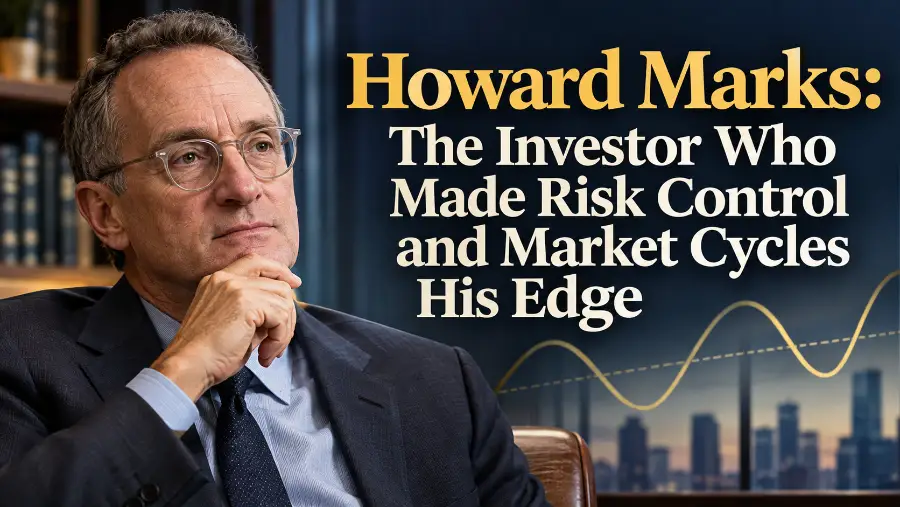
Howard Marks built his reputation in investing by focusing on something many investors underestimate: controlling risk. While the market often celebrates investors who identify multibaggers or deliver extraordinary returns, Marks developed a philosophy centred on avoiding major losses, understanding market psychology and recognising when investment opportunities become attractive.
As co-founder of Oaktree Capital Management, Marks became one of the most respected voices in value and credit investing. His investment memos, books and observations on market cycles have influenced investors across the world. His central message is straightforward: successful investing is not simply about finding winners. It is equally about understanding what can go wrong and paying the right price for risk.
In simple words
Howard Marks believes that investors should focus on controlling losses rather than chasing extraordinary returns. His approach combines understanding market cycles, identifying mispriced assets and remaining disciplined when others become excessively optimistic or pessimistic.
Also Read: Benjamin Graham: The Father of Value Investing & Intelligent Investing
Who Is Howard Marks?
Howard Marks is an American investor, author and co-founder of Oaktree Capital Management, an investment management firm known for its expertise in distressed debt, credit markets and alternative investments.
Marks studied finance at the Wharton School of the University of Pennsylvania and later completed an MBA in accounting and marketing at the University of Chicago. He also holds the CFA charter.
His professional career began at Citicorp Investment Management in 1969, where he worked in equity research and later managed convertible and high-yield securities. In 1985, he moved to TCW Group, leading investment teams focused on distressed debt, high-yield bonds and convertible securities.
In 1995, Marks and his partners established Oaktree Capital Management. The firm built its reputation by investing in areas where uncertainty, financial distress and market pessimism created opportunities.
Also Read: Narayana Murthy: The Father of Indian IT Revolution – Inspirational Story
| Career milestone | Year |
|---|---|
| Joined Citicorp | 1969 |
| Joined TCW Group | 1985 |
| Co-founded Oaktree Capital Management | 1995 |
| Published The Most Important Thing | 2011 |
| Published Mastering the Market Cycle | 2018 |
1. Risk Control Comes Before Chasing Returns
One of Marks’ most important investment principles is that avoiding major losses can be more valuable than chasing exceptional gains.
Many investors evaluate an investment based on its potential upside. Marks believes the downside deserves equal, if not greater, attention. An investment that offers attractive returns but carries an excessive probability of permanent capital loss may not be worth taking.
He also distinguishes between volatility and risk. Price fluctuations are visible, but the real danger is the possibility of losing money permanently because the underlying investment turns out to be weaker than expected.
For Marks, risk management does not mean avoiding every risky investment. It means understanding the risks being taken and ensuring that the potential return adequately compensates for them.
Also Read: Elon Musk: The Man Who Refused to Stop Dreaming – The Ultimate Inspirational Story
2. Understanding Market Cycles
Marks believes financial markets move through recurring cycles driven by economic conditions, investor psychology, credit availability and risk appetite.
During optimistic periods, investors become confident, valuations rise and lending standards often weaken. As enthusiasm increases, people become willing to pay higher prices and accept risks they previously avoided.

The opposite happens during market downturns. Fear increases, investors withdraw capital and even fundamentally sound businesses can become undervalued.
Marks studies these changes to understand where opportunities and dangers are developing.
Also Read: Raamdeo Agrawal Life Story: The Legendary Investor Who Taught India to Build Wealth
| Market environment | Investor behaviour | Investment approach |
|---|---|---|
| Excessive optimism | Greed and overconfidence | Increase caution |
| Rising confidence | Growing risk appetite | Evaluate valuations carefully |
| Increasing pessimism | Fear and selling pressure | Search for opportunities |
| Extreme pessimism | Panic and forced selling | Look for mispriced assets |
His objective is not to predict the exact market top or bottom. It is to adjust investment decisions according to the prevailing environment.
3. Second-Level Thinking: Looking Beyond the Obvious
Marks introduced the concept of second-level thinking in The Most Important Thing.
First-level thinking involves looking at information and reaching an obvious conclusion. Second-level thinking goes further by considering what other investors already know, what they expect and whether those expectations are reflected in the price.
For example, a company may report strong business growth. A first-level investor may immediately consider buying its shares. A second-level investor asks whether the market has already priced in that growth and whether actual performance can exceed expectations.
Also Read: Vijay Kedia Life Story: From Kolkata’s Backstreets to India’s Multibagger King
| First-level thinking | Second-level thinking |
|---|---|
| The company is growing | Is growth already priced in? |
| The stock has fallen | Has its intrinsic value deteriorated? |
| The market is bullish | Is optimism excessive? |
| The business is attractive | Is the purchase price attractive? |
This approach explains why Marks often emphasises independent thinking. Finding a good company is not enough. Investors must identify opportunities where their assessment differs meaningfully from the market’s expectations.
4. Contrarian Investing and Investor Psychology
Marks believes superior investment opportunities frequently emerge when market sentiment becomes extreme.
When investors are excessively optimistic, they may ignore risks and overpay for assets. When pessimism dominates, they may sell investments without properly evaluating their underlying value.
Contrarian investing means being willing to take a different position when market expectations become unreasonable.
Also Read: Warren Buffett Inspirational Story:
However, simply going against the crowd is not a strategy. Marks stresses that investors need research, valuation discipline and an understanding of the underlying asset before taking a contrarian position.
The objective is to recognise when the market price has moved too far away from the investment’s underlying value.
5. Why Price Matters More Than Popularity
A major part of Marks’ philosophy is the relationship between price and intrinsic value.
Even an excellent company can become a poor investment if purchased at an excessive valuation. Similarly, a struggling company or distressed asset can offer attractive returns if purchased at a sufficiently discounted price and its underlying risks are understood.
Also Read: Rakesh Jhunjhunwala – The Big Bull of Dalal Street (Success Story & Lessons)
This principle is particularly important in value investing and distressed debt, where investors search for opportunities that the wider market may be overlooking.
Marks does not believe investors should confuse a quality business with an attractive investment. The price paid determines a significant part of the eventual return.
6. Investing in Distressed Debt
Marks made his name in credit investing, particularly distressed debt.
Distressed debt involves investing in the bonds or loans of companies experiencing serious financial difficulties. These securities often trade at substantial discounts because investors fear default, restructuring or bankruptcy.
For experienced investors, such situations can create opportunities to purchase debt below its potential recovery value.
However, the strategy requires detailed credit analysis, an understanding of a company’s assets and liabilities, and the ability to evaluate different restructuring outcomes.
Oaktree developed significant expertise in this area, making distressed investing one of the firm’s defining strategies.
7. Books and Investment Memos That Shaped His Philosophy
Marks is also widely respected for communicating complex investment ideas in straightforward language. His investment memos have covered market bubbles, credit conditions, risk, investor psychology and the limitations of economic forecasting.
Two of his most influential books are:
| Book | Publication year | Central idea |
|---|---|---|
| The Most Important Thing | 2011 | Risk control, second-level thinking and investment discipline |
| Mastering the Market Cycle | 2018 | Understanding market cycles and adjusting investment behaviour |
His writing repeatedly returns to one important idea: investors cannot consistently predict the future, but they can study the current environment and prepare for different outcomes.
Key Takeaways from Howard Marks
- Protect capital: Avoiding major investment losses is essential for long-term wealth creation.
- Understand risk: Volatility and permanent capital loss are not the same thing.
- Study market cycles: Investor psychology creates periods of excessive optimism and pessimism.
- Think independently: Second-level thinking helps identify opportunities overlooked by the wider market.
- Respect valuations: A good business is not automatically a good investment at every price.
- Be patient: Attractive opportunities often emerge when other investors are unwilling to take risks.
- Stay disciplined: Do not allow greed, fear or market excitement to dictate investment decisions.
Howard Marks’ investing philosophy offers an important lesson for both professional and individual investors. Building wealth is not simply about identifying the next big opportunity. It requires understanding risk, recognising market conditions and making decisions with a margin of safety.
His approach reminds investors that long-term success often comes from consistency, patience and avoiding mistakes that can permanently damage capital.
Financial Disclaimer: This article is intended for educational and informational purposes only. It should not be considered investment advice or a recommendation to buy or sell any security. Investors should conduct their own research and consult a qualified financial adviser before making investment decisions.




Keep learning with OneTrader
Explore structured lessons and practical guides to build your market knowledge.

Need a laugh after all that money talk?
Paisa LOL: India's funniest finance page, with memes, comics, jokes and long funny stories.
