
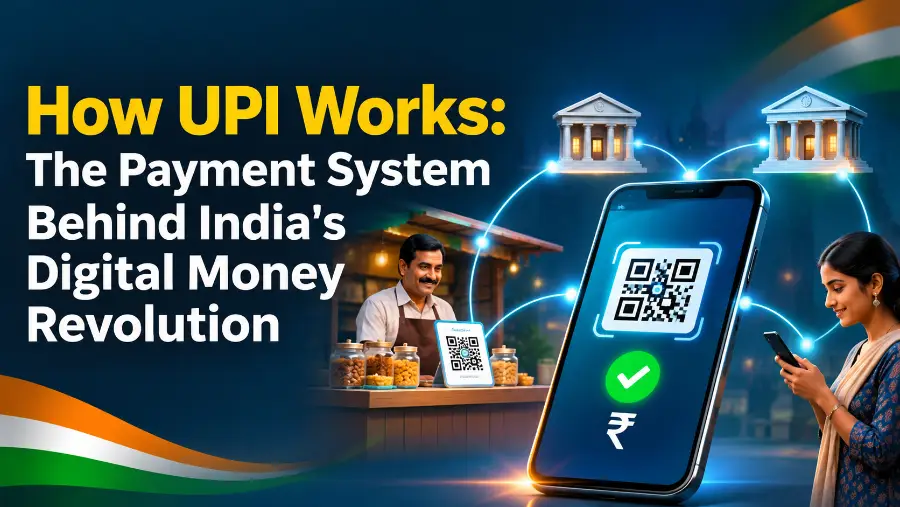
India’s digital payment landscape has undergone a remarkable transformation over the past decade. From street vendors and grocery shops to large retailers and online businesses, accepting payments has become easier with a simple QR code. At the centre of this change is the Unified Payments Interface (UPI), which has made instant bank-to-bank transfers accessible to millions of Indians.
UPI has changed how people use money by removing the need to carry cash, remember bank account details or wait for traditional bank transfers. But behind a simple tap or QR code scan is a sophisticated payment network connecting banks, mobile applications and merchants.
In simple words
UPI is a real-time payment system that allows money to move directly between bank accounts using a mobile application. It connects the sender’s bank and the receiver’s bank through a common network, making payments possible within seconds, 24 hours a day.
Also Read: Where is Indian Investors’ Wealth? Gold, Real Estate, or Markets?
What Is UPI?
Unified Payments Interface is an instant payment system developed by the National Payments Corporation of India (NPCI), an organisation operating India’s retail payment infrastructure.
Launched in April 2016, UPI was designed to make bank transfers simpler and more accessible. It operates over the Immediate Payment Service (IMPS) infrastructure and allows customers to transfer money between participating bank accounts.
Unlike traditional bank transfers, users do not need to enter the beneficiary’s account number and IFSC code every time. A UPI ID, mobile number or QR code can be sufficient to initiate a payment.
How Does UPI Work?
UPI works by connecting the sender’s bank account, the receiver’s bank account and the payment application through NPCI’s central switching network.
Consider a simple example: You scan a shopkeeper’s QR code and pay ₹500 using Google Pay.
The process happens in the following steps:
- Payment initiation: You scan the merchant’s QR code or enter their UPI ID and payment amount.
- Payment authorisation: You review the details and enter your UPI PIN to approve the transaction.
- Request routing: Your payment application sends the transaction request through its connected Payment Service Provider (PSP) bank to NPCI.
- Account verification: NPCI routes the request to your bank, which verifies the account and authorises the debit.
- Money transfer: Your bank debits ₹500 and the recipient’s bank credits the merchant’s account.
- Confirmation: The transaction status is communicated through the payment network, and both parties receive confirmation.
The entire process generally takes only a few seconds.
Who Are the Main Participants in the UPI Ecosystem?
UPI is not operated by a single mobile application. It is a network involving several institutions that perform different functions.
| Participant | Role |
|---|---|
| NPCI | Operates the UPI network and routes transactions |
| Remitter bank | Bank account from which money is deducted |
| Beneficiary bank | Bank account receiving the money |
| PSP bank | Provides payment connectivity to UPI applications |
| TPAP | Third-party application offering UPI services |
| Customer | Person sending or receiving money |
| Merchant | Business accepting UPI payments |
For example, Google Pay and PhonePe are third-party applications. They provide the interface customers use, while the actual money movement happens through participating banks and the UPI network.

What Is a UPI ID and How Does It Work?
A UPI ID, also known as a Virtual Payment Address (VPA), is a unique payment identifier linked to a bank account.
Instead of sharing sensitive banking information, users can receive money through their UPI IDs.
A typical UPI ID may look like:
rajkumar@upi
The exact format depends on the payment application and its banking partners.
UPI IDs make transactions easier because the sender does not need to remember the recipient’s bank account number or IFSC code.
How Do UPI Apps Connect to Bank Accounts?
Payment applications act as an interface between customers and the UPI network. They allow users to link eligible bank accounts, check balances, transfer money and make merchant payments.
Popular UPI applications include:
- Google Pay
- PhonePe
- Paytm
- BHIM
Customers can also use multiple UPI applications with the same bank account. The money is not stored in these applications. It remains in the linked bank account unless a separate wallet or prepaid payment instrument is being used.
What Are the Different Types of UPI Payments?
UPI supports different payment methods for personal transfers, shopping and recurring payments.
| Payment type | How it works |
|---|---|
| Person-to-person | Transfer money to another individual |
| Merchant payment | Pay businesses using QR codes or UPI IDs |
| Collect request | Receive a payment request from another user |
| UPI AutoPay | Authorise recurring payments |
| UPI Lite | Make eligible low-value payments using an on-device balance |
| UPI 123PAY | Access UPI services through supported feature phones |
UPI also supports online shopping, utility bill payments, subscriptions and other digital payment requirements.
UPI Transaction Limits: How Much Can You Transfer?
UPI transaction limits depend on the payment category, bank policies and applicable NPCI rules.
For standard person-to-person transfers, the general transaction ceiling is ₹1 lakh. Certain verified merchant categories have higher limits.
| Transaction category | General limit |
|---|---|
| Standard person-to-person payments | ₹1 lakh |
| Capital markets and insurance | Up to ₹5 lakh |
| Credit card bill payments | Up to ₹5 lakh |
| Tax payments | Up to ₹5 lakh |
| Hospital and educational institutions | Up to ₹5 lakh |
Higher limits apply only to eligible transactions and verified merchants. Individual banks may also impose lower limits.
Is UPI Safe? Understanding UPI Security
UPI uses multiple security mechanisms to protect transactions, including device verification, bank authentication and a UPI PIN.
However, users must understand that UPI payments are generally authorised by the account holder.
Important precautions include:
- Never share your UPI PIN, OTP or banking credentials.
- Enter your UPI PIN only when sending money or approving an authorised debit.
- Scanning a QR code to receive money does not require entering your UPI PIN.
- Verify the recipient’s name and payment amount before confirming.
- Never approve unknown collect requests.
- Avoid clicking suspicious payment links.
If money is lost through a suspected fraud, contact your bank immediately and report the incident through India’s cybercrime helpline 1930.
How Big Has UPI Become in India?
UPI has grown from a relatively small payment platform into one of the world’s largest real-time digital payment networks.
The October 2026 statistics demonstrate the scale of its adoption.
| Metric | October 2026 |
|---|---|
| Transactions | 25,466.70 million |
| Transaction value | ₹31.53 lakh crore |
| Banks live on UPI | 758 |
Source: NPCI monthly UPI statistics. Figures represent October 2026.
UPI’s growth has also encouraged digital payment adoption among small businesses, street vendors and consumers who previously relied heavily on cash.
What Is the Future of UPI?
UPI is expanding beyond conventional bank transfers. Features such as UPI Lite, UPI AutoPay, credit-line-linked payments and international acceptance are widening its potential applications.
Its integration with different payment systems also creates opportunities for Indian users to make payments in selected international markets.
Going forward, the focus will be on improving transaction reliability, strengthening fraud prevention, expanding merchant acceptance and making digital payments accessible to more people.
Key Takeaways
- UPI is an instant bank-to-bank payment system developed by NPCI.
- It operates over the IMPS infrastructure and supports 24-hour payments.
- UPI IDs and QR codes simplify money transfers.
- Payment applications connect users to the banking network but do not hold the money in ordinary bank-linked UPI transactions.
- Transaction limits vary according to payment categories and bank policies.
- UPI PIN protection and awareness of payment fraud are essential.
- UPI has become a major part of India’s digital financial infrastructure.
Financial Disclaimer: This article is intended for educational and informational purposes only. Payment limits, banking policies and UPI features may change over time. Users should verify applicable conditions with their respective banks and payment service providers before initiating transactions. OneTrader does not provide financial, banking or investment advice.

Keep learning with OneTrader
Explore structured lessons and practical guides to build your market knowledge.

Need a laugh after all that money talk?
Paisa LOL: India's funniest finance page, with memes, comics, jokes and long funny stories.
