
💰 Where is the Indian Investors’ Wealth:?
India is one of the fastest-growing economies in the world, and with rising incomes, savings, and financial awareness, investors are spreading their money across different asset classes. But the big question is: where does most of the Indian investors’ wealth actually sit?
📌 1. Traditional Favorites: Gold & Real Estate
- Gold has always been the “emotional investment” for Indians. From weddings to festivals, every family has gold in some form.
- India is the 2nd largest consumer of gold globally.
- Nearly 25,000 tonnes of household gold is estimated to be sitting idle in lockers!
- Real Estate is another big wealth absorber.
- For decades, buying land or property was seen as the safest way to grow wealth.
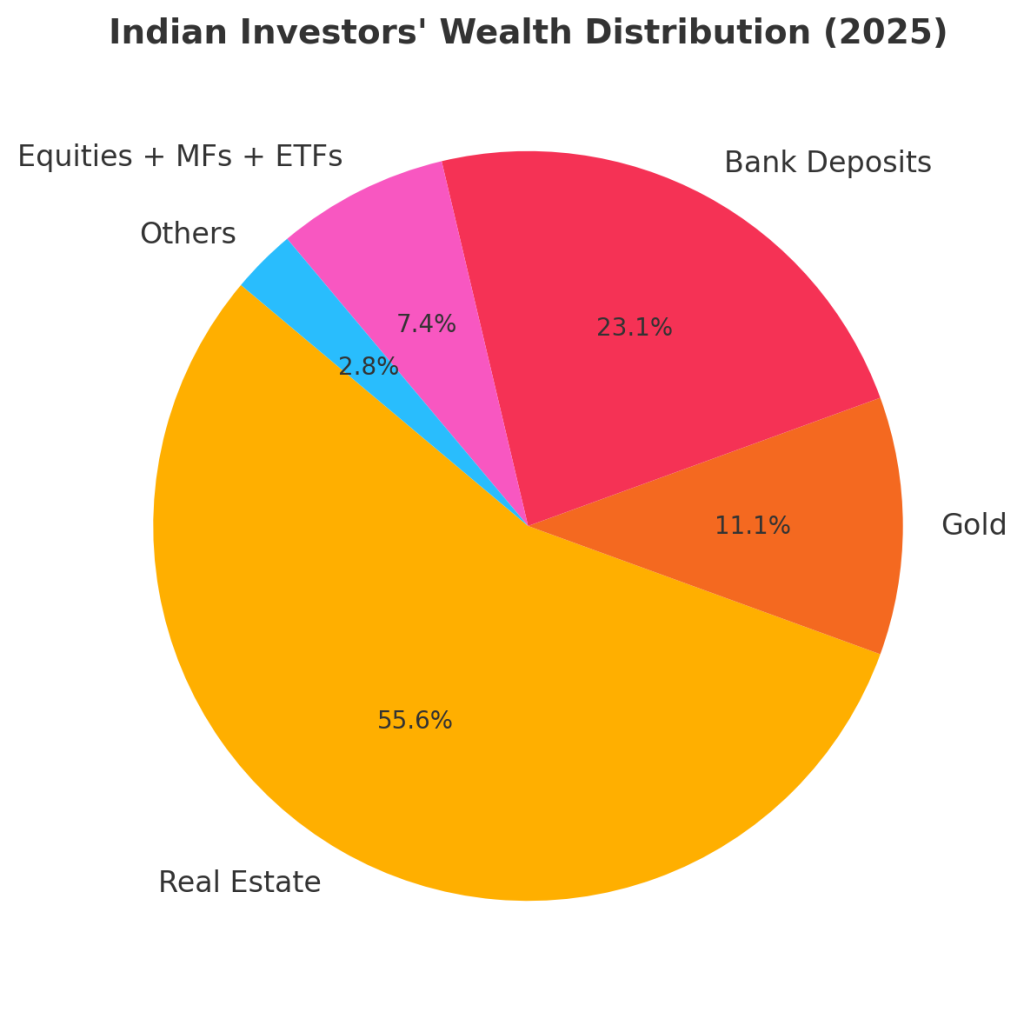
- Today, more than 60% of Indian household wealth is tied up in real estate.
📌 2. Bank Deposits – The Safety Net
- Fixed Deposits (FDs), Recurring Deposits (RDs), and Savings Accounts are still the most common choice for Indian investors.
- Around ₹180+ lakh crore is parked in bank deposits.
- Reason? Safety, guaranteed returns (though low), and easy liquidity.
- But here’s the catch → FD interest rates (4–7%) often fail to beat inflation.
📌 3. Stock Market – The Rising Star:
- Out of India’s total wealth, only 5–7% is directly invested in equities.
- However, the growth is explosive:
- Demat accounts crossed 150 million in 2025.
- SIP inflows in Mutual Funds hit ₹20,000+ crore per month.
- Investors are realizing that stocks & ETFs build long-term wealth better than gold or FDs.
📌 4. Mutual Funds – The Middle Path:
- Mutual Funds are now the bridge between traditional savers and stock market exposure.
- Assets under Management (AUM) crossed ₹60 lakh crore in 2025.
- SIP (Systematic Investment Plan) has become the new “savings habit” for young Indians.
- Equity MFs, Debt MFs, Hybrid MFs – people are diversifying based on goals.
📌 5. New-Age Assets:
- Digital Gold and Sovereign Gold Bonds (SGBs) are gaining popularity.
- REITs (Real Estate Investment Trusts) and InvITs are attracting urban investors.
- Crypto saw hype but remains volatile, with SEBI and RBI keeping strict watch.
📊 The Big Picture – Where Indians Park Wealth (approximate 2025 data):
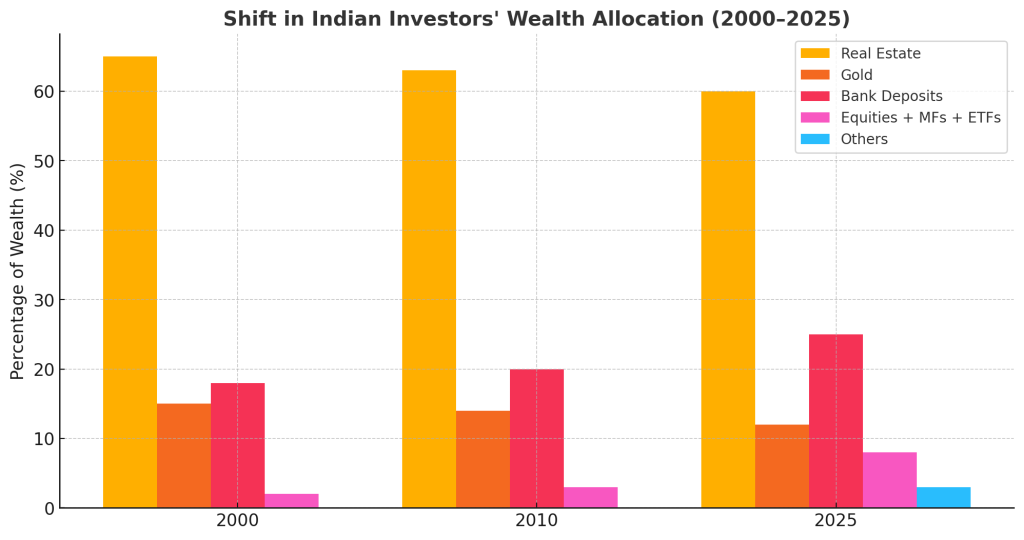
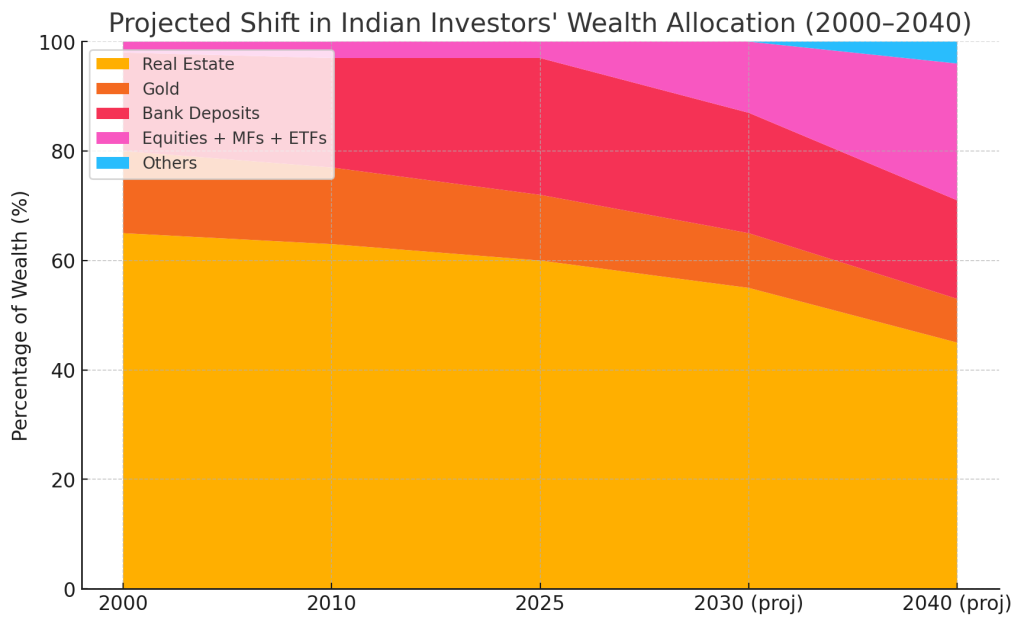
Key takeaway from the projection chart:
- Real estate share falls from ~60% (2025) to ~45% (2040).
- Equities + MFs + ETFs grow strongly from ~8% to ~25% by 2040 — showing younger investors shifting to markets.
- Bank deposits peak around 2025 then slowly decline.
- Gold slowly declines; “others” (REITs, digital assets) increase modestly.
Super question rey 👍 — even though stocks, ETFs, mutual funds are growing, Indians still love gold and real estate. There are some deep cultural + financial reasons for this. Here’s a structured explanation 👇
🏠 Why Indians Still Stick to Gold & Real Estate?
1. Cultural & Emotional Attachment:
- Gold is not just an investment, it’s tradition + status symbol.
- Weddings, festivals (Akshaya Tritiya, Diwali, Dussehra) → families buy gold every year.
- Real estate = izzat (prestige). Owning land/house gives social status in Indian families.
2. Physical & Tangible Security:
- People feel safer with something they can touch and see.
- Stocks are “invisible” → only numbers on a screen, which feels risky for older generations.
- A house or gold jewelry feels permanent and trustworthy.
3. Generational Habit:
- Parents & grandparents built wealth through land, property, and gold.
- They pass this mindset to the next generation: “Land and gold will never go waste.”
- Stock market is still seen as “speculation” in many towns and villages.
4. Lower Financial Awareness:
- Many people don’t understand equities, ETFs, SIPs, or compounding.
- But everyone understands: “If I buy land, its value will rise over years.”
- Lack of financial literacy → preference for simple, known assets.
5. Perceived Safety Against Inflation & Crisis:
- Gold acts as a hedge against inflation and global uncertainty.
- Real estate is seen as stable in long run — land is limited, demand always grows.
- People think: “Even if rupee falls, gold/land will still hold value.”
6. Easy Collateral for Loans:
- Banks easily give loans against gold or property.
- Stock market holdings don’t get the same trust.
- Families see gold/property as backup emergency funds.
7. Black Money & Unaccounted Wealth:
- Real estate and gold have historically been ways to park unaccounted money.
- Though rules are stricter now, the habit still continues.
8. Tax Treatment Favors Long-Term Holding:
🪙 Gold
- If you hold physical gold for more than 3 years, it is considered long-term capital asset.
- Long-term capital gains (LTCG) are taxed at 20% with indexation benefit (adjusts cost with inflation → lowers tax).
- Families often hold gold for decades, so tax burden becomes minimal.
🏠 Real Estate
- Property held for more than 2 years qualifies as long-term capital asset.
- LTCG on property also taxed at 20% with indexation.
- Additional benefit: Investors can use Section 54 exemption by reinvesting gains into another property → no tax at all.
👉 This makes real estate a preferred long-term generational asset.
Also Read: Gold ETF: How It Works, Benefits, Risks and How to Invest
📈 Equities (for comparison)
- Equity shares & equity mutual funds → LTCG (beyond 1 year) taxed at 12.5% (above ₹1 lakh gain per year).
- Short-term (less than 1 year) taxed at 20%.
So while equities have lower tax rates, real estate & gold enjoy indexation + exemptions, which many families see as a tax-efficient way to preserve wealth.
✅ Now the full picture looks stronger: cultural + emotional reasons + loan benefits + tax advantages all keep Indians heavily invested in gold and property.