
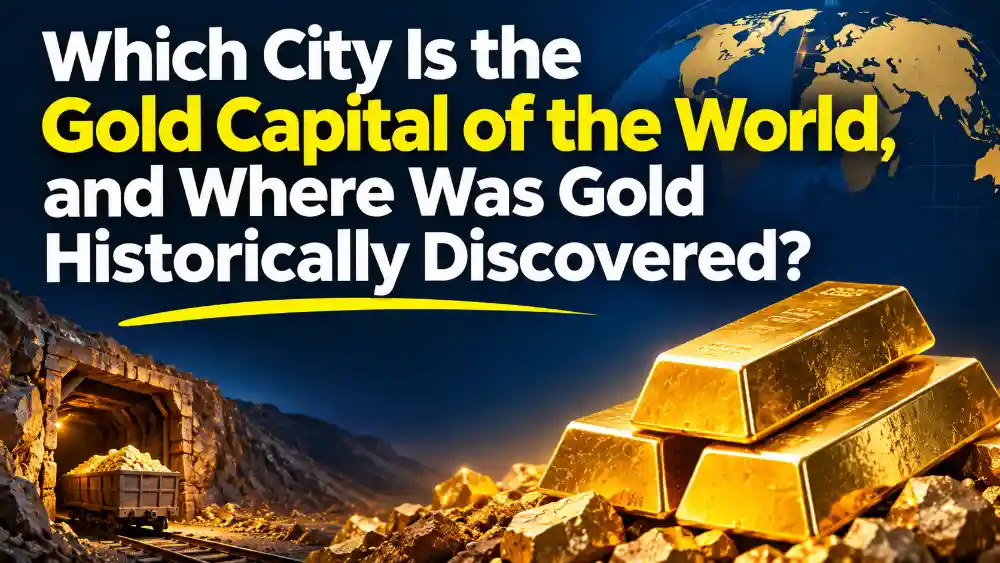
Gold has shaped economies, cities and civilisations for thousands of years. From ancient mining regions to modern bullion markets, it remains an important part of global wealth, trade and investment.
Johannesburg in South Africa is widely recognised as the historic gold capital because of the 1886 Witwatersrand discovery. However, several other discoveries and modern trading centres have shaped the global gold industry.
Johannesburg: The Historic Gold Capital of the World
Johannesburg earned its reputation as the historic gold capital after George Harrison discovered payable gold on the farm Langlaagte in July 1886, in the Witwatersrand region of South Africa.
The discovery triggered a major gold rush, attracting prospectors, workers, mining companies and international investors. A mining settlement developed rapidly, eventually becoming Johannesburg, one of Africa’s most important economic centres.
Also Read: How Long Did Gold and Silver Take to Recover After Their 1980 Peaks?
The Witwatersrand became one of the richest gold-producing regions in history. Unlike shallow deposits where gold could be collected from riverbeds, much of the South African gold was embedded deep underground in extensive rock formations.
Extracting this gold required large investments, specialised equipment and advanced mining techniques. The resulting mining industry helped South Africa become one of the world’s leading gold producers during much of the twentieth century.
Johannesburg’s historic importance therefore comes from the extraordinary scale of the Witwatersrand discovery and the mining economy it created.
Where Was Gold First Discovered?
There is no single universally accepted location where humans first discovered gold. Archaeological evidence shows that ancient civilisations in Egypt, the Middle East and other regions collected and worked gold thousands of years ago.
Gold was valued for jewellery, religious objects, royal ornaments and trade because of its natural beauty, rarity and resistance to corrosion.
India also has a long history of gold extraction. The Kolar region in Karnataka contains evidence of ancient mining activity, making it an important part of India’s gold mining heritage.
It is important to distinguish between the first historical use of gold and major modern gold discoveries. Johannesburg became famous because of its enormous economic impact, not because it was the first place where humans found gold.
Five Historic Gold Discoveries That Changed the World
Several discoveries during the nineteenth century transformed migration, settlement, mining and international trade.

Also Read: Gold Price Crashes Below $3,600 as Fed Rate Hike Fears and Forced Liquidation Trigger Heavy Selling
| Year | Location | Historical significance |
|---|---|---|
| 1848 | California, USA | Started the famous California Gold Rush |
| 1851 | Ophir, Australia | Triggered Australia’s major gold rushes |
| 1880 | Kolar, India | Industrial gold mining developed |
| 1886 | Witwatersrand, South Africa | Created Johannesburg’s gold mining industry |
| 1896 | Klondike, Canada | Triggered the famous Yukon Gold Rush |
A Closer Look at the Major Discoveries
California, USA (1848): James W. Marshall discovered gold at Sutter’s Mill on 24 January 1848, triggering a massive migration to California and transforming its economy.
Australia (1851): Edward Hargraves identified payable gold near Ophir in New South Wales, followed by important discoveries around Ballarat and Bendigo.
Kolar Gold Fields, India: Systematic industrial mining began in 1880 under John Taylor & Sons, and the mines eventually produced more than 800 tonnes of gold before closing in 2001.
Witwatersrand, South Africa (1886): George Harrison’s discovery of payable gold transformed Johannesburg into a major international mining centre.
Also Read: How Gold Prices Are Set in India: Rupee, Import Duty and GST Explained
Klondike, Canada (1896): Gold discovered on Bonanza Creek in the Yukon on 16 August 1896 triggered the famous Klondike Gold Rush of 1897 to 1898.
The World’s Major Gold Trading Hubs Today
Gold mining and gold trading are two different activities. While mining locations produce the metal, financial centres and commercial cities connect producers, traders, investors, refiners and jewellery manufacturers.
Four important cities play distinct roles in the international gold industry.
| City | Country | Importance in the gold industry |
|---|---|---|
| London | United Kingdom | Major international wholesale bullion trading centre |
| Dubai | UAE | Important physical gold trading, refining and jewellery hub |
| Mumbai | India | Major bullion and jewellery trading centre |
| Shanghai | China | Home to the Shanghai Gold Exchange, a major physical gold exchange |
London: The International Bullion Centre
London is one of the world’s most influential wholesale gold markets, supported by the London Bullion Market Association (LBMA), established bullion infrastructure and the internationally recognised LBMA Gold Price benchmark.
Also Read: Why Gold Prices Have Fallen and What It Means for Long-Term Investors
Dubai: The Physical Gold Trading Gateway
Dubai connects gold-producing regions with major consumer markets through its bullion businesses, refining facilities and famous Gold Souk, making it an important international physical gold trading destination.
Mumbai: India’s Gold Trading Capital
Mumbai is a major centre for India’s bullion and jewellery industry, with Zaveri Bazaar serving as an important marketplace for jewellery manufacturers, wholesalers, bullion dealers and retailers.
Shanghai: China’s Gold Market Powerhouse
Shanghai is home to the Shanghai Gold Exchange, established in 2002, which provides an important platform for physical gold trading and domestic price discovery in China.
Gold Capital vs Gold Production: Understanding the Difference
The phrase gold capital can describe different types of importance in the industry. A city famous for gold mining is not necessarily the largest trading centre or the location with the highest jewellery demand.
Also Read: Commodity News Today: Gold Prices Slip as Hot US Inflation Raises Rate Hike Concerns
Johannesburg represents the historic mining industry, London is a major international wholesale bullion market, Dubai connects physical gold trade across regions, Mumbai serves India’s extensive jewellery market, and Shanghai supports China’s physical gold market.
These cities demonstrate how the gold industry operates through different locations rather than a single global centre.
What Investors Should Know
Gold has an important place in investment portfolios, but investors should understand the different ways to gain exposure to the metal.
- Investment options: Indian investors can consider physical gold, coins, bars, Gold ETFs and sovereign gold bonds where available through applicable channels.
- Global price movements: International gold prices are influenced by interest rates, central bank purchases, geopolitical developments, currency movements and investment demand.
- Rupee impact: Indian gold prices are affected by the rupee-dollar exchange rate, meaning a weaker rupee can increase domestic gold prices even when international prices remain unchanged.
- Different investment risks: Gold mining stocks are businesses with operational, financial and management risks, so their returns may differ significantly from the performance of physical gold.
Investors should evaluate costs, liquidity, taxation, storage requirements and their investment horizon before selecting a gold investment product.
Disclaimer: This article is intended for educational and informational purposes only. It does not constitute investment advice or a recommendation to buy or sell gold, Gold ETFs, mining stocks or other financial instruments. Investors should evaluate their financial goals, risk tolerance and investment horizon before making investment decisions.


Keep learning with OneTrader
Explore structured lessons and practical guides to build your market knowledge.

Need a laugh after all that money talk?
Paisa LOL: India's funniest finance page, with memes, comics, jokes and long funny stories.
