
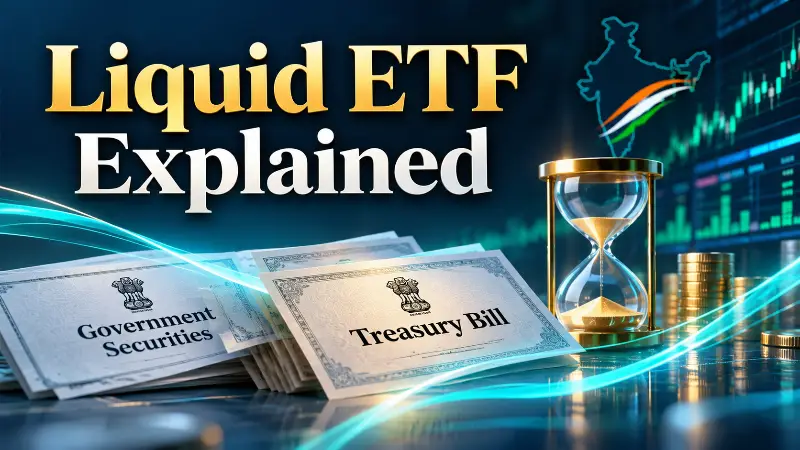
Investors often have money sitting idle in their trading accounts or bank accounts while waiting for the right investment opportunity. Leaving this money unused means losing the opportunity to earn returns, while moving it into equity investments may expose it to unnecessary market risk. Liquid Exchange Traded Funds (ETFs) offer an alternative for managing short-term surplus money.
In India, Liquid ETFs have become particularly useful for investors and active traders who want to earn overnight money-market returns without committing their funds to longer-duration investments. However, understanding how these ETFs generate returns, how quickly investors can access their money and what risks are involved is important before investing.
In simple words: A Liquid ETF is a mutual fund that invests primarily in overnight and very short-term money-market instruments. Its units trade on stock exchanges like shares, allowing investors to park temporarily unused money and potentially earn returns while retaining relatively easy access to their funds.
What Is a Liquid ETF?
A Liquid ETF is a debt-oriented exchange-traded mutual fund designed to generate returns from short-term interest-bearing instruments. Unlike equity ETFs that track indices such as the Nifty 50 or Sensex, Liquid ETFs focus on overnight interest rates and money-market instruments.
Also Read: Liquid ETF Explained: How Liquid ETFs Work in India, Returns, Risks and Who Should Buy Them
Many Indian Liquid ETFs invest predominantly in Tri-Party Repo (TREPS), where funds are lent against government securities or treasury bills as collateral. Depending on the scheme, permitted investments may also include other short-term instruments.
Their investment objective is generally to provide returns corresponding to overnight market rates, after expenses and subject to tracking differences.
How Do Liquid ETFs Work?
Liquid ETFs collect money from investors and deploy it into eligible short-term instruments. These investments generate interest income, which contributes to the scheme’s returns.
Investors purchase ETF units through a stock exchange using a demat and trading account. Unlike conventional liquid mutual funds, where transactions are generally based on the applicable end-of-day NAV, Liquid ETFs trade during market hours at exchange-determined prices.
For example, an investor with ₹1 lakh sitting idle in a trading account can purchase Liquid ETF units instead of leaving the entire amount unused. When the investor needs the money, the units can be sold through the exchange.
Some schemes, including Liquid BeES, distribute accumulated income through additional units rather than a conventional cash payout. Investors should understand the scheme’s distribution mechanism before comparing unit prices or calculating returns.
How Much Return Can Liquid ETFs Generate?
Liquid ETF returns are closely linked to prevailing overnight money-market rates. When short-term interest rates rise, the income generated by new investments generally improves. When rates decline, potential returns can also moderate.

These ETFs are designed for relatively stable short-term returns rather than aggressive capital appreciation.
Also Read: Railway and Capital Goods ETF Explained: How It Works, Holdings, Risks and Who Should Buy It
Consider the following illustrative example:
| Particulars | Amount |
|---|---|
| Investment | ₹1,00,000 |
| Assumed annual return | 6% |
| Approximate monthly return | ₹500 |
| Approximate annual return | ₹6,000 |
These figures are illustrative, before expenses and taxes. Actual returns will vary with market interest rates, fund expenses and investment duration.
Investors should compare total returns rather than looking only at the displayed ETF unit price, particularly when a scheme distributes income through additional units.
Liquid ETF vs Liquid Mutual Fund
Both products serve short-term cash management needs, but their operating mechanisms differ.
| Feature | Liquid ETF | Liquid Fund |
|---|---|---|
| Purchase | Stock exchange | AMC or platform |
| Demat account | Required | Not required |
| Pricing | Market price | Applicable NAV |
| Trading | During market hours | Subscription and redemption process |
| Liquidity | Depends on exchange trading | Depends on scheme redemption facility |
| Costs | Expense ratio, brokerage and spread | Expense ratio and applicable charges |
Investors comfortable with stock-market trading may prefer Liquid ETFs, while those seeking a conventional mutual fund experience may find liquid funds more convenient.
Risks of Investing in Liquid ETFs
Liquid ETFs are generally considered relatively low-risk debt investments, but they are not risk-free.
1. Interest rate risk: Changes in overnight interest rates affect the income generated by the portfolio. Returns are not fixed or guaranteed.
2. Liquidity risk: Some ETFs may have limited trading volumes. Investors could face wider bid-ask spreads or difficulty selling large quantities at their preferred prices.
Also Read: Bharat 22 ETF Explained: How It Works, Holdings, Risks and Who Should Buy It
3. Tracking and pricing risk: The exchange price may differ slightly from the indicative NAV, affecting the actual buying and selling price.
4. Operational and settlement risk: Exchange transactions follow settlement timelines. Selling units does not necessarily mean the money becomes immediately available in the bank account.
5. Taxation: Liquid ETFs generally fall under the specified mutual fund taxation framework. Gains on units acquired on or after April 1, 2023, are treated as short-term capital gains irrespective of the holding period and taxed at the applicable income-tax slab rate. Distributed income is also taxable according to the applicable provisions.
Who Should Buy Liquid ETFs?
Liquid ETFs may suit investors who:
Also Read: CPSE ETF Explained: How India’s PSU Enterprise ETF Works, Holdings, Risks and Who Should Buy It
- Keep surplus cash in their trading accounts between investment opportunities.
- Want to park money temporarily instead of leaving it idle.
- Prefer exchange-traded investments and already maintain demat accounts.
- Need a relatively low-interest-rate-risk option for short-term cash management.
- Want flexibility to move funds between cash-equivalent investments and equity positions.
However, investors who need guaranteed returns, immediate bank withdrawals or a simple savings product should compare other alternatives before choosing a Liquid ETF.
How to Choose a Liquid ETF
Before investing, compare the following factors:
- Expense ratio and its impact on net returns.
- Average trading volume and bid-ask spread.
- Assets under management and fund size.
- Portfolio composition and underlying investment quality.
- Tracking difference and the scheme’s income distribution mechanism.
Do not select a Liquid ETF purely because its displayed unit price appears stable or its recent return is higher than competing products.
Key Takeaways
Liquid ETFs provide an exchange-traded option for managing temporarily unused money. Their returns primarily come from overnight and short-term money-market instruments, making them more suitable for cash management than long-term wealth creation.
For active investors, they can be a practical way to put idle trading capital to work. However, liquidity, transaction costs, taxation and scheme-specific features should be considered before investing.
Financial Disclaimer: This article is for educational purposes only and should not be considered investment advice. Mutual fund investments are subject to market risks. Investors should read all scheme-related documents carefully and evaluate their financial objectives and risk tolerance before investing.



Keep learning with OneTrader
Explore structured lessons and practical guides to build your market knowledge.

Need a laugh after all that money talk?
Paisa LOL: India's funniest finance page, with memes, comics, jokes and long funny stories.
