
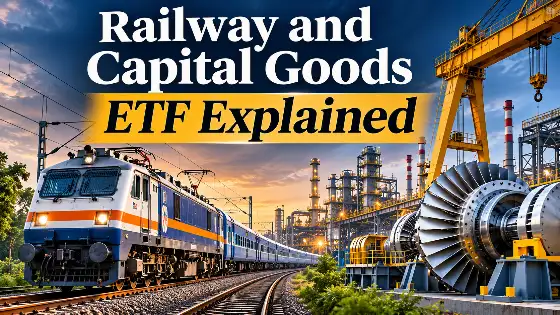
India’s railway and capital goods industries are closely connected to the country’s infrastructure ambitions. Railway modernisation, new train manufacturing, freight corridors, industrial expansion, power infrastructure and government capital expenditure create opportunities for companies supplying equipment, engineering services and transportation solutions. For investors looking to participate in this growth, sector-focused Exchange Traded Funds (ETFs) offer an alternative to selecting individual stocks.
Railway and capital goods ETFs provide exposure to businesses that could benefit from India’s infrastructure and manufacturing expansion. However, these investments come with sector concentration, valuation and economic-cycle risks. Understanding what these ETFs hold, how they work and what drives their performance is important before adding them to a portfolio.
In simple words
A railway or capital goods ETF is a basket of listed companies operating in railway infrastructure, engineering, manufacturing, construction and industrial equipment. Instead of purchasing several individual shares, investors can buy one ETF unit to gain exposure to multiple businesses. Its returns depend on the performance of the underlying companies and their stock prices.
What Is a Railway and Capital Goods ETF?
A railway ETF generally tracks an index of companies connected to railway infrastructure, operations, financing, equipment and logistics. Depending on the index methodology, it may include railway public sector undertakings (PSUs) and other government-owned companies supplying goods or services to Indian Railways.
A capital goods ETF has a broader investment universe. It typically tracks engineering, industrial machinery, electrical equipment, construction equipment, manufacturing and other businesses that supply the infrastructure and industrial sectors.
These are related but different investment themes. A railway ETF provides relatively focused exposure to the railway ecosystem, while a capital goods ETF offers wider participation in India’s industrial investment cycle.
How Does a Railway or Capital Goods ETF Work?
Most sector ETFs in India follow passive investment strategies. The fund tracks a predefined stock market index and attempts to hold its constituent shares in proportions similar to their index weightings.
Also Read: Liquid ETF Explained: How Liquid ETFs Work in India, Returns, Risks and Who Should Buy Them
Investors purchase ETF units through a stock exchange using a demat and trading account, just like buying shares. The market price changes throughout trading hours according to demand, supply and the underlying portfolio’s value.
The ETF does not depend on a fund manager actively selecting stocks to outperform the market. Instead, its objective is to replicate the benchmark’s performance, subject to expenses and tracking error.
Investors should understand three important terms:

- NAV: The per-unit value of the ETF’s underlying investments after liabilities.
- Expense ratio: The annual operating cost charged by the fund.
- Tracking error: The difference between the ETF’s returns and its benchmark returns.
What Companies Do These ETFs Hold?
Railway ETFs can include businesses involved in railway construction, rolling stock, signalling, ticketing, catering, financing and freight transportation.
Also Read: Liquid ETF Explained: How Liquid ETFs Work in India, Returns, Risks and Who Should Buy Them
Depending on the benchmark, investors may find exposure to companies such as IRFC, IRCTC, RVNL, IRCON, RITES, RailTel and Container Corporation of India.
Capital goods ETFs typically cover a wider industrial landscape, including companies involved in:
- Heavy electrical equipment and power machinery.
- Industrial automation and engineering.
- Construction and infrastructure equipment.
- Manufacturing machinery and components.
- Industrial project execution and engineering services.
Holdings and weightings differ between indices and funds. Investors should examine the latest portfolio rather than assuming every railway-related ETF holds the same companies.
Why Are Investors Interested in These ETFs?
India’s infrastructure development creates demand for equipment, engineering capabilities and transportation networks. Railway electrification, track expansion, station redevelopment, rolling stock procurement and freight capacity improvements can create business opportunities for companies operating in this ecosystem.
Similarly, higher private and public investment in manufacturing, energy, industrial facilities and construction can support capital goods companies.
An ETF allows investors to participate in these themes without having to identify individual winners. However, infrastructure spending does not automatically translate into higher profits or share prices. Execution, order profitability, competition and valuations remain important.
Major Risks of Railway and Capital Goods ETFs
These ETFs carry several risks that investors should evaluate before investing.
| Risk | Why it matters |
|---|---|
| Sector concentration | Poor performance in one industry can affect the entire ETF. |
| Valuation risk | Expensive stocks can correct even when businesses grow. |
| Government spending | Project delays or lower capital expenditure can affect orders. |
| Execution risk | Delayed projects and rising costs can reduce profitability. |
| PSU exposure | Government ownership and policy decisions can influence businesses. |
| Liquidity risk | Low trading volumes can increase buying and selling costs. |
Another important consideration is cyclical performance. Capital goods companies often benefit during investment expansions but can experience slower growth when industrial spending weakens.
Railway stocks can also become vulnerable when market expectations rise faster than actual business performance.
How to Choose the Right ETF
Before investing, compare ETFs using the following factors:
- Underlying index: Understand the companies and industries included in the benchmark.
- Expense ratio: Lower expenses can help preserve returns over long investment periods.
- Liquidity: Check daily trading volumes and bid-ask spreads before purchasing.
- Portfolio concentration: Examine how much of the fund is invested in its largest holdings.
- Tracking difference: Compare actual fund performance with its benchmark.
- Fund size: Consider assets under management when assessing the fund’s operating scale.
Investors should also compare the ETF’s performance across different market conditions rather than selecting one purely because of recent returns.
Who Should Invest in These ETFs?
Railway and capital goods ETFs may suit investors who have a positive long-term outlook on India’s infrastructure and industrial development.
Also Read: Bharat 22 ETF Explained: How It Works, Holdings, Risks and Who Should Buy It
They can be considered by investors who:
- Want targeted exposure to railway or industrial businesses.
- Already hold diversified equity investments.
- Can tolerate significant short-term price fluctuations.
- Have an investment horizon of at least five years.
However, these ETFs may not be appropriate for investors seeking stable returns, regular income or low-volatility investments. They should also not replace diversified equity funds or broad-market ETFs in a long-term portfolio.
Should You Invest Through SIP or Lump Sum?
A systematic investment plan (SIP) can help investors spread purchases across different market conditions and reduce the pressure of identifying the right entry point.
A lump-sum investment may work when valuations are reasonable and the investor has sufficient risk tolerance. However, sector ETFs can experience sharp corrections, making staggered investments a practical alternative.
Also Read: CPSE ETF Explained: How India’s PSU Enterprise ETF Works, Holdings, Risks and Who Should Buy It
Investors should avoid allocating a disproportionate share of their equity portfolio to a single infrastructure theme. A measured allocation alongside diversified investments can help manage concentration risk.
Key Takeaways
- Railway ETFs focus on companies connected to railway infrastructure, services and operations.
- Capital goods ETFs provide broader exposure to industrial equipment, engineering and manufacturing.
- Both themes could benefit from India’s infrastructure and industrial expansion.
- Valuations, government spending, execution and liquidity are important risks.
- Compare index composition, expense ratios, tracking differences and trading volumes before investing.
- These ETFs are better suited to investors who understand sector risks and have a long-term investment horizon.
Financial Disclaimer: This article is for educational purposes only and should not be considered investment advice. ETFs are subject to market risks, including the potential loss of invested capital. Investors should evaluate their financial goals, risk appetite and investment horizon before making investment decisions.


Keep learning with OneTrader
Explore structured lessons and practical guides to build your market knowledge.

Need a laugh after all that money talk?
Paisa LOL: India's funniest finance page, with memes, comics, jokes and long funny stories.
