
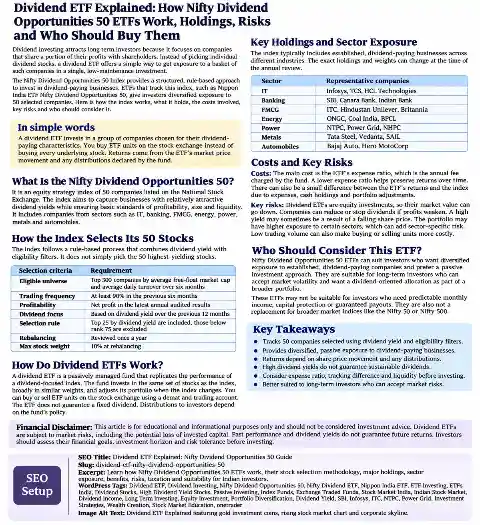
Dividend investing attracts investors who want exposure to companies that share a portion of their profits with shareholders. However, identifying reliable dividend-paying businesses, checking their financial strength and maintaining a diversified portfolio requires research. Dividend-focused exchange-traded funds (ETFs) simplify this process by providing exposure to multiple companies through a single investment.
In India, the Nifty Dividend Opportunities 50 Index offers a rules-based approach to investing in companies with relatively attractive dividend yields. ETFs tracking this index, including Nippon India ETF Nifty Dividend Opportunities 50, allow investors to access a basket of dividend-oriented stocks without purchasing each company individually. However, dividend yield alone does not determine investment quality. Understanding the index methodology, costs and risks is essential before investing.
In simple words
A dividend ETF invests in a basket of companies selected for their dividend-paying characteristics. Investors buy ETF units through the stock exchange instead of purchasing individual shares. Returns come from changes in the ETF’s market price and any distributions declared by the fund.
What Is the Nifty Dividend Opportunities 50?
The Nifty Dividend Opportunities 50 is an equity strategy index comprising 50 companies listed on the National Stock Exchange. Its objective is to identify businesses offering relatively attractive dividend yields while maintaining minimum standards for profitability, market capitalisation and trading liquidity.
Unlike the Nifty 50, which represents large companies across different industries, this index gives greater importance to dividend yield during stock selection. Its constituents can come from banking, information technology, energy, consumer goods, metals, automobiles and other sectors.
The index does not simply select the 50 highest-yielding stocks. Companies must satisfy additional eligibility conditions, helping reduce exposure to businesses that may have attractive yields but insufficient profitability or liquidity.
How Does the Index Select Its 50 Stocks?
The index follows a systematic selection methodology based on dividend yield, with additional filters for financial health and tradability.
Also Read: Liquid ETF Explained: How Liquid ETFs Work in India, Returns, Risks and Who Should Buy Them
| Selection criteria | Requirement |
|---|---|
| Eligible universe | Top 300 by average free-float market capitalisation and average daily turnover over six months |
| Trading frequency | At least 90% in the previous six months |
| Profitability | Net profit in the latest annual audited results |
| Dividend assessment | Dividend yield based on dividends paid over the previous 12 months |
| Initial selection | Top 25 eligible companies by dividend yield are included |
| Exclusion rule | Companies ranked below 75 are excluded |
| Constituents | 50 companies |
| Maximum stock weight | 10% at rebalancing |
The remaining stocks are selected to complete the 50-company portfolio. The index is reviewed annually, allowing its composition to change as dividend yields and company eligibility evolve.
Stock weights are based on free-float market capitalisation, subject to a 10% individual stock cap at rebalancing. Therefore, the index is not equally weighted, and larger eligible companies can have a greater influence on performance.
How Do Dividend ETFs Work?
A dividend ETF is a passively managed fund that attempts to replicate the performance of a dividend-focused index.
For example, Nippon India ETF Nifty Dividend Opportunities 50 invests in the companies forming its benchmark index, broadly following their respective weights. Investors can purchase or sell its units through the stock exchange using a demat and trading account, just like ordinary shares.
Also Read: Liquid ETF Explained: How Liquid ETFs Work in India, Returns, Risks and Who Should Buy Them

As the index changes its constituents or weightings, the ETF adjusts its portfolio to maintain alignment with the benchmark. Its returns depend on the performance of the underlying stocks, along with dividends received by the fund.
Importantly, investors should not confuse a dividend ETF with a guaranteed income product. Dividends received from portfolio companies contribute to the fund’s assets, while distributions to investors depend on the scheme’s applicable distribution policy. Regular monthly or quarterly payments are not guaranteed.
Top Holdings and Sector Exposure
The index generally provides exposure to established businesses across several industries. Its sector allocation changes as companies enter or leave the index during reviews.
Representative companies from its constituent universe include:
| Sector | Representative companies |
|---|---|
| IT | Infosys, TCS, HCL Technologies |
| Banking | SBI, Canara Bank, Indian Bank |
| FMCG | ITC, Hindustan Unilever, Britannia |
| Energy | ONGC, Coal India, BPCL |
| Power | NTPC, Power Grid, NHPC |
| Metals | Tata Steel, Vedanta, SAIL |
| Automobiles | Bajaj Auto, Hero MotoCorp |
These are examples rather than a guaranteed list of current ETF holdings. Investors should check the latest monthly portfolio disclosure from the fund house to identify actual constituents, individual stock weights and sector exposure.
This is particularly important because a portfolio containing 50 stocks is not necessarily equally diversified. A few large holdings or sectors can still account for a significant proportion of the investment.
Costs to Check Before Investing
The expense ratio is one of the most important costs associated with an ETF. It represents the annual management and operating expenses charged by the fund and is reflected in its net asset value.
However, the expense ratio is not the only consideration. Investors should also examine tracking difference, which measures how closely the ETF’s actual returns follow its benchmark over time. Expenses, cash balances, transaction costs and portfolio adjustments can affect this difference.
Also Read: Railway and Capital Goods ETF Explained: How It Works, Holdings, Risks and Who Should Buy It
Trading liquidity matters as well. An ETF with low trading volumes may have wider bid-ask spreads, increasing the cost of entering or exiting an investment.
Before buying, investors should examine:
- Expense ratio and historical tracking difference.
- Average daily trading volume and bid-ask spread.
- Assets under management and portfolio concentration.
- Exchange price compared with indicative net asset value.
Avoid buying ETF units at a substantial premium to their underlying portfolio value. Using limit orders rather than relying entirely on market orders can also help control execution prices.
Risks of Dividend ETFs
Dividend ETFs remain equity investments, and their market prices can fall during corrections. A dividend-focused selection strategy does not protect investors from broader market volatility.
One important risk is the dividend yield trap. When a company’s share price falls sharply, its dividend yield can increase even though its business outlook is deteriorating. A high yield may therefore indicate financial difficulties rather than an attractive opportunity.
Companies can also reduce or discontinue dividends when earnings and cash flows weaken. Historical dividend payments do not guarantee future distributions.
Sector concentration is another consideration. If several constituents belong to industries facing similar challenges, their share prices may decline together. Investors should also understand that tracking error can cause the ETF to underperform its benchmark.
Who Should Consider Buying These ETFs?
Nifty Dividend Opportunities 50 ETFs may suit long-term investors who want diversified exposure to established dividend-oriented businesses without researching and managing individual stocks.
Also Read: Bharat 22 ETF Explained: How It Works, Holdings, Risks and Who Should Buy It
They can be considered as a specialised allocation alongside broader equity investments such as Nifty 50 or Nifty 500 funds. Investors who prefer passive strategies and can tolerate market fluctuations may find this approach useful.
However, these ETFs are not suitable substitutes for fixed deposits or other predictable-income products. Investors requiring guaranteed payments, capital protection or regular monthly cash flows should consider investments designed specifically for those needs.
The strategy should also not be selected purely because its underlying companies have attractive dividend yields. Business quality, valuation, portfolio concentration and overall asset allocation remain important.
Taxation of Dividend ETFs in India
Taxation depends on the ETF’s classification and the applicable provisions when units are sold or distributions are received.
Also Read: CPSE ETF Explained: How India’s PSU Enterprise ETF Works, Holdings, Risks and Who Should Buy It
For qualifying equity-oriented ETFs, capital gains are generally taxed under the equity-oriented mutual fund provisions. Short-term gains on units held for 12 months or less are generally taxed at 20%. Long-term gains on units held for more than 12 months are generally taxed at 12.5% on aggregate eligible gains exceeding ₹1.25 lakh in a financial year.
Distributions received from mutual fund schemes are generally taxable according to the investor’s applicable income tax slab. Surcharge and cess may also apply. Investors should check prevailing tax rules before investing.
Key Takeaways
- The Nifty Dividend Opportunities 50 tracks 50 companies selected using dividend yield and eligibility filters.
- ETFs provide diversified exposure without requiring investors to purchase individual stocks.
- Returns depend on underlying share prices and distributions, if declared.
- High dividend yields do not guarantee sustainable dividends or better returns.
- Expense ratio, tracking difference, liquidity and sector concentration deserve attention.
- These ETFs are more appropriate for long-term investors who can accept equity market risks.
Financial Disclaimer
This article is for educational and informational purposes only and should not be considered investment advice. Dividend ETFs carry market risks, including potential loss of capital. Past performance and dividend yields do not guarantee future returns. Investors should evaluate their financial goals, investment horizon and risk tolerance before investing.
Also Read: Nifty 50 Equal Weight ETF Explained: How It Works, Holdings, Risks and Who Should Buy It






Keep learning with OneTrader
Explore structured lessons and practical guides to build your market knowledge.

Need a laugh after all that money talk?
Paisa LOL: India's funniest finance page, with memes, comics, jokes and long funny stories.
