
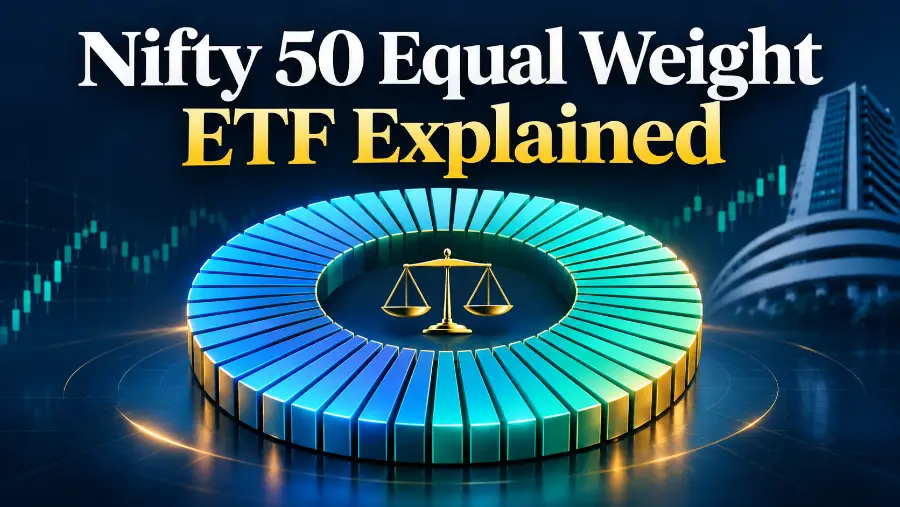
The Nifty 50 is one of India’s most widely followed stock market indices, but its traditional market-capitalisation weighting gives larger companies considerably more influence over its performance. This means a handful of heavyweight stocks, particularly major banks and large technology companies, can influence the index more than many of its other constituents.
A Nifty 50 Equal Weight ETF offers a different approach. Instead of allowing the biggest companies to dominate the portfolio, it allocates approximately the same weight to all 50 constituents. This changes how investors participate in the Indian equity market and creates an alternative for those who prefer broader exposure across large-cap companies.
In simple words
A Nifty 50 Equal Weight ETF invests in the same 50 companies as the regular Nifty 50 but gives each company approximately 2% weight. Rather than concentrating heavily on the largest stocks, it spreads investments more evenly across the index. It is designed for investors who want diversified large-cap exposure without depending too much on a few heavyweight companies.
What Is a Nifty 50 Equal Weight ETF?
A Nifty 50 Equal Weight ETF is an exchange-traded fund that tracks the Nifty 50 Equal Weight Total Return Index. It invests in the 50 companies forming the Nifty 50, but follows an equal-weighting strategy instead of the traditional free-float market-capitalisation method.
In a conventional Nifty 50 index, companies with larger free-float market capitalisations receive higher weights. Consequently, movements in heavyweight stocks have a greater impact on index performance.
The equal-weight version removes much of this concentration. Each company receives approximately 2% allocation when the index is rebalanced. This gives smaller constituents within the Nifty 50 a greater influence on overall returns.
How Does a Nifty 50 Equal Weight ETF Work?
The fund generally holds the underlying shares in proportions that reflect the index. Investors purchase ETF units through a stock exchange, just as they would purchase listed shares.
Also Read: Liquid ETF Explained: How Liquid ETFs Work in India, Returns, Risks and Who Should Buy Them
For example, consider an investment of ₹1 lakh in an equal-weight portfolio:
| Allocation | Investment |
|---|---|
| Each company | ₹2,000 |
| Number of companies | 50 |
| Total investment | ₹1,00,000 |
If one company rises sharply, its portfolio weight increases. Similarly, a declining stock occupies a smaller proportion of the portfolio.
The underlying index follows a systematic rebalancing process. Weights are reset quarterly, while the index’s constituent review takes place semi-annually alongside the Nifty 50. This process effectively reduces exposure to stocks that have become relatively expensive and increases exposure to those whose weights have declined.
However, investors should understand that equal weighting does not mean every stock maintains exactly 2% weight every trading day. Market movements cause allocations to drift between rebalancing dates.
Also Read: Liquid ETF Explained: How Liquid ETFs Work in India, Returns, Risks and Who Should Buy Them

Nifty 50 Equal Weight ETF Holdings
The biggest attraction of this strategy is that investors gain exposure to all 50 Nifty companies without allowing a few large businesses to dominate the portfolio.
Its holdings span multiple industries, including:
- Banking and financial services, including HDFC Bank, ICICI Bank and SBI.
- Information technology, including TCS, Infosys and HCL Technologies.
- Automobile companies such as Maruti Suzuki, Mahindra & Mahindra and Tata Motors.
- Pharmaceuticals, including Sun Pharmaceutical and Cipla.
- Consumer businesses such as ITC, Titan and Nestlé India.
- Industrial and infrastructure businesses such as Larsen & Toubro and UltraTech Cement.
Individual stock weights generally remain close to 2% immediately after rebalancing. Actual ETF holdings can differ slightly depending on market movements, cash balances, expenses and tracking differences.
Investors should check the latest portfolio disclosure before investing because Nifty 50 constituents and individual allocations can change.
Nifty 50 Equal Weight ETF vs Regular Nifty 50 ETF
Both strategies invest in the same large-cap universe, but their portfolio construction creates meaningful differences.
| Parameter | Regular Nifty 50 ETF | Equal Weight ETF |
|---|---|---|
| Weighting method | Market-cap based | Equal weighting |
| Stock allocation | Varies significantly | Around 2% |
| Large-cap influence | Higher | Lower |
| Diversification | More concentrated | More evenly distributed |
| Rebalancing | Market-cap driven | Quarterly weight reset |
| Investment approach | Market representation | Balanced large-cap exposure |
The regular Nifty 50 is more representative of the overall market’s free-float capitalisation. The equal-weight version provides a more balanced participation across its constituents.
Neither strategy is universally superior. Their performance depends on which segments of the large-cap market lead during a particular period.
Advantages of Nifty 50 Equal Weight ETFs
Reduced concentration risk: An individual heavyweight company has less influence on portfolio performance. This can help when a few large stocks underperform.
Also Read: Railway and Capital Goods ETF Explained: How It Works, Holdings, Risks and Who Should Buy It
Broader participation: Companies outside the biggest index constituents receive meaningful allocations, allowing investors to participate more evenly across large-cap businesses.
Systematic rebalancing: Quarterly weight adjustments introduce a disciplined process that reduces allocation differences caused by changing share prices.
Convenient diversification: Investors gain exposure to 50 established Indian companies through a single exchange-traded investment rather than purchasing individual stocks.
Risks Investors Should Understand
Equal weighting does not eliminate equity market risk. The ETF remains fully exposed to stock market fluctuations, and its value can decline significantly during market corrections.
One important consideration is that equal weighting gives relatively greater exposure to smaller Nifty 50 constituents. These companies can experience sharper price movements than the largest index members.
The strategy can also underperform the regular Nifty 50 when heavyweight companies lead the market. During periods when a few banking or technology giants drive index returns, market-cap-weighted funds may benefit more.
Other important risks include:
- Tracking error: The ETF may not perfectly replicate its benchmark because of expenses, trading costs and portfolio adjustments.
- Liquidity: Some ETFs have relatively limited trading volumes, potentially creating wider bid-ask spreads.
- Expense ratio: Annual fund expenses reduce the returns received by investors.
- Rebalancing costs: Frequent portfolio adjustments can create additional transaction costs.
How to Choose a Nifty 50 Equal Weight ETF
Several fund houses offer products tracking this index. Investors should compare the following factors before selecting an ETF:
Also Read: Bharat 22 ETF Explained: How It Works, Holdings, Risks and Who Should Buy It
- Expense ratio: Lower recurring costs can improve long-term returns.
- Tracking difference: Check how closely the ETF has followed its benchmark.
- Trading liquidity: Prefer funds with reasonable trading volumes and tighter bid-ask spreads.
- Assets under management: Consider fund size alongside liquidity and operating efficiency.
- Fund management: Review the scheme’s investment approach and portfolio disclosures.
It is also worth comparing the ETF’s market price with its indicative or published net asset value before placing an order.
Who Should Buy a Nifty 50 Equal Weight ETF?
This ETF may suit long-term investors who want exposure to India’s largest listed companies but are uncomfortable with the concentration created by market-cap weighting.
It can also appeal to investors who believe market leadership will broaden beyond a handful of heavyweight companies. A systematic investment approach can help investors build exposure over time without attempting to predict short-term market movements.
However, it may not be necessary for someone who already holds a regular Nifty 50 ETF and is satisfied with its market-cap-weighted exposure. Holding both funds introduces an additional investment strategy, not an entirely different set of companies.
Also Read: CPSE ETF Explained: How India’s PSU Enterprise ETF Works, Holdings, Risks and Who Should Buy It
Investors should also avoid treating equal weighting as a replacement for asset allocation. Equity exposure should be considered alongside debt investments and other financial goals, depending on individual risk tolerance and investment horizons.
Key Takeaways
- Nifty 50 Equal Weight ETFs invest in the same 50 companies as the regular Nifty 50.
- Each constituent receives approximately 2% weight after rebalancing.
- Quarterly rebalancing helps maintain relatively balanced stock allocations.
- The strategy reduces dependence on heavyweight companies but can underperform when market leaders dominate.
- Expense ratios, tracking differences and liquidity deserve attention when selecting an ETF.
- It is most suitable for investors seeking diversified large-cap exposure with a long-term investment horizon.
A Nifty 50 Equal Weight ETF provides a different way to participate in India’s large-cap market. Its biggest advantage is balanced stock exposure, but investors should understand that equal allocation does not guarantee better returns. The right choice ultimately depends on portfolio construction, investment objectives and risk tolerance.
Financial Disclaimer: This article is for educational purposes only and should not be considered investment advice. Mutual fund and ETF investments are subject to market risks. Investors should read the scheme information documents carefully and evaluate their financial objectives and risk appetite before investing.




Keep learning with OneTrader
Explore structured lessons and practical guides to build your market knowledge.

Need a laugh after all that money talk?
Paisa LOL: India's funniest finance page, with memes, comics, jokes and long funny stories.
