
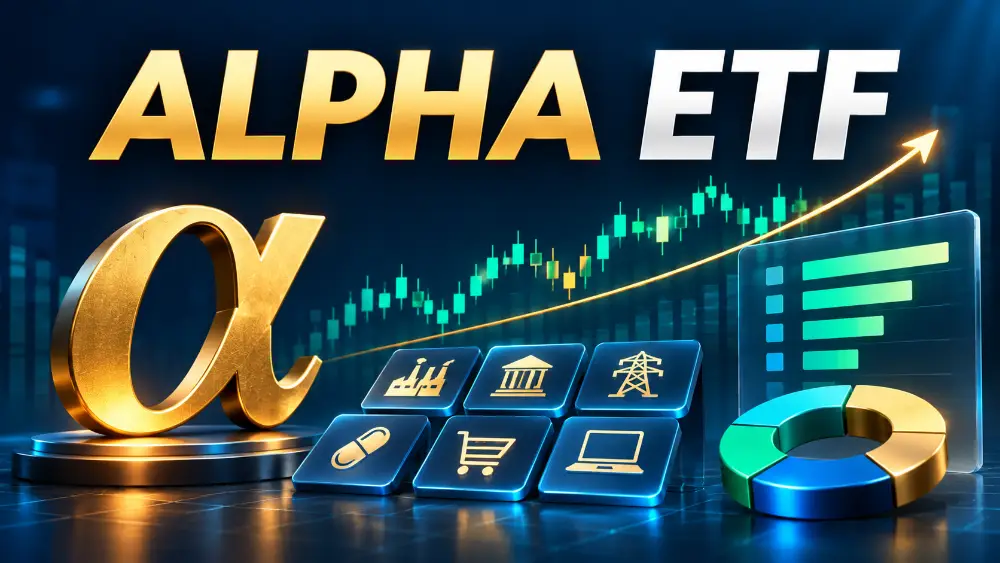
Investors looking beyond traditional index funds are increasingly exploring factor-based investing. Among these strategies, Alpha ETFs have attracted attention because they aim to identify stocks that have historically delivered returns above their market benchmarks. Instead of simply following the largest companies in the market, these ETFs use quantitative rules to select and weight stocks based on their performance characteristics.
For Indian investors, Alpha ETFs offer an interesting way to participate in market-leading companies without individually researching and buying multiple stocks. However, their investment approach is different from conventional Nifty 50 ETFs, and understanding how the underlying strategy works is important before investing.
In simple words
An Alpha ETF invests in stocks selected for their ability to outperform a broader market benchmark based on a predefined quantitative methodology. It follows a factor-based strategy rather than simply tracking companies by market capitalisation. The objective is to capture potential excess returns over time, although outperformance is never guaranteed.
What Is an Alpha ETF?
An Alpha ETF is an exchange-traded fund that tracks an index designed around the alpha factor. In investing, alpha represents the excess return generated by an investment compared with its benchmark after adjusting for market risk.
Unlike a conventional market-cap-weighted ETF, which allocates more money to companies with larger market values, an Alpha ETF follows a stock selection and weighting methodology based on historical performance characteristics.
In India, the Nifty Alpha 50 is one of the prominent examples. It tracks 50 eligible NSE-listed companies with high alpha values. Stocks receive weights based on their alpha, with higher-alpha companies receiving larger allocations.
How Do Alpha Factor ETFs Work?
Alpha ETFs use mathematical models and predefined screening rules to identify stocks that have demonstrated stronger performance relative to a benchmark.
Also Read: Liquid ETF Explained: How Liquid ETFs Work in India, Returns, Risks and Who Should Buy Them
The process generally involves three stages:
- Stock screening: Eligible companies are evaluated using historical market data, liquidity requirements and other index-specific conditions.
- Alpha calculation: The methodology measures excess performance relative to a benchmark, taking market risk into consideration where specified.
- Portfolio weighting: Selected stocks receive allocations according to their calculated alpha scores or the index’s prescribed weighting formula.
For example, consider two companies. Company A delivers strong returns but also carries substantially higher market risk. Company B generates slightly lower returns with comparatively lower risk. A risk-adjusted alpha calculation can help distinguish their performance rather than simply rewarding the stock with the highest absolute return.

The underlying index periodically reviews its constituents. In the case of the Nifty Alpha 50, the index follows a quarterly review schedule, allowing its portfolio to reflect changing stock performance.
What Stocks Do Alpha ETFs Hold?
Alpha ETFs do not necessarily focus on one industry or company size. Their holdings depend on which eligible stocks rank highest under the underlying index methodology.
Also Read: Liquid ETF Explained: How Liquid ETFs Work in India, Returns, Risks and Who Should Buy Them
The portfolio can include companies from sectors such as:
- Banking and financial services
- Capital goods and industrials
- Automobile and auto components
- Pharmaceuticals and healthcare
- Information technology
- Energy and infrastructure
Holdings can change as companies gain or lose their relative performance rankings. Consequently, an Alpha ETF purchased today may have a considerably different portfolio after subsequent index rebalancing.
Investors should examine the latest portfolio disclosure rather than assuming that an ETF will permanently hold the same popular stocks.
Alpha ETF vs Traditional Index ETF
| Feature | Alpha ETF | Nifty 50 ETF |
|---|---|---|
| Selection | Alpha-based methodology | Market capitalisation |
| Objective | Capture excess returns | Track market performance |
| Weighting | Factor-based | Free-float market cap |
| Portfolio | Changes with factor rankings | Changes with index reviews |
| Risk | Can be relatively high | Broad large-cap exposure |
The key distinction is that a traditional index ETF aims to replicate the market, whereas an Alpha ETF attempts to capture a particular investment factor that could potentially outperform the market.
Benefits of Investing in Alpha ETFs
Potential for market outperformance: Alpha strategies target companies with strong historical relative performance, creating an opportunity to outperform conventional benchmarks.
Rule-based investing: Stock selection follows predefined quantitative rules rather than depending entirely on a fund manager’s personal judgement.
Diversification: Investors gain exposure to multiple companies through a single exchange-traded product, reducing dependence on individual stock selection.
Portfolio transparency: The underlying index methodology and ETF portfolio disclosures help investors understand what they own.
Also Read: Railway and Capital Goods ETF Explained: How It Works, Holdings, Risks and Who Should Buy It
Convenient access: Investors can purchase ETF units through a demat and trading account without individually buying every constituent stock.
Risks of Alpha ETFs
Alpha ETFs are not low-risk alternatives to conventional index funds. Their factor-based approach introduces several important risks.
- Performance reversal: Stocks that previously outperformed can underperform when market leadership changes.
- Higher volatility: Exposure to mid-cap and smaller companies can increase portfolio fluctuations.
- Sector concentration: Certain industries may receive disproportionately high weights when their stocks demonstrate stronger alpha.
- Frequent portfolio changes: Rebalancing can increase transaction costs and affect returns.
- Tracking error: The ETF may not perfectly replicate its underlying index because of expenses, liquidity and execution differences.
Most importantly, historical alpha does not guarantee future outperformance. An Alpha ETF can underperform the Nifty 50 for extended periods.
Who Should Invest in Alpha ETFs?
Alpha ETFs may suit investors who already understand equity market volatility and want factor-based exposure alongside conventional diversified investments.
They can be considered by:
- Long-term investors seeking an additional return-generating strategy.
- Investors comfortable with periods of benchmark underperformance.
- Those looking to diversify beyond traditional market-cap-weighted ETFs.
- Investors who prefer systematic stock selection over individual stock picking.
However, conservative investors, short-term traders looking for guaranteed returns and beginners without an established diversified portfolio should approach these products carefully.
Before investing, compare the expense ratio, trading liquidity, bid-ask spread, tracking difference, underlying index methodology and historical performance across different market cycles.
Key Takeaways
- Alpha ETFs use factor-based strategies to identify stocks with strong historical performance relative to a benchmark.
- The Nifty Alpha 50 is an established example in the Indian market.
- Holdings and stock weights can change during periodic index reviews.
- These ETFs offer diversification and systematic exposure but can experience higher volatility and prolonged underperformance.
- Alpha ETFs are better considered as a supplementary equity allocation rather than an automatic replacement for broad-market index funds.
Financial Disclaimer: This article is for educational purposes only and should not be considered investment advice or a recommendation to buy or sell any ETF. Mutual fund and ETF investments are subject to market risks. Investors should read the scheme information documents and assess their financial goals and risk tolerance before investing.
Also Read: Bharat 22 ETF Explained: How It Works, Holdings, Risks and Who Should Buy It




Keep learning with OneTrader
Explore structured lessons and practical guides to build your market knowledge.

Need a laugh after all that money talk?
Paisa LOL: India's funniest finance page, with memes, comics, jokes and long funny stories.
