Evergreen Trading Psychology OneTrader Academy
Many traders enter the stock market with a clear strategy, defined stop-loss and a reasonable profit target. However, their discipline often disappears after a few consecutive losses or an unexpected market move. Instead of following their trading plan, they begin taking additional positions, increasing quantities and searching for opportunities to recover lost money.
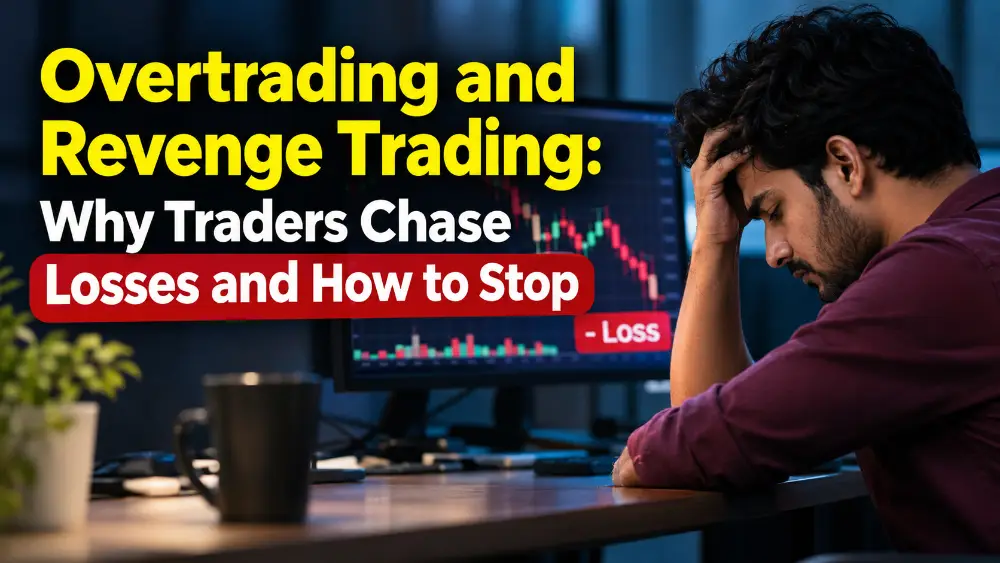
This behaviour is commonly known as overtrading and revenge trading. Both can gradually damage a trading account, even when the trader has a profitable strategy. Understanding the psychology behind these habits is essential for anyone who wants to become a consistent trader.
In simple words
Also Read: Sunk Cost Fallacy in Trading: Why You Hold a Losing Stock Too Long
Overtrading means taking more trades than your strategy or risk plan allows. Revenge trading happens when you enter new trades primarily to recover money lost in previous trades. Both are driven by emotions rather than valid trading opportunities.
What Is Overtrading?
Overtrading occurs when traders take excessive positions without sufficient technical or fundamental justification. Instead of waiting for high-quality setups, they enter trades simply because they want to remain active in the market.
For example, a trader may plan to take only two trades during a session. After completing those trades, the trader continues looking for opportunities and enters five more positions, even when the market offers no clear setup.
More trading does not necessarily mean more profit. Every additional position introduces transaction costs, brokerage, taxes and the possibility of another loss.
Also Read: Trading Discipline: The Key to Better Decision-Making in the Stock Market
What Is Revenge Trading?
Revenge trading happens when a trader attempts to recover a previous loss quickly by entering another position.
Imagine a trader loses ₹2,000 on a Bank Nifty trade. Instead of accepting the loss, the trader immediately enters another position with a larger quantity, hoping to recover the money in one move.
If the second trade also fails, frustration increases and the trader may take even bigger risks.
The original trading strategy gradually disappears, replaced by an emotional need to get the lost money back.
Also Read: Why Traders Keep Making the Same Mistakes
Why Do Traders Overtrade and Chase Losses?
Several psychological factors contribute to these behaviours.
1. Fear of missing out: Traders see stocks moving sharply and feel they are missing an opportunity. They enter positions without waiting for proper confirmation.
2. Loss aversion: A financial loss often creates stronger emotional discomfort than the satisfaction of an equivalent profit. Traders struggle to accept that a trade has failed.
3. Need for immediate recovery: After losing money, traders want to return to their previous account balance as quickly as possible. This creates pressure to take unnecessary risks.
Also Read: How to Eliminate Emotional Decisions in the Stock Market
4. Overconfidence after profits: A series of successful trades can make traders believe they understand every market movement. They begin taking lower-quality setups and increasing position sizes.
5. Lack of trading rules: Without predefined limits on the number of trades, daily losses and position sizes, emotions can easily influence decisions.
Overtrading vs Revenge Trading: Key Differences
| Factor | Overtrading | Revenge Trading |
|---|---|---|
| Main reason | Excessive market activity | Recovering previous losses |
| Trigger | Boredom, FOMO, excitement | Frustration and anger |
| Trading frequency | Unnecessarily high | Often increases after losses |
| Position size | May remain unchanged or increase | Often increases |
| Decision-making | Poor setup selection | Emotion-driven decisions |
| Main risk | Accumulating losses and costs | Large, uncontrolled losses |
Revenge trading is often a form of overtrading, but not every overtrader is trying to recover previous losses.
Warning Signs That You Are Trading Emotionally
Recognising the behaviour early can prevent a small loss from becoming a major account drawdown.
Also Read: How to Develop a Winning Trading Mindset
Watch for these warning signs:
- Entering trades immediately after a stop-loss is hit.
- Increasing quantity to recover previous losses.
- Taking trades without a clearly defined setup.
- Moving stop-loss levels because you do not want to accept a loss.
- Trading outside your planned market hours.
- Feeling uncomfortable when you are not holding a position.
- Continuing to trade after reaching your daily loss limit.
If these behaviours become frequent, it is time to review your trading discipline.
How to Stop Overtrading and Revenge Trading
1. Set a Daily Maximum Number of Trades
Decide how many trades you are allowed to take before the market opens. This forces you to become selective and wait for quality opportunities.
For example:
Also Read: How to Control Emotions While Trading
| Trading rule | Example limit |
|---|---|
| Maximum trades per day | 3 |
| Maximum consecutive losses | 2 |
| Maximum daily loss | ₹2,000 |
| Risk per trade | ₹1,000 |
These are illustrative limits, not universal recommendations. Set them according to your capital, strategy and risk tolerance.
2. Follow a Fixed Risk-Reward Ratio
Define your stop-loss and profit target before entering a trade. A predefined risk-reward ratio prevents you from increasing risk simply because you want to recover money.
For example, with a 1:2 risk-reward ratio:
| Parameter | Amount |
|---|---|
| Risk per trade | ₹1,000 |
| Potential reward | ₹2,000 |
| Risk-reward ratio | 1:2 |
The objective is not to win every trade. It is to maintain a process where potential rewards justify the risks being taken.
Also Read: Why Most Traders Lose Money in the Stock Market
3. Take a Break After Consecutive Losses
After two consecutive losing trades, step away from the trading terminal for some time. Do not immediately search for another opportunity.
A break helps reduce emotional pressure and gives you time to evaluate whether the next trade genuinely meets your strategy.
If you have reached your daily loss limit, stop trading for the day.
4. Never Increase Quantity to Recover Losses
Position size should be calculated using your predefined risk limit and stop-loss distance.
Also Read: Gambler’s Fallacy in Trading – Why Traders Think Markets Must Reverse
For example, if your planned risk is ₹1,000, do not increase it to ₹3,000 simply because you lost money earlier.
A previous loss should never determine the quantity of your next trade.
5. Maintain a Trading Journal
Record every trade, including the entry reason, stop-loss, target, outcome and emotional state.
At the end of each week, review how many trades followed your strategy and how many were driven by emotions.
Also Read: The 1.8 Crore Solapur Trading Tragedy: A Warning to Every Retail Trader
This exercise helps identify recurring mistakes that may not be obvious during live trading.
6. Learn to Accept Losing Trades
Losses are an unavoidable part of trading. Even a well-tested strategy will produce losing trades.
A disciplined trader understands that one unsuccessful position does not mean the strategy has stopped working.
The objective should be to execute a repeatable process rather than recover every individual loss.
Also Read: Recency Bias in Trading – Why Recent Trends Fool Traders
A Practical Rule to Protect Your Trading Account
Before entering another trade, ask yourself three questions:
- Does this trade meet my predefined strategy?
- Is my entry supported by a valid setup and confirmation?
- Am I taking this trade because of the opportunity or because I want to recover a loss?
If the third answer is recovery, step away from the market.
Building this habit can help traders avoid unnecessary positions and protect their capital over time.
Key Takeaways
- Overtrading means taking more positions than your strategy justifies.
- Revenge trading is driven by the desire to recover previous losses.
- FOMO, frustration, overconfidence and poor discipline contribute to emotional trading.
- Set daily trade limits and maximum loss limits before the market opens.
- Never increase position size to recover money from an earlier trade.
- Maintain a trading journal to identify repeated mistakes.
- Accepting small losses is an important part of long-term trading discipline.
Financial Disclaimer
This article is intended for educational purposes only and should not be considered investment advice or a recommendation to buy or sell any financial instrument. Trading in stocks, futures and options involves substantial financial risk, including the possibility of losing the entire capital invested. Traders should understand their risk tolerance, follow appropriate risk management practices and consult a qualified financial advisor when necessary.
Also Read: Anchoring Bias in Trading – Why Traders Get Stuck to One Price (2025)

Also on OurPaisa
Buy, sell and find jobs and services in OurPaisa Market.