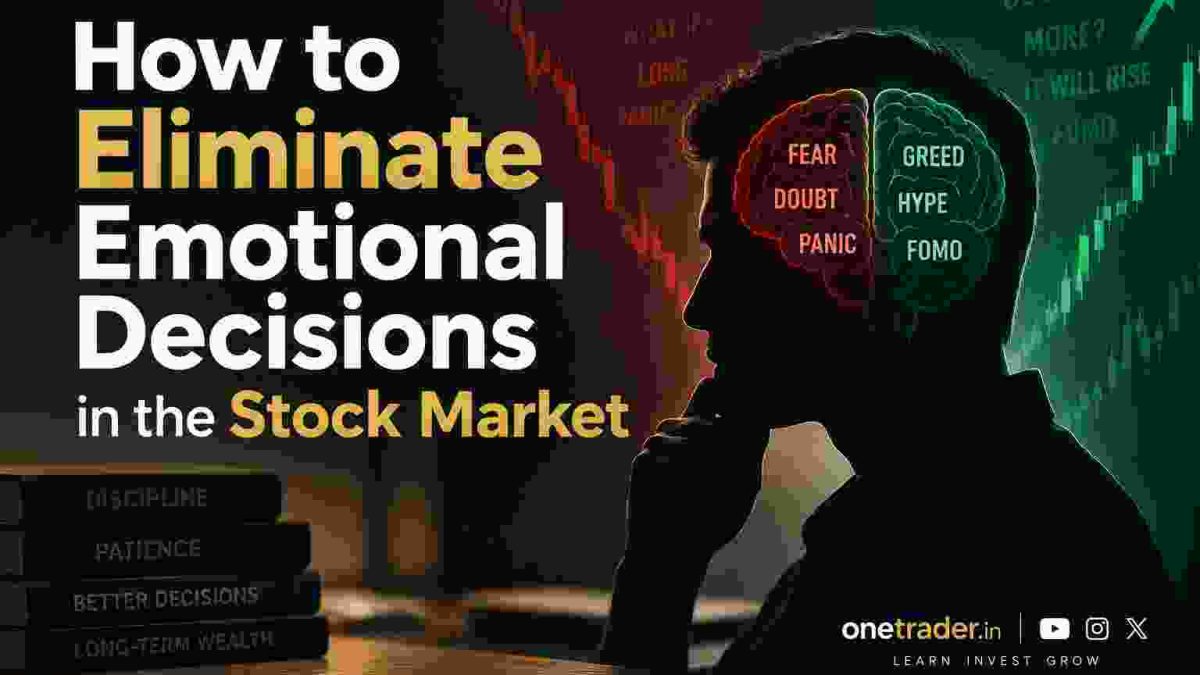
The stock market does not usually test an investor’s knowledge as much as it tests their behavior. A person may understand valuation, technical analysis, risk management and market cycles, yet still make poor decisions when money is actually on the line. A stock falls sharply and fear takes over. A stock rises rapidly and greed creates the feeling that the opportunity cannot be missed. The problem is not having emotions. The real problem begins when emotions start making financial decisions.
The idea of becoming completely emotionless in the stock market is unrealistic. Fear, excitement, anxiety and greed are natural human responses to uncertainty. Instead of trying to eliminate emotions completely, investors should build a process that prevents those emotions from controlling their actions. The goal is not to stop feeling; it is to stop reacting impulsively.
Why Emotions Become Dangerous in the Stock Market
Markets continuously provide information that can trigger emotional reactions. A portfolio may be green for several months and suddenly lose a significant portion of its value during a correction. At that moment, an investor who was confident about the future may start questioning everything. The opposite happens during strong rallies. When prices keep moving higher, investors can become overconfident and increase their exposure without properly evaluating the risk.
One of the biggest psychological mistakes is confusing a temporary price movement with a permanent change in the underlying investment. A falling stock can create fear even when the original investment thesis remains intact. Similarly, a rising stock can create confidence even when its valuation or risk has changed significantly. Emotional decisions often happen because investors respond to the latest price instead of following a predefined decision-making process.
Also Read: How to Develop a Winning Trading Mindset
The Solution Starts Before You Buy
One of the simplest ways to reduce emotional decisions is to make important decisions before entering a position. Before buying a stock, an investor should know why they are buying it, what could prove their thesis wrong, how much capital they are willing to risk and what would make them exit.
This changes the nature of the decision. Instead of asking, “What should I do now that the stock has fallen?” the investor can ask, “Has the condition I defined before buying actually changed?”
For a trader, this could mean defining the entry, stop-loss, target and position size in advance. For a long-term investor, it could mean defining the business factors that would justify continuing to hold the stock and the circumstances that would invalidate the investment thesis. The exact rules may differ, but the principle remains the same: make the plan when you are calm, not when the market is creating pressure.
Position Size Can Control Emotion
Sometimes the problem is not the investor’s psychology but the amount of money involved. When a position becomes too large relative to the portfolio, every price movement starts feeling important. A normal 3% decline can suddenly feel like a crisis.
Also Read: How to Control Emotions While Trading
Position sizing therefore has a psychological benefit as well as a financial one. If the amount invested is appropriate for the investor’s risk capacity, temporary volatility becomes easier to tolerate. Smaller, manageable positions can make it easier to follow a predetermined strategy instead of reacting to every market movement.
This is particularly important for traders. A strategy may look excellent on paper, but if every losing trade feels unbearable, the trader may move the stop-loss, exit too early or revenge trade after a loss. Risk management protects not only capital but also decision-making ability.
Stop Watching Every Price Movement
Constantly checking a portfolio can create unnecessary emotional pressure. Investors who look at prices repeatedly may start treating every short-term movement as a signal that requires action.
A long-term investment does not suddenly become a different investment because its price moved during the last hour. Similarly, a trading strategy should not be changed simply because one trade is temporarily moving against the trader.
Also Read: Why Most Traders Lose Money in the Stock Market
The frequency with which an investor checks the market should match the investment horizon. Long-term investors generally need a process for reviewing the business and their original thesis rather than reacting to every intraday movement.
Learn to Accept Losses
Another important step is accepting that losses are unavoidable. No investment strategy produces only winning decisions. Even a well-researched trade can fail, and even a high-quality company can experience periods of disappointing performance.
The emotional mistake occurs when investors refuse to accept a small loss and keep holding simply because they want to be proven right. The market does not know an investor’s purchase price, and it does not owe anyone a recovery.
Accepting a loss as part of the process can prevent a small mistake from becoming a much larger one. The objective should not be to avoid every loss. It should be to prevent individual mistakes from damaging the overall portfolio.
Also Read: Gambler’s Fallacy in Trading – Why Traders Think Markets Must Reverse
Separate the Decision From the Outcome
A good decision can sometimes produce a bad outcome, while a poor decision can occasionally produce a profitable outcome. This distinction is extremely important.
For example, buying a stock after proper research, appropriate position sizing and a clearly defined risk level may still result in a loss. That does not automatically mean the decision was wrong. Similarly, buying a stock purely because someone mentioned it on social media and making a profit does not necessarily make the decision good.
Investors should evaluate the quality of their process, not just the result of one trade or investment. Keeping an investment journal can help identify repeated mistakes and emotional patterns that are difficult to notice in the moment.
Build Rules That Make Discipline Easier
The strongest defense against emotional decisions is a repeatable process. Investors can create simple rules around research, entry, position sizing, risk, portfolio review and exit decisions.
Also Read: The 1.8 Crore Solapur Trading Tragedy: A Warning to Every Retail Trader
The purpose of these rules is not to predict the market perfectly. It is to reduce the number of decisions that have to be made under pressure.
When the market rises sharply, the rules can prevent excessive excitement. When the market falls sharply, they can prevent panic. Over time, consistency becomes more important than trying to make the perfect decision every time.
The stock market will always create fear, excitement and uncertainty. Investors cannot control what the market does, but they can control how they respond to it. Emotional discipline is therefore not about becoming a robot. It is about creating a system strong enough that temporary emotions do not override long-term thinking.
The real objective is simple: make decisions based on a process, not based on the emotion created by the latest price movement. Once that mindset develops, market volatility may still be uncomfortable, but it becomes much less capable of controlling your financial decisions.
Also Read: Recency Bias in Trading – Why Recent Trends Fool Traders
Financial Disclaimer: This article is for educational and informational purposes only and should not be considered investment, trading, or financial advice. Stock market investments are subject to market risks. Investors should conduct their own research and consider their financial goals and risk tolerance before making investment decisions.