
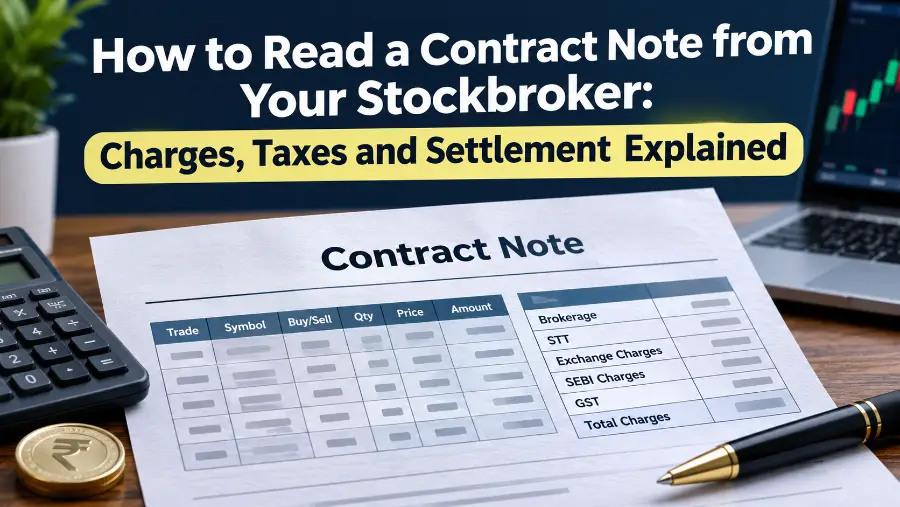
Every time an investor buys or sells shares through a stockbroker, the broker generates a contract note recording the executed trades and the charges associated with them. It is an important document that confirms the transaction and provides a breakdown of brokerage, statutory taxes, exchange fees and other applicable costs.
However, many investors focus only on the share price and brokerage, overlooking the other deductions. Understanding a contract note helps investors verify their trades, identify incorrect charges and calculate the actual cost of buying or selling shares.
In simple words
A contract note is the official record of your stock market transactions. It tells you what you bought or sold, at what price, how much brokerage and tax you paid, and what your final financial obligation is. Checking it regularly helps you avoid unnecessary costs and maintain accurate trading records.
Also Read: Market Structure Explained: HH, HL, LH and LL
What Is a Contract Note?
A contract note is an official document issued by a registered stockbroker after executing trades on a recognised stock exchange. It serves as proof of the transactions carried out on behalf of the investor.
The document generally contains:
- Stockbroker’s name, address and SEBI registration number.
- Investor’s name and client identification code.
- Contract note number and trade date.
- Stock name, quantity and executed price.
- Buy and sell transaction details.
- Brokerage and statutory charges.
- Applicable taxes and final settlement amount.
Investors generally receive electronic contract notes through their registered email address. They should retain these documents for future reference, tax calculations and dispute resolution.
How to Read the Important Sections
A contract note may look complicated because it contains several columns and financial entries. These are the main details investors should understand.
Also Read: How to Choose a Financial Advisor: 7 Things to Check Before Hiring One
| Particular | What it means |
|---|---|
| Trade date | Date on which the transaction was executed |
| Symbol | Stock or security traded |
| Buy/Sell | Type of transaction |
| Quantity | Number of shares traded |
| Trade price | Executed price per share |
| Trade value | Quantity multiplied by price |
| Brokerage | Fee charged by the broker |
| Other charges | Exchange and regulatory fees |
| Net amount | Amount payable or receivable after applicable adjustments |
Example: If you purchase 100 shares at ₹500 each, your trade value is ₹50,000. The contract note records this transaction along with applicable brokerage, taxes and other charges.
Understanding the Different Charges
The total cost of a transaction includes several components. Some are determined by the government and regulators, while brokerage and certain service charges depend on the broker’s tariff.
1. Brokerage Charges
Brokerage is the fee charged by a stockbroker for executing a transaction. The amount depends on the broker’s pricing structure and trading segment.
Common brokerage models include:
Also Read: How to Change Bank Account in Demat Account Online: Step-by-Step Guide
- Zero brokerage on selected delivery transactions.
- Flat fees per executed order.
- Percentage-based brokerage subject to a maximum limit.
Investors should compare the brokerage mentioned in their contract note with the tariff sheet provided during account opening.
2. Securities Transaction Tax (STT)
STT is a government tax levied on specified securities transactions executed through recognised stock exchanges.
EQUITY AND EQUITY DERIVATIVES STT RATES APPLICABLE FROM 1 APRIL 2026
| Transaction | STT rate | Applicable side |
|---|---|---|
| Equity delivery | 0.10% | Buy and sell |
| Equity intraday | 0.025% | Sell |
| Equity futures | 0.05% | Sell |
| Equity options | 0.15% | Sell premium |
| Exercised options | 0.15% | Buyer, on intrinsic value |
STT is calculated on the applicable transaction value or option premium, depending on the segment. The increased derivatives rates effective April 2026 are particularly important for active traders.

3. Exchange Transaction Charges
Stock exchanges charge fees for executing transactions on their platforms. These charges depend on the exchange and trading segment.
For example, NSE equity cash, futures and options transactions have different charge structures. These fees are generally calculated on the applicable turnover or premium value.
Investors should check whether the exchange charges shown in their contract notes match the applicable exchange schedule.
4. SEBI Turnover Charges
SEBI collects regulatory fees through stockbrokers based on transaction turnover.
Also Read: Can You Have Multiple Demat Accounts in India? Rules, Benefits & Charges
The standard rate for securities other than debt securities is:
| Particular | Rate |
|---|---|
| SEBI turnover fee | 0.0001% |
| Per ₹1 crore turnover | ₹10 |
Although the amount is small, it appears as a separate charge in the transaction cost calculation.
5. Stamp Duty
Stamp duty is a government levy collected on securities transactions. It is generally charged on the buyer’s side.
| Transaction | Stamp duty |
|---|---|
| Equity delivery | 0.015% |
| Equity intraday | 0.003% |
| Equity futures | 0.002% |
| Equity options | 0.003% |
The applicable rate depends on the transaction category, and stamp duty is collected through the clearing corporation.
Also Read: How to Calculate Your Stock Market Returns: Absolute Return vs CAGR vs XIRR
6. Goods and Services Tax (GST)
GST is charged at 18% on applicable brokerage and taxable service charges.
It generally applies to brokerage, exchange transaction charges, SEBI turnover fees and applicable depository services. It is not calculated on STT or stamp duty.
This distinction matters because GST is calculated on the applicable service charges rather than the entire transaction value.
7. Depository Participant (DP) Charges
DP charges are associated with transferring shares from an investor’s demat account when shares are sold.
Also Read: Why Do Stock Markets Crash? The Real Reasons Behind Market Crashes
These charges generally apply to delivery-based selling transactions, not ordinary intraday trades.
The amount depends on the depository participant and broker’s pricing structure. Some brokers charge a fixed amount per stock sold, while others may have different pricing arrangements.
Example: Understanding Charges on an Equity Delivery Trade
Suppose an investor purchases shares worth ₹1,00,000 and later sells them for ₹1,10,000.
The following table illustrates the statutory charges, excluding brokerage and exchange-specific fees.
Also Read: How to Build a Diversified Investment Portfolio in India
| Charge | Buy transaction | Sell transaction |
|---|---|---|
| STT at 0.10% | ₹100 | ₹110 |
| Stamp duty at 0.015% | ₹15 | Not applicable |
| SEBI fee at 0.0001% | ₹0.10 | ₹0.11 |
Exchange charges, brokerage, GST and applicable DP charges must also be considered to calculate the final transaction cost.
The actual amount payable or receivable will therefore differ from the gross trade value.
What Is Trade Settlement? Understanding T+1
Settlement refers to the process through which funds and securities are transferred between buyers and sellers after a trade.
Indian equity markets generally follow the T+1 settlement cycle.
Also Read: Market Order vs Limit Order: Key Differences Explained
Here, T represents the trading day, while T+1 represents the next applicable settlement working day.
| Transaction | Settlement process |
|---|---|
| Monday trade | Tuesday settlement |
| Tuesday trade | Wednesday settlement |
| Friday trade | Usually Monday settlement |
Exchange holidays and settlement calendars can change the actual date.
Under this system, purchased shares are generally credited to the investor’s demat account through the settlement process, while sale proceeds are paid according to the applicable payout arrangements.
Certain eligible securities and trades may also be available under the optional T+0 settlement framework. This does not replace the regular T+1 cycle for all stocks.
Also Read: How to Buy Your First Stock in India: A Beginner’s Step-by-Step Guide
How to Identify Incorrect Charges
Investors should make it a habit to check their contract notes instead of relying entirely on the broker’s trading application.
Pay attention to these points:
- Verify that the stock name, quantity and execution price match your trade history.
- Check whether brokerage matches the agreed tariff.
- Compare STT and stamp duty with the applicable rates.
- Check whether GST has been calculated correctly.
- Look for unexpected penalties, additional fees or service charges.
- Verify the net payable or receivable amount against your ledger.
If you identify an incorrect entry, contact your broker with the contract note number, trade details and supporting transaction records. If the issue remains unresolved, you can use the applicable stock exchange investor grievance mechanism.
Key Takeaways
- A contract note is the official record of executed stock market transactions.
- Brokerage is determined by the broker’s agreed pricing structure.
- STT, stamp duty, SEBI fees and exchange charges add to transaction costs.
- GST applies to eligible service charges, not STT or stamp duty.
- DP charges generally apply when delivery shares are sold.
- India’s regular equity settlement cycle is T+1.
- Investors should verify every transaction and retain contract notes for tax and financial records.
Financial Disclaimer
This article is intended for educational and informational purposes only. Brokerage structures, statutory levies and settlement procedures may change according to regulatory requirements and exchange rules. Investors should verify applicable charges with their stockbroker and consult a qualified financial or tax professional for transaction-specific guidance. This article does not constitute investment or tax advice.
Also Read: Best Stock Market Apps in India: Features, Charges and How to Choose





Keep learning with OneTrader
Explore structured lessons and practical guides to build your market knowledge.

Need a laugh after all that money talk?
Paisa LOL: India's funniest finance page, with memes, comics, jokes and long funny stories.
