The Investor Who Made Ordinary Observations Powerful
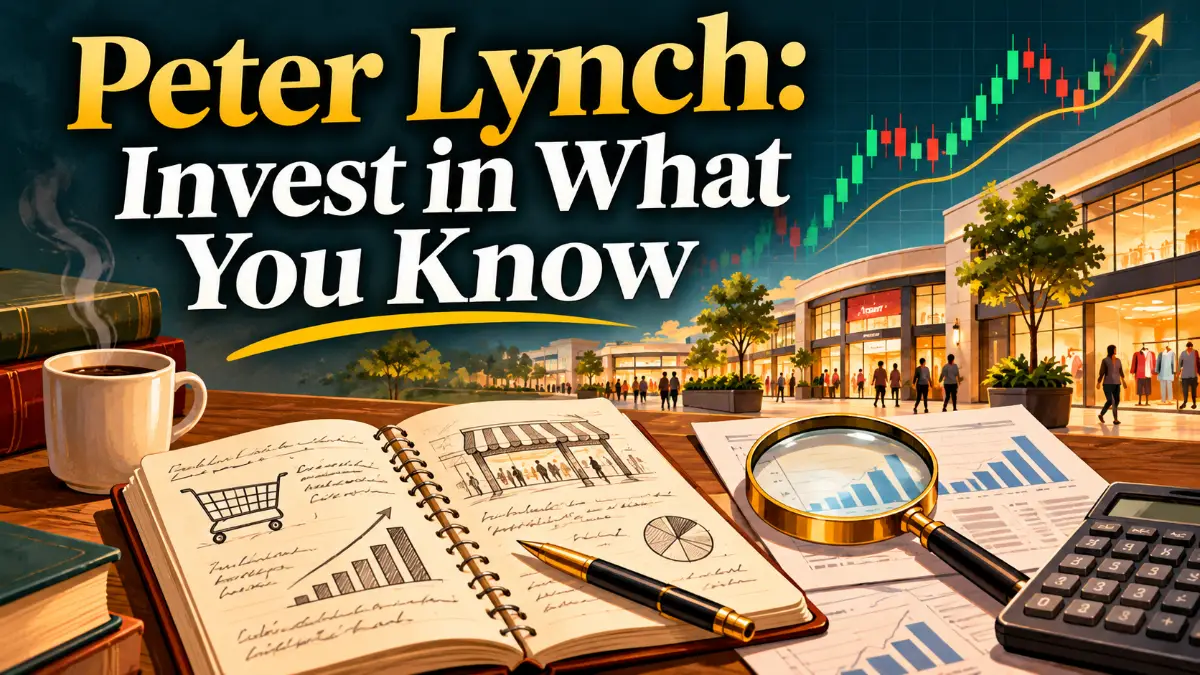
Peter Lynch’s investment career is a reminder that successful stock picking does not always begin with complicated financial models or secret information from Wall Street. Sometimes it begins with something much closer to everyday life: a crowded restaurant, a popular product, a growing retail store or a business that customers genuinely love. Lynch became one of the most respected fund managers in history by combining this kind of observation with serious company research, financial discipline and an extraordinary appetite for learning. His philosophy, widely associated with the phrase “invest in what you know”, helped ordinary investors understand that they could identify promising businesses without working on Wall Street.
Born on January 19, 1944, in the Boston area of Massachusetts, Peter Lynch experienced financial responsibility at a young age. His father died when he was ten, and his family faced difficult circumstances. As a teenager, Lynch worked as a golf caddie at a private club, where he regularly heard business executives discussing stocks and investments. Those conversations sparked his curiosity about the stock market. He began paying attention to the companies people discussed and noticed how their businesses and share prices developed over time. What started as casual exposure gradually became a serious interest in investing.
Lynch studied history, psychology, philosophy and mathematics at Boston College, graduating in 1965. He later earned an MBA from the Wharton School of the University of Pennsylvania in 1968. His connection with Fidelity Investments began earlier, in 1966, when he secured a summer internship with the company. After completing his education and military service, he returned to Fidelity as a full-time analyst in 1969. His early assignments included studying industries and companies in detail, an experience that helped develop the research habits that would define his career.
The Magellan Fund Opportunity
In May 1977, Lynch was appointed manager of Fidelity’s Magellan Fund. At the time, it was a relatively small investment fund with assets of roughly $18 million to $20 million. He was only 33 years old, and managing the fund would become the defining responsibility of his professional life. Rather than relying on a narrow collection of familiar large companies, Lynch searched across industries and company sizes for businesses with attractive growth prospects and reasonable valuations.
Also Read: Radhakishan Damani: The Quiet Investor Who Built DMart and a Market Fortune
His approach involved extensive research. He studied company reports, spoke with management teams, visited businesses and examined how products performed in the real world. He was interested in companies that could grow earnings over time, but he did not assume that a popular product automatically made its manufacturer a good investment. He wanted to understand how the company made money, whether its growth could continue, how much debt it carried and whether its share price already reflected unrealistic expectations.
Under Lynch, Magellan developed into one of the most successful mutual funds of its era. From May 1977 to May 1990, the fund delivered an average annual return of approximately 29.2%. Its assets grew from around $18 million to approximately $14 billion. These results placed Lynch among the most successful fund managers of his generation and attracted investors from across the United States.
Finding Investment Ideas in Everyday Life
Lynch’s best-known investment principle was that individuals could sometimes notice promising businesses through their everyday experiences before those companies became widely discussed by professional investors. A consumer might observe that a particular restaurant is always crowded, that a retailer is expanding rapidly or that a product is becoming increasingly popular. These observations can provide the starting point for investment research.
However, Lynch’s philosophy was often misunderstood. He was not suggesting that people should buy shares simply because they liked a product or regularly visited a particular store. A popular business can still be an expensive investment, and a successful product does not guarantee that shareholders will earn attractive returns. The important step was to investigate further. Investors needed to examine the company’s financial statements, competitive position, growth opportunities, debt and valuation before committing money.
Also Read: Prem Watsa: The Indian-Born Investor Who Built a Global Financial Empire Through Patience
This distinction made his approach particularly useful. Everyday experience could help investors discover ideas, but research had to determine whether those ideas deserved investment. Lynch encouraged individuals to use what they understood as an advantage, while reminding them that understanding a business and understanding its stock valuation were two different tasks.
The Search for Tenbaggers
One of the concepts closely associated with Lynch is the tenbagger, a stock that increases to ten times its original purchase price. He popularized the term in investment writing and used it to describe the kind of exceptional growth that can transform a portfolio over time.
Lynch searched for companies that could expand substantially while remaining undervalued relative to their future potential. He paid attention to businesses that were growing faster than the market expected, especially when investors had not yet fully recognized their opportunities. His investment universe included retailers, restaurants, consumer businesses, financial companies and many other industries.
His approach was not limited to one type of stock. He categorized businesses according to their characteristics, including slow growers, stalwarts, fast growers, cyclicals, turnarounds and asset plays. Each category required a different way of thinking. A fast-growing company needed to demonstrate that its expansion could continue, while a cyclical business had to be evaluated in relation to its industry cycle. A turnaround required evidence that a troubled company could genuinely recover.
Also Read: Uday Kotak – The Man Who Turned a Small Financial Idea Into a Banking Giant
This classification helped investors avoid treating every stock as though it followed the same rules. It also reinforced one of Lynch’s central beliefs: investors should understand exactly what kind of business they own and what conditions could determine its future performance.
The Decision to Walk Away at 46
In March 1990, Lynch announced that he would retire from managing Magellan. He was only 46 years old, and the fund had grown into one of the largest mutual funds in the world. His decision surprised many investors because he was leaving a position that had made him internationally famous. But the demanding nature of managing such a large fund had taken a considerable amount of time and energy, and he wanted to spend more time with his family and charitable activities.
His retirement did not mean that he abandoned investing or public life. Lynch continued to remain connected with Fidelity and became involved in mentoring analysts and supporting philanthropic work. He also devoted significant attention to education and community initiatives through the Lynch Foundation, which he established with his wife Carolyn.
Lynch’s investment experience also became accessible to a much wider audience through his books. One Up on Wall Street, published in 1989, explained his approach to finding investment opportunities and understanding businesses. Beating the Street and Learn to Earn followed, helping introduce generations of readers to company research, stock market fundamentals and long-term investing.
Also Read: Dhirubhai Ambani – The Man Who Dreamed Bigger Than His Circumstances
What Investors Can Learn from Peter Lynch
The most important lesson from Lynch’s career is that investing should begin with understanding. A rising share price is not a substitute for knowing what a company does, how it earns money and what could support its future growth. Investors who understand a business are better positioned to evaluate new information and decide whether their original reasons for buying still hold.
His philosophy also highlights the importance of separating a good company from a good investment. Even an excellent business can become a poor investment when its share price is excessively high. Similarly, a company with an attractive valuation may not be worth buying if its business is deteriorating. Investors need to consider both the quality of the business and the price they are paying.
Another lesson is the value of patience. Lynch’s Magellan record was built over thirteen years, not through a handful of short-term market calls. His approach required continuous research, careful monitoring and the ability to remain focused on business performance rather than daily market noise. That does not mean every stock should be held indefinitely. It means investors should have clear reasons for owning a company and should review those reasons as the business changes.
For beginners, perhaps his most practical lesson is to stay curious. The businesses people encounter in daily life can provide useful investment ideas, but curiosity must lead to investigation. Read company reports, understand the industry, compare valuations and learn how the business makes money. The stock market rewards neither blind confidence nor casual observation. It demands informed decisions.
Also Read: Ray Dalio: The Investor Who Turned Failure Into Principles
The Legacy of an Investor Who Looked Beyond Wall Street
Peter Lynch showed that successful investing could be grounded in common sense without becoming simplistic. His remarkable performance at Magellan made him a legend, but his lasting influence comes from the way he explained investing to ordinary people. He encouraged individuals to look around, ask questions and develop the confidence to study businesses for themselves.
His journey from a young caddie listening to conversations about stocks to managing one of the world’s most successful mutual funds demonstrates the power of curiosity combined with disciplined work. He did not suggest that every investor could achieve his results. Instead, he showed that people could become more thoughtful investors by understanding the companies they own and refusing to follow market excitement blindly.
The message of Peter Lynch’s career remains relevant today: opportunities may be visible in everyday life, but turning an observation into a sound investment requires knowledge, patience and independent research. Invest in what you know, but make sure you truly understand what you own.
Stay tuned for the next inspirational story, only on Onetrader.
Also Read: Charlie Munger: The Thinking Partner Behind Warren Buffett’s Success
Financial Disclaimer: This article is intended for educational and informational purposes only. It does not constitute investment, financial or trading advice or a recommendation to buy or sell any security. Investing involves risk, including the possible loss of capital. Readers should conduct independent research and consider their financial goals and risk tolerance before making investment decisions.

Also on OurPaisa
Buy, sell and find jobs and services in OurPaisa Market.