From Hyderabad to a World of Opportunities
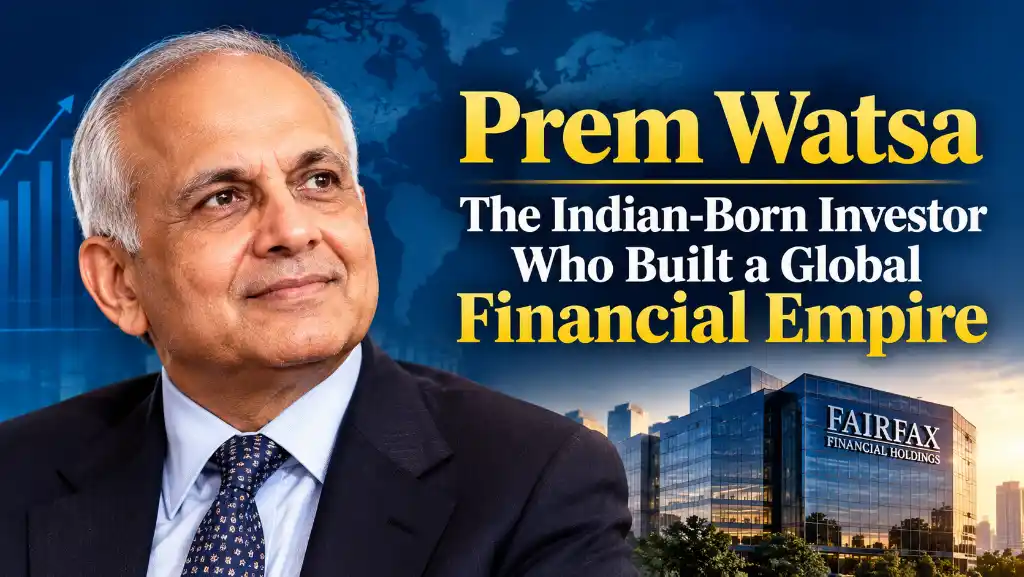
Some of the most remarkable success stories begin with people who leave familiar surroundings without knowing exactly where life will take them. Prem Watsa’s journey is one such story. Born in Hyderabad, India, in 1950, he grew up in a country where opportunities in global finance were far more limited than they are today. Yet his ambitions eventually carried him across continents, into the competitive world of international investing, and ultimately to the leadership of one of Canada’s most prominent financial holding companies.
Watsa’s story is particularly interesting because he did not build his reputation through spectacular stock market predictions or aggressive trading. His career was shaped by patience, financial discipline, an understanding of business value and a willingness to remain cautious when other investors became excessively optimistic. Over several decades, he transformed a relatively small Canadian insurance operation into Fairfax Financial Holdings, a diversified international business with investments across insurance, financial services and other industries.
His early journey began with education. Watsa studied chemical engineering at the Indian Institute of Technology Madras before moving to Canada, where he completed an MBA at the University of Western Ontario’s business school, now known as Ivey Business School. Like many young professionals who move abroad, he had to establish himself in an unfamiliar environment. His technical education gave him analytical skills, but building a career in finance required a different understanding of businesses, markets and human behaviour.
Discovering the Power of Value Investing
After completing his studies, Watsa entered the investment industry and worked at Confederation Life, a Canadian insurance company. During these early professional years, he encountered the principles of value investing associated with Benjamin Graham and Warren Buffett. The philosophy appealed to his analytical nature because it emphasized examining the underlying worth of a business rather than following short-term market enthusiasm.
Also Read: Uday Kotak – The Man Who Turned a Small Financial Idea Into a Banking Giant
Value investing offered a framework for thinking about uncertainty. Instead of treating a rising share price as proof that a company was attractive, an investor would examine its financial condition, earnings potential, assets and long-term prospects. The objective was to understand what a business might reasonably be worth and compare that assessment with the price available in the market. Watsa gradually adopted this approach as a central part of his professional identity.
He also recognized the importance of protecting capital. For an insurance company, investment decisions cannot be separated from the responsibility of meeting future claims. An insurer may receive premiums today but face significant financial obligations years later. Managing those obligations requires careful attention to liquidity, risk and the strength of the balance sheet. This understanding would later become central to the way Watsa built Fairfax.
Building Fairfax from a Modest Beginning
In 1985, Watsa and a group of partners acquired control of a small Canadian financial services company that would become Fairfax Financial Holdings. The name Fairfax reflected the company’s emphasis on fair and friendly acquisitions. Rather than attempting to create an entirely new financial institution from nothing, Watsa saw an opportunity to develop an existing business through disciplined acquisitions and long-term ownership.
The early years demanded careful decisions. Fairfax did not possess the scale or financial resources of the world’s largest insurance companies. Growth required finding suitable businesses, understanding their financial condition and ensuring that acquisitions did not weaken the organization. Watsa concentrated on building a company that could own insurance operations while investing the capital generated by those businesses.
Also Read: Dhirubhai Ambani – The Man Who Dreamed Bigger Than His Circumstances
Over time, Fairfax expanded through acquisitions in insurance and reinsurance. The company’s operations eventually reached multiple countries, giving it a broader financial base and exposure to different markets. Its development was gradual rather than instantaneous, and the organization experienced difficult periods alongside successful ones. Nevertheless, Watsa continued pursuing the idea that disciplined underwriting, intelligent capital allocation and long-term ownership could create a durable financial institution.
When Caution Became an Unpopular Decision
One of the most revealing periods of Watsa’s career came during the years preceding the global financial crisis of 2008. Financial markets were experiencing strong growth, credit was widely available, and many investors believed that the global economy had entered a period of greater stability. Financial institutions were expanding their exposure to complex securities, while rising asset prices encouraged confidence.
Watsa and the Fairfax investment team became concerned about weaknesses in the financial system, particularly the risks associated with credit markets. Fairfax established protective positions, including credit default swaps, that could increase in value if credit conditions deteriorated. Maintaining these positions involved costs, and the company’s cautious outlook attracted criticism while markets continued rising.
For a considerable period, Fairfax’s defensive positioning appeared unnecessary to observers who believed the economic expansion would continue. But when the financial crisis intensified in 2008, the company’s credit protection generated substantial gains. The outcome became one of the best-known examples of Fairfax’s willingness to act differently from prevailing market sentiment.
Also Read: Ray Dalio: The Investor Who Turned Failure Into Principles
The episode was not simply a story about predicting a crisis. It demonstrated the difficulty of maintaining an unpopular position when the financial consequences are uncertain and the majority of market participants appear to disagree. It also showed that protection has a cost and that even a well-reasoned assessment can require considerable patience before events reveal its value.
Success Did Not Mean Avoiding Mistakes
Watsa’s investment career has included setbacks as well as successes. Fairfax’s cautious positioning following the financial crisis sometimes limited its participation in rising equity markets. Certain investments and acquisitions also produced disappointing outcomes. These experiences illustrate an important reality that is often missing from motivational stories: even highly experienced investors can make decisions that prove costly.
The ability to acknowledge mistakes is especially important in finance because confidence can easily become overconfidence. An investor who correctly anticipates one major event may begin to believe that future market developments can be predicted with similar accuracy. Yet economies change, businesses evolve and unexpected events can undermine even carefully developed assumptions.
Watsa’s career therefore offers a more balanced lesson than the idea that caution always wins. Being defensive can protect capital during periods of severe stress, but excessive caution can also carry opportunity costs. The challenge is to evaluate risks without allowing fear to dominate every decision. Long-term investing requires judgment, flexibility and the willingness to reassess earlier conclusions when circumstances change.
Also Read: Charlie Munger: The Thinking Partner Behind Warren Buffett’s Success
Maintaining a Connection with India
Although Watsa built his professional career in Canada, India remained an important part of his personal and business identity. Fairfax gradually developed substantial interests in Indian businesses, including investments connected with financial services, infrastructure and other sectors of the economy.
The establishment of Fairfax India Holdings in 2014 created a dedicated vehicle for investing in Indian businesses and infrastructure opportunities. The company subsequently developed interests in areas such as airports, financial institutions and industrial businesses. These investments reflected a belief in India’s long-term economic development and the opportunities created by expanding infrastructure, rising consumption and financial modernization.
For Indian readers, this aspect of Watsa’s journey is particularly meaningful. His career demonstrates that professional success abroad does not necessarily require abandoning an interest in one’s country of origin. Experience gained in international markets can also create opportunities to participate in the development of businesses closer to home.
At the same time, investing in India involves the same fundamental challenges found elsewhere. Economic growth does not guarantee that every company will succeed, and an attractive industry does not automatically make every investment profitable. Fairfax’s activities in India have involved both opportunities and business risks, reinforcing the importance of evaluating individual companies rather than relying entirely on broad economic expectations.
Also Read: Benjamin Graham: The Father of Value Investing & Intelligent Investing
What Investors Can Learn from Prem Watsa
Perhaps the most important lesson from Prem Watsa’s career is that patience must be supported by a clear understanding of what one is trying to achieve. Waiting alone is not a strategy. A disciplined investor needs a reason for owning an asset, an understanding of the risks involved and the ability to recognize when the original assumptions have changed.
His experience also highlights the importance of financial strength. Businesses with excessive debt or inadequate liquidity can struggle during unexpected downturns, even when their long-term prospects appear promising. By contrast, organizations that maintain stronger financial foundations may have greater flexibility when difficult conditions emerge. This does not eliminate losses, but it can improve their ability to withstand uncertainty.
Another valuable lesson concerns independent thinking. Watsa became known for taking positions that differed from popular market expectations, particularly before the financial crisis. Yet independent thinking is not valuable simply because it opposes the crowd. Its value comes from research, evidence and the ability to evaluate competing possibilities without becoming emotionally attached to a particular outcome.
For young professionals, his story offers a broader message about careers and ambition. Watsa did not begin as the head of a multinational financial institution. He studied engineering, moved abroad, entered a different professional field, learned from experienced investors and gradually developed the skills required to build a business. His success emerged through a long process of education, adaptation and responsibility.
Also Read: Shiv Nadar: The Quiet Genius Who Built HCL & India’s Tech Future
The Legacy of a Patient Builder
Prem Watsa’s journey from Hyderabad to the leadership of Fairfax Financial Holdings is an example of how ambition can develop through decades of consistent work. His achievements were not built around a single invention, a sudden business breakthrough or an uninterrupted series of profitable investments. They came from learning how financial institutions operate, recognizing opportunities, building partnerships and accepting the responsibilities that accompany the management of other people’s capital.
What makes his story inspiring is not the suggestion that every investor can reproduce his results. Financial markets are uncertain, and no philosophy can guarantee success. The deeper lesson is that an individual can begin in one country, study one profession, discover an entirely different field and gradually build something of international significance.
Watsa’s career reminds us that success is rarely a straight line. There will be decisions that work, periods when progress slows and moments when the world appears to be moving in a different direction. The people who build lasting institutions are often those who continue learning through these experiences rather than allowing either success or failure to define their entire future.
For anyone beginning a career, developing a business or learning about investing, his journey offers a lasting perspective. Great achievements do not always require dramatic beginnings. Sometimes they emerge from curiosity, discipline, careful judgment and the determination to keep improving over many years.
Also Read: Narayana Murthy: The Father of Indian IT Revolution – Inspirational Story
Stay tuned for the next inspirational story, only on Onetrader.
Financial Disclaimer: This article is intended for educational and informational purposes only. It does not constitute investment, trading or financial advice. Historical investment performance does not guarantee future returns. Onetrader is not a SEBI-registered investment adviser.
Also Read: Azim Premji: The Billionaire Who Gave It All Away – Inspirational Story

Also on OurPaisa
Buy, sell and find jobs and services in OurPaisa Market.