
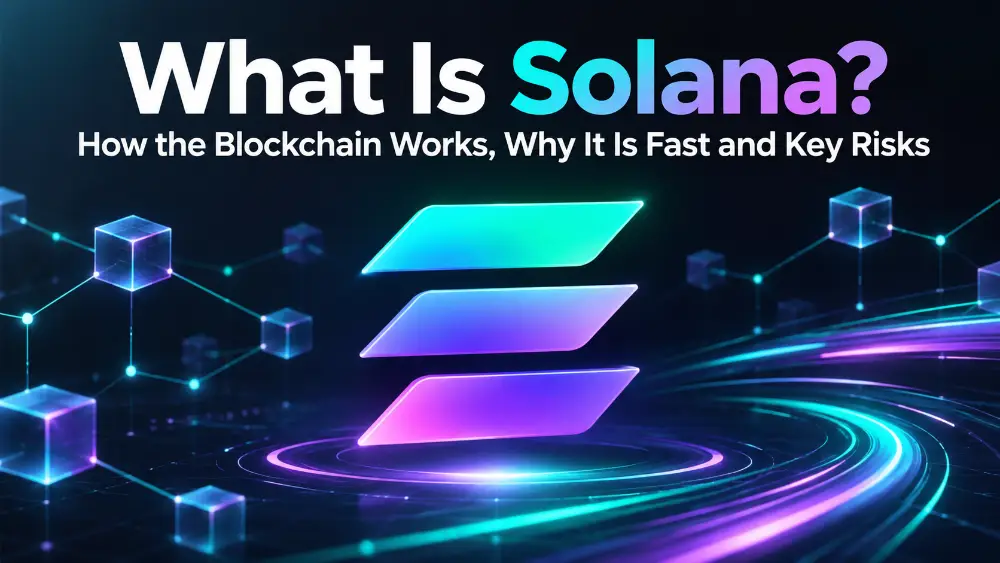
Solana is a public blockchain network designed to process digital transactions quickly and at relatively low cost. It supports cryptocurrencies, decentralised finance (DeFi), NFTs, gaming applications and other blockchain-based services. Its native cryptocurrency, SOL, is used to pay transaction fees, participate in network security through staking and interact with applications built on the network.
Solana has attracted attention as an alternative to Ethereum because of its focus on transaction speed, scalability and lower fees. However, its technology is only one part of the investment story. Network reliability, competition, token economics, decentralisation and regulatory uncertainty are equally important when evaluating Solana.
In simple words
Solana is like a digital payment and application network that operates without a central bank or single controlling authority. It uses a combination of Proof of Stake and Proof of History to coordinate transactions efficiently. SOL is the cryptocurrency that powers this ecosystem.
Also Read: What Are Altcoins? Types, Risks and How to Judge a Coin Before Buying
What Is Solana?
Solana is a Layer 1 blockchain, meaning it has its own infrastructure for processing and validating transactions rather than depending on another blockchain.
It was founded by Anatoly Yakovenko, and the Solana mainnet beta launched in March 2020. The network was developed to address challenges associated with blockchain scalability, particularly slow transaction processing and high fees during periods of heavy demand.
Unlike traditional financial networks, Solana allows users to transfer digital assets and interact with applications directly through blockchain-based smart contracts.
Its native token, SOL, plays a central role in the network’s operation and economic structure.
How Does the Solana Blockchain Work?
Solana combines two important mechanisms: Proof of Stake (PoS) and Proof of History (PoH).
Proof of Stake: Validators help secure the network by staking SOL. They participate in transaction processing and consensus, while staking creates an economic incentive to follow network rules.
Proof of History: This mechanism creates a cryptographic record that helps establish the order and passage of time between events. It allows network participants to coordinate transaction processing without relying on repeated communication to establish the sequence of every event.
Proof of History is not a replacement for consensus. It works alongside Solana’s consensus mechanism to improve coordination and efficiency.

The network also uses parallel transaction processing and other specialised components to handle multiple operations efficiently.
Why Is Solana So Fast?
Solana’s speed comes from its architecture rather than a single technology. Its design reduces coordination between validators, supports parallel transaction execution and uses specialised systems to distribute transaction data.
Three features are particularly important:
- Parallel processing: Solana’s Sealevel execution environment allows independent smart contract transactions to run simultaneously instead of processing every transaction strictly one after another.
- Efficient consensus: Its Alpenglow consensus upgrade, activated on mainnet in October 2026, introduced the Votor voting protocol, designed to bring transaction finality down to approximately 150 milliseconds.
- High-performance infrastructure: Solana uses specialised networking and validator software to distribute and process transactions across the network.
| Performance feature | Solana |
|---|---|
| Target transaction finality under Alpenglow | ~150 milliseconds |
| Target block slot time | ~200 milliseconds |
| Transaction fee | Generally very low, with variable priority fees |
These figures describe protocol performance targets and typical design characteristics, not a guarantee that every transaction will achieve the same speed. Actual performance depends on network conditions and transaction complexity.
Also Read: Bitcoin Holds Near $76,000 as Weekend Trading Slows, Zcash Upgrade Draws Altcoin Attention
What Is SOL Cryptocurrency Used For?
SOL is the native cryptocurrency of the Solana blockchain. It serves several purposes within the ecosystem.
| Use | Explanation |
|---|---|
| Transaction fees | Pays for transfers and smart contract execution |
| Staking | Allows holders to delegate SOL to validators and earn rewards |
| Network security | Supports the Proof of Stake mechanism |
| DeFi applications | Used across decentralised exchanges, lending and other financial applications |
| Digital assets | Supports the creation and trading of tokens and NFTs |
SOL is also traded on cryptocurrency exchanges. Its market price is determined by supply, demand, investor sentiment, network activity and broader cryptocurrency market conditions.
What Can You Do on Solana?
Solana supports a growing range of blockchain applications.
- Decentralised Finance: Users can trade cryptocurrencies, provide liquidity, borrow and lend digital assets without relying on conventional financial intermediaries.
- NFTs: Creators can issue and trade digital collectibles and other tokenised assets.
- Payments: The network can facilitate transfers of digital assets with relatively low transaction costs.
- Gaming: Developers can build blockchain-based games with digital ownership and in-game assets.
- Tokenisation: Businesses and developers can create tokens representing digital assets, financial interests or other forms of value.
The availability of these applications does not automatically make them safe or profitable. Individual projects carry their own risks.
Also Read: Altcoin Market Today: Ethereum, Solana and XRP Slide as TRON Shows Relative Strength
Solana vs Ethereum: What Is the Difference?
Solana
Focuses on high transaction throughput, low fees and parallel execution.
Ethereum
Focuses on decentralised applications, a broad developer ecosystem and a modular scaling approach using Layer 2 networks.
Also Read: Bitcoin Rebounds Above $78,000 as Binance Hack Puts Crypto Exchange Security Under Scrutiny
| Feature | Solana | Ethereum |
|---|---|---|
| Blockchain type | Layer 1 | Layer 1 |
| Consensus | Proof of Stake with Alpenglow | Proof of Stake |
| Transaction processing | Parallel execution | Primarily sequential execution on the base layer |
| Fees | Generally low | Can be higher during congestion |
| Scaling approach | High-performance base layer | Layer 2 rollups and base-layer upgrades |
| Native cryptocurrency | SOL | ETH |
Both networks support smart contracts, DeFi, NFTs and tokenisation. Solana prioritises high performance on its base layer, while Ethereum relies more heavily on its wider Layer 2 ecosystem to scale transaction activity.
Neither network is automatically better for every application. The choice depends on cost, security, decentralisation, developer requirements and user experience.
What Are the Major Risks of Solana?
Despite its technological advantages, Solana carries several risks that users and investors should understand.
1. Network reliability: Solana has experienced outages and performance disruptions in its earlier years. Although its infrastructure has improved, software bugs, validator failures and congestion remain potential risks.
Also Read: Bitcoin Falls Below $77,000 as Crypto Liquidations Rise and Altcoins Face Fresh Selling
2. Centralisation concerns: Running a competitive validator can require substantial computing resources, reliable internet connectivity and technical expertise. These requirements may create barriers for smaller operators.
3. Cryptocurrency volatility: SOL is a speculative digital asset. Its market price can experience sharp movements due to market sentiment, liquidity changes, regulatory developments and broader cryptocurrency cycles.
4. Smart contract vulnerabilities: Applications operating on Solana can contain coding errors, security weaknesses or vulnerabilities that lead to financial losses. A secure blockchain does not guarantee that every application built on it is secure.
5. Competition: Solana competes with Ethereum, other Layer 1 blockchains and emerging blockchain technologies. Developers and users can move between networks, making long-term adoption uncertain.
6. Regulatory uncertainty: Cryptocurrency regulations differ across countries and can change over time. Restrictions on exchanges, trading, taxation or digital asset services can affect SOL’s accessibility and demand.
Key Takeaways
- Solana is a Layer 1 blockchain designed for fast and relatively inexpensive transactions.
- SOL is the network’s native cryptocurrency, used for transaction fees and staking.
- Solana supports DeFi, NFTs, payments, gaming and tokenisation.
- Its parallel execution architecture and Alpenglow consensus upgrade contribute to its high performance.
- Solana competes with Ethereum and other blockchain networks.
- Network reliability, decentralisation, smart contract vulnerabilities, volatility and regulation remain important risks.
- Strong technology does not necessarily translate into higher SOL prices or guaranteed investment returns.
Financial Disclaimer
This article is intended for educational and informational purposes only. Cryptocurrencies such as SOL are highly volatile digital assets and carry significant risks, including the possibility of losing the entire investment. Readers should conduct independent research and assess their financial situation and risk tolerance before investing. OneTrader does not provide investment advice or guarantee returns.
Keep learning with OneTrader
Explore structured lessons and practical guides to build your market knowledge.

Need a laugh after all that money talk?
Paisa LOL: India's funniest finance page, with memes, comics, jokes and long funny stories.
