
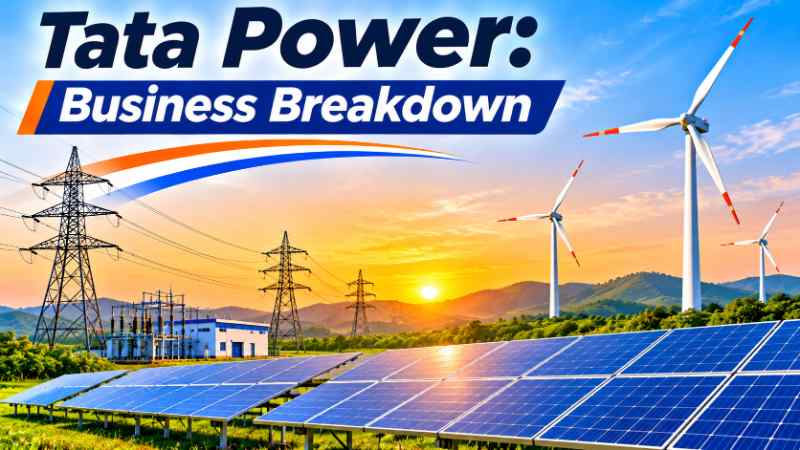
Explore Tata Power's renewable energy, solar manufacturing, storage projects, Q2 FY27 results and business growth strategy.
- Tata Power generates revenue through electricity generation and sales, transmission and distribution operations, renewable energy projects and related energy businesses.
- Renewable energy is one of Tata Power’s most important growth areas.
- Tata Power operates across several competitive energy businesses.
What Tata Power Does
Tata Power Company Limited is one of India’s integrated power companies, with operations spanning electricity generation, transmission, distribution, renewable energy, solar manufacturing, electric vehicle charging and energy storage. A Tata group company and a constituent of the Nifty Next 50, it has a business model that covers several stages of the electricity value chain.
Its generation business includes both thermal and renewable power. While conventional generation remains part of its operations, renewable energy has become an important area of expansion. The company is developing solar and wind capacity while also participating in rooftop solar installations and solar equipment manufacturing.
Transmission and distribution provide another important part of the business. These activities connect electricity generation with consumers and support the delivery of power through distribution operations.
Tata Power is also expanding into related energy businesses. Its activities include EV charging infrastructure, pumped hydro storage and integrated solar cell and module manufacturing. This combination gives the company exposure not only to electricity production but also to the infrastructure and equipment required for the wider energy transition.
The integrated structure is important because the company’s growth opportunities come from different parts of the electricity ecosystem rather than depending on power generation alone.
Customers and How Tata Power Makes Money
Tata Power generates revenue through electricity generation and sales, transmission and distribution operations, renewable energy projects and related energy businesses.
Its generation business produces electricity using thermal and renewable sources. Distribution operations provide another revenue stream by supplying electricity to consumers in the areas served by the company. These businesses have different operating requirements, making generation performance and distribution efficiency important to overall results.
Renewable energy provides an expanding business opportunity through utility-scale solar and wind projects. The company develops and commissions clean energy capacity, adding to its generation portfolio.
Solar manufacturing creates another source of business activity. Tata Power manufactures solar cells and modules, connecting equipment production with its wider renewable energy operations. Rooftop solar installations extend its presence into customer-facing solar solutions.
The company also participates in EV charging and energy storage. Pumped hydro storage projects are particularly relevant to the integration of renewable electricity because storage can help manage the timing difference between power generation and consumption.

This combination of activities makes Tata Power different from a business focused exclusively on electricity generation. Its earnings depend on the performance of multiple operating segments, including conventional power, distribution, renewables and solar manufacturing.
Growth Drivers
Renewable energy is one of Tata Power’s most important growth areas. Its installed clean and green capacity stood at 8.6 GW, including 7.2 GW of utility-scale renewable capacity. The utility-scale portfolio comprised approximately 5,825 MW of solar and 1,329 MW of wind capacity.
This development pipeline provides visibility into future renewable generation capacity. However, actual growth will depend on completing projects and bringing them into commercial operation.
Manufacturing gives the company exposure to the equipment side of renewable energy in addition to developing power generation projects. The performance of its manufacturing operations, including production efficiency and output quality, will influence this business’s contribution.
Energy storage is also becoming an important part of its portfolio. The company has signed pumped hydro storage projects with a combined capacity of 2.8 GW. These projects add another dimension to its integrated energy strategy, complementing renewable generation.
Competition and Risks
Tata Power operates across several competitive energy businesses. Its performance depends on electricity generation, distribution efficiency, renewable project execution, manufacturing operations and the development of supporting infrastructure.
One important risk is project execution. Renewable capacity under construction does not generate the same operating contribution as commissioned capacity. Delays in completing projects can affect the timing of expected growth.
Manufacturing performance also deserves attention. Solar cell and module operations require consistent production quality and efficient utilisation of installed capacity. Investors should monitor output and module yield rather than evaluating manufacturing expansion only through capacity announcements.
The difference between revenue and EBITDA growth is another consideration. Strong sales expansion does not necessarily produce an equivalent increase in operating earnings. The contribution and profitability of individual businesses will influence consolidated performance.
Storage projects bring their own execution requirements. Pumped hydro developments need to progress from signed projects towards commissioning before contributing to the operating portfolio.
Finally, Tata Power’s diverse business structure makes segment-level performance important. Strong growth in one activity may not automatically translate into similar growth across the entire company.
What Investors Should Watch
Investors evaluating Tata Power should first track renewable capacity additions and commissioning progress. The company’s construction pipeline and FY27 commissioning expectations provide important indicators of future generation growth.
Second, solar manufacturing performance deserves attention. Production volumes and module yield can help investors assess how effectively the company is using its integrated manufacturing facilities.
Third, rooftop solar installations provide an indication of progress in the customer-facing renewable energy business. Investors should monitor whether installation activity continues to contribute meaningfully to the company’s clean energy operations.
Energy storage is another area to follow. Progress on the signed pumped hydro projects will indicate how the company is developing capabilities beyond electricity generation.
Finally, distribution performance and the contribution from thermal generation remain relevant because Tata Power’s business is not limited to renewables. Its ability to manage its different operations together will shape overall financial performance.
Also Read: Brainbees Solutions: How FirstCry Is Building Growth Through an Omnichannel Parenting Platform
Conclusion
Tata Power has developed an integrated energy business spanning conventional and renewable generation, transmission, distribution, solar manufacturing, rooftop installations, EV charging and energy storage.
However, investors should distinguish between planned capacity and commissioned assets, while also monitoring manufacturing efficiency and the relationship between revenue and EBITDA growth.
For long-term investors, Tata Power offers exposure to several parts of India’s evolving electricity and clean energy ecosystem. Its ability to execute projects, expand renewable operations and maintain profitability across its diversified businesses will be central to its growth.
Also Read: Apollo Hospitals: How India’s Healthcare Giant Is Building Growth
Financial Disclaimer: This article is for educational and informational purposes only. It is not investment advice or a recommendation to buy or sell Tata Power Company Limited shares. Investors should conduct independent research before making financial decisions.








Keep learning with OneTrader
Explore structured lessons and practical guides to build your market knowledge.

Need a laugh after all that money talk?
Paisa LOL: India's funniest finance page, with memes, comics, jokes and long funny stories.
