
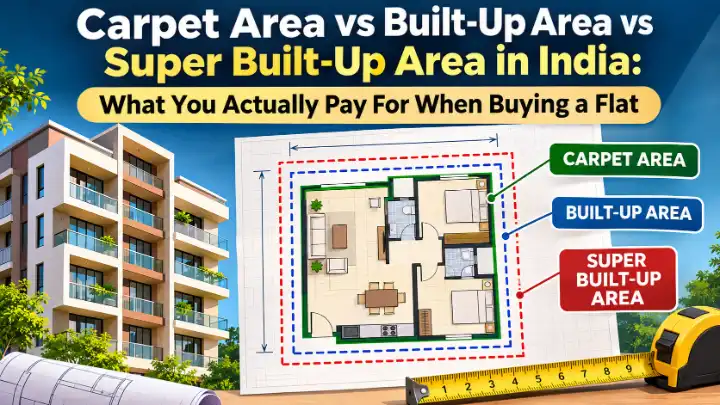
Buying a flat is one of the biggest financial decisions for an Indian family. However, many buyers focus on the advertised apartment size without understanding how much usable space they will actually receive. A flat advertised as 1,200 sq. ft. may have a carpet area of only 900 sq. ft. The difference comes from three measurements: carpet area, built-up area and super built-up area.
Understanding these terms helps buyers compare properties, calculate the actual price per square foot and avoid confusion during negotiations. RERA has made carpet-area disclosure an important part of property transactions. Before paying a booking amount or signing an agreement, buyers should know what each measurement includes and how much they are actually paying for.
Understanding Carpet Area, Built-Up Area and Super Built-Up Area
These three measurements describe different aspects of an apartment.
Carpet Area
Carpet area is the net usable floor area inside an apartment. Under Section 2(k) of the Real Estate (Regulation and Development) Act, 2016, it includes internal partition walls but excludes external walls, service shafts, exclusive balconies, verandahs and open terraces.
Also Read: Rental Yield Explained: How to Judge a Property Investment in India
It covers the usable floor space of rooms such as the living room, bedrooms, kitchen and bathrooms, along with internal partition walls.
Built-Up Area
Built-up area includes carpet area, external wall thickness and applicable attached spaces such as an exclusive balcony or verandah.
For example, an apartment with 900 sq. ft. of carpet area and another 150 sq. ft. of external walls and balcony space has a built-up area of 1,050 sq. ft.
Super Built-Up Area
Super built-up area includes the built-up area and the apartment’s allocated share of common areas within the residential project.
Also Read: Rent vs Buy in India: Which Makes More Financial Sense in 2026?
These may include shared corridors, entrance lobbies, staircases, lift lobbies and other qualifying common facilities. It is commonly called saleable area.
| Measurement | What It Includes |
|---|---|
| Carpet area | Usable floor space and internal partition walls |
| Built-up area | Carpet area, external walls and applicable attached areas |
| Super built-up area | Built-up area plus allocated common areas |
Generally, carpet area is the smallest measurement, followed by built-up area and super built-up area. Therefore, an advertised apartment size should never be treated as the actual usable living space without checking its measurement.
How RERA Makes Carpet Area Important
Before RERA, builders commonly marketed apartments using super built-up area or other measurements. This made property comparisons difficult because buyers could not easily identify the actual usable space.
The RERA Act introduced a standard legal definition of carpet area to improve transparency.
Also Read: How to Check RERA Registration Before Buying a Property in India
Under the Act, promoters must disclose apartment sizes based on carpet area when registering projects. The agreement for sale must also specify carpet area and provide applicable details of balconies and verandahs.
This gives buyers a consistent measurement for comparing apartments across different projects.
However, RERA does not require every builder to advertise the selling price exclusively per carpet-area square foot. Builders may quote an overall apartment price or use another pricing presentation, provided the required disclosures and contractual information are maintained.
For buyers, the essential point is to verify the carpet area in the registered project information and agreement before committing money.
Also Read: Home Loan Basics in India: EMI, Interest Rate, Tenure and Eligibility Explained
What Is Loading Percentage in Real Estate?
Loading percentage represents the additional area between the carpet area and super built-up area.
It reflects the allocation of common spaces and other applicable components included in the larger saleable measurement.
Loading % = (Super built-up area minus Carpet area) divided by Carpet area, times 100

Consider an apartment with a carpet area of 900 sq. ft. and a super built-up area of 1,200 sq. ft.
Also Read: First-Time Home Buyer Checklist in India: Everything to Check Before Buying a House
Additional area = 1,200 – 900 = 300 sq. ft.
Loading % = (300 divided by 900) times 100 = 33.33%.
This means the super built-up area is approximately 33.33% higher than the carpet area.
Another useful measurement is carpet-area efficiency.
Carpet Area Efficiency % = (Carpet area divided by Super built-up area) times 100
In this example, carpet-area efficiency is 75%.
A higher loading percentage indicates a larger difference between the usable apartment area and saleable area. It is not automatically evidence of unfair pricing because residential buildings require shared infrastructure. Buyers should examine whether the allocation is transparent and properly explained.
Worked Example: Calculate the Actual Price Per Square Foot
Buyers often compare apartments using the advertised price per square foot. However, builders may calculate this rate using super built-up area, making the quoted price appear lower.
Consider a flat with a super built-up area of 1,200 sq. ft., a carpet area of 900 sq. ft. and a basic apartment price of ₹90 lakh.
The advertised rate is:
₹90,00,000 divided by 1,200 = ₹7,500 per sq. ft.
The actual rate based on carpet area is:
₹90,00,000 divided by 900 = ₹10,000 per sq. ft.
| Particulars | Result |
|---|---|
| Super built-up area | 1,200 sq. ft. |
| Carpet area | 900 sq. ft. |
| Basic apartment price | ₹90 lakh |
| Advertised rate | ₹7,500 per sq. ft. |
| Carpet-area rate | ₹10,000 per sq. ft. |
Although the advertised rate is ₹7,500, the buyer effectively pays ₹10,000 for every square foot of carpet area.
This calculation makes it easier to compare properties with different loading percentages. For a realistic comparison, also consider the total acquisition cost, including applicable taxes, stamp duty, registration charges, parking and other additional expenses.
How to Verify Carpet Area in the Agreement and RERA Portal
Never depend entirely on a builder’s brochure or salesperson’s explanation. Verify the measurements against the registered project information and agreement for sale.
Check the agreement for sale
Before signing, examine these details:
- Confirm the tower, floor and apartment number.
- Check the carpet area specified for the exact apartment.
- Verify balcony and verandah areas separately.
- Compare the agreement with the apartment floor plan.
- Understand the area variation clause and adjustment of consideration.
Check whether measurements are provided in square feet or square metres. One square metre equals approximately 10.7639 square feet.
Check the state RERA website
Search for the project using its RERA registration number or registered name. Examine the registered project details, apartment configurations, carpet-area disclosures and available floor plans.
If the project offers multiple configurations, verify the exact configuration you intend to purchase.
Compare the registered information with the builder’s quotation and agreement. If the measurements differ, request a written explanation and supporting documents before proceeding.
Common Builder Practices Home Buyers Should Watch For
Certain marketing practices can make it difficult to understand the actual value of an apartment.
Advertising only super built-up area: A large advertised size may create the impression of more usable space. Always request the carpet area.
Quoting an attractive price: A low price per square foot may be calculated using super built-up area. Calculate the carpet-area rate independently.
Mixing area measurements: Brochures may mention carpet, built-up and saleable areas without explaining their differences. Request a written area statement.
Including balconies in carpet area: Exclusive balconies and verandahs are excluded from the RERA carpet-area definition. Check their separate disclosure.
Unclear loading calculations: Ask how common areas are allocated and how the super built-up area is calculated.
Different sample apartment layouts: Compare the model apartment with the actual floor plan and specifications.
Unexplained additional charges: Request a complete cost sheet covering parking, maintenance deposits, club facilities and other applicable charges.
Always rely on written measurements and contractual commitments rather than verbal assurances.
Home Buyer Checklist Before Purchasing a Flat
Before paying a booking amount or signing an agreement, check the following:
- Verify the project’s RERA registration.
- Confirm the carpet area of your apartment.
- Obtain and examine the floor plan.
- Request built-up and super built-up area details.
- Calculate the loading percentage.
- Compare properties using carpet-area prices.
- Obtain a complete cost sheet.
- Review area variation and compensation clauses.
- Get unclear legal terms checked by a qualified professional.
These checks help buyers understand the actual space and financial commitment before purchasing.
Key Takeaways
Carpet area, built-up area and super built-up area represent different measurements. Carpet area is the net usable apartment floor area under the RERA definition, including internal partition walls but excluding external walls, service shafts, exclusive balconies, verandahs and open terraces.
Built-up area includes carpet area and applicable structural and attached spaces. Super built-up area additionally includes an allocated share of common areas.
Loading percentage explains the difference between carpet area and super built-up area. A higher percentage means the saleable area is considerably larger than the actual carpet area.
RERA makes carpet-area disclosure an important part of project registration and apartment sale documentation. Buyers should verify the measurement on the state RERA portal and in the agreement for sale.
Most importantly, compare apartments using their actual carpet-area price rather than relying only on advertised square footage. Examine the complete purchase cost before making a decision.
Financial Disclaimer: This article is intended for educational and informational purposes only and should not be considered financial, investment or legal advice. Real estate transactions involve financial, regulatory and contractual risks that may vary depending on the property, project, state laws and applicable regulations. Buyers should independently verify project registration, approved plans, carpet-area disclosures, title documents and contractual terms before purchasing a property. Consult a qualified real estate lawyer and financial professional before making a significant property-related financial commitment.





Keep learning with OneTrader
Explore structured lessons and practical guides to build your market knowledge.
