
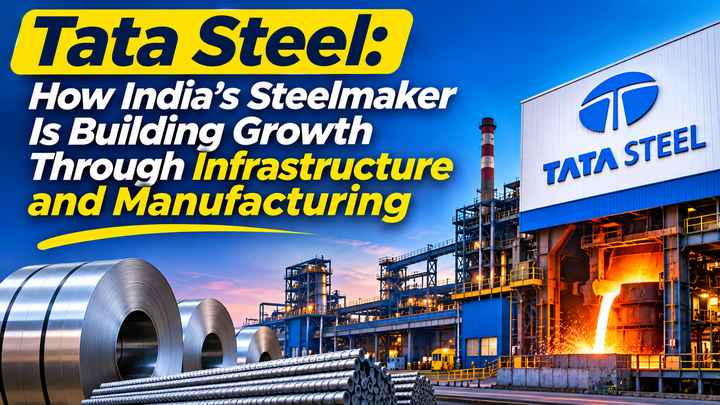
Tata Steel is one of India’s oldest and largest steel producers, with operations spanning mining, steelmaking, processing and distribution. Its business supplies materials used in buildings, bridges, vehicles, machinery, appliances and industrial equipment. Unlike companies that focus only on selling finished steel, Tata Steel operates across much of the production chain, giving it greater control over raw materials, manufacturing and product development.
The company has a strong position in India, alongside operations in the Netherlands, the UK and Southeast Asia. Its future growth depends heavily on expanding its Indian business, improving the performance of its European operations and managing the capital required for a more competitive, lower-emission steel industry.
What Tata Steel Does
Tata Steel manufactures a wide range of steel products, from basic construction materials to specialised grades used in demanding industrial applications. Its portfolio includes hot-rolled and cold-rolled steel, coated products, tubes, wires, rebars, sheets and steel used by automotive manufacturers.
Its business begins with raw materials such as iron ore and coal, which are processed through steelmaking facilities into finished products. The company has captive iron ore resources in India, an important advantage in an industry where raw material costs can significantly influence profitability. It also operates processing and finishing facilities that turn steel into products designed for specific customer requirements.
Also Read: Infosys: How India’s IT Giant Is Building Its Business Around Digital Transformation and AI
The company sells construction steel through brands such as Tata Tiscon, while its automotive and industrial businesses supply specialised steel grades to manufacturers. Downstream products, including coated steel and tinplate, serve applications where surface quality, corrosion resistance and product consistency are important.
Customers and How Tata Steel Makes Money
Tata Steel serves several major customer groups. Construction companies, infrastructure developers, builders and distributors purchase steel for residential projects, commercial buildings, roads and industrial structures. Automotive manufacturers use specialised steel in vehicle bodies, chassis and other components. Engineering companies, appliance manufacturers, packaging businesses and industrial customers require different grades and specifications.
The company’s main revenue comes from selling steel by volume and product category. Revenue and profitability depend on production levels, sales volumes, the selling price of steel and the cost of raw materials, energy, logistics and manufacturing. Higher-value products can generate better margins than standard commodity steel, making product mix an important part of the strategy.
Tata Steel also operates through distribution networks and digital platforms. Its Aashiyana platform supports retail construction customers, while DigECA serves business customers. These channels help the company connect with buyers, distributors and smaller businesses while improving access to its products.
Also Read: Suzlon Energy: How India’s Wind Power Company Is Building a Larger Renewable Energy Business
Financial Strength and Latest Results
Tata Steel reported consolidated revenue of ₹65,436 crore for Q2 FY2026-27, up 11.5% year on year. EBITDA increased 17% to ₹10,665 crore, while reported consolidated profit after tax was ₹3,700 crore. The stronger operating performance was supported by higher deliveries and improved profitability in India and the Netherlands.
India remains the central earnings engine. The India business reported revenue of ₹42,653 crore and EBITDA of ₹10,634 crore, giving it an EBITDA margin of approximately 25%. Crude steel production reached 6.18 million tonnes, while deliveries increased to 5.98 million tonnes.
The international businesses presented a mixed picture. The Netherlands generated revenue of €1,395 million and EBITDA of €72 million, helped by the restart of its Direct Sheet Plant. The UK reported revenue of £411 million but recorded an EBITDA loss of £56 million, reflecting subdued demand and elevated imports and inventory levels.

| Q2 FY2026-27 measure | Reported figure |
|---|---|
| Consolidated revenue | ₹65,436 crore |
| Consolidated EBITDA | ₹10,665 crore |
| Consolidated profit after tax | ₹3,700 crore |
| India EBITDA | ₹10,634 crore |
| India crude steel production | 6.18 million tonnes |
| Consolidated deliveries | 7.92 million tonnes |
| Net debt | ₹91,423 crore |
| Net debt to EBITDA | 2.4x |
The balance sheet needs attention because steel manufacturing requires substantial investment in plants, equipment and environmental upgrades. Net debt stood at ₹91,423 crore at the end of September 2026, with net debt to EBITDA at 2.4 times. Group liquidity was approximately ₹40,076 crore. Capital expenditure was ₹6,860 crore during the first half of the financial year.
Growth Drivers
India’s infrastructure development, housing demand, manufacturing expansion and automobile production provide long-term demand opportunities for steel. Tata Steel can benefit from these trends through its construction products, automotive grades and industrial steel portfolio.
Capacity expansion is another important driver. The company is progressing with a 4.8 million-tonne expansion at Neelachal Ispat Nigam Limited. Downstream investments include a hot-rolled pickling and galvanising line and additional tinplate capacity. These projects can increase production and strengthen the company’s presence in higher-value product categories.
The automotive business is also an important area to watch. Tata Steel reported strong demand for automotive and special products during the quarter, including growth in higher-end sales. Its ability to supply advanced steel grades for vehicles, including products required by newer vehicle technologies, could support better product realisation.
Decarbonisation is a longer-term strategic priority, particularly in Europe. The company is working on changes to its steelmaking operations, including the transition towards electric arc furnace technology in the UK. Such investments are important for the future competitiveness of European steel production, although they involve significant capital and execution requirements.
Also Read: Reliance Industries: How India’s Conglomerate Is Building Growth Beyond Oil and Petrochemicals
Competition and Risks
Tata Steel competes with JSW Steel, Jindal Steel, Steel Authority of India and other domestic producers. Internationally, it faces competition from large steelmakers in Europe and Asia. Competition is influenced by production costs, access to raw materials, technology, product quality, logistics and the ability to supply customers consistently.
Steel is a cyclical industry. Weak construction or manufacturing demand can reduce selling prices and capacity utilisation. At the same time, imported steel can increase competitive pressure in domestic markets. Changes in trade policy, tariffs and international steel prices can also affect the economics of individual operations.
Raw material and energy costs are major risks. Iron ore, coking coal, electricity and freight expenses influence production costs. Even when demand remains healthy, higher input costs can reduce margins if steel prices do not rise at the same pace.
The European operations require particular attention. The UK business continues to face operating losses, while the transition to cleaner steelmaking requires substantial investment. The group’s debt and capital expenditure also need monitoring because expansion projects must eventually generate returns and cash flows sufficient to justify the investment.
Also Read: Bharat Electronics: How India’s Defence Electronics Giant Is Building a Bigger Technology Business
What Investors Should Watch
India’s EBITDA per tonne and operating margins are important indicators of Tata Steel’s competitive position. Investors should track production, deliveries, capacity utilisation and the contribution from higher-value products. These measures help show whether the company is converting demand into profitable sales.
The progress of the Neelachal expansion and downstream projects will indicate how effectively Tata Steel is building its next phase of Indian capacity. In Europe, investors should watch whether the Netherlands can sustain its improved performance and whether the UK can reduce losses as its restructuring and technology transition progress.
Net debt, capital expenditure and cash generation are equally important. Strong operating earnings are valuable, but the company must balance expansion with financial discipline. The returns from new capacity and decarbonisation investments will influence its longer-term financial strength.
Tata Steel has a strong industrial position, established customer relationships and a significant Indian growth opportunity. Its integrated operations and product range provide advantages, but steel remains a capital-intensive and cyclical business. Sustained profitability will depend on cost competitiveness, disciplined investment, improved overseas operations and the ability to capture demand for higher-value steel.
Also Read: Kalyan Jewellers: How India’s Jewellery Retailer Is Growing Beyond Its Traditional Markets
Financial Disclaimer: This article is for educational and informational purposes only. It is not investment advice or a recommendation to buy or sell any security. Investors should review company disclosures, financial statements, risks and valuations and consult a qualified financial adviser before making investment decisions.
SEO Setup
Focus Keyword: Tata Steel Business Model
Slug: `tata-steel-business-model-growth-analysis`
Meta Description: Tata Steel business model, steel products, financial results, India expansion, global operations, competition and growth outlook.
WordPress Tags: Tata Steel, Tata Steel Business Model, Tata Steel Share, Tata Steel Share Price, Tata Steel Stock Analysis, Tata Steel Financial Results, Tata Steel Q2 Results, Tata Steel India, Tata Steel Production, Tata Steel Order Book, Indian Steel Industry, Steel Stocks India, Steel Manufacturing India, Steel Production, Iron Ore Mining, Automotive Steel, Construction Steel, Tata Tiscon, Tata Steel Europe, Neelachal Ispat Nigam, JSW Steel, Jindal Steel, SAIL, Infrastructure Stocks India, Manufacturing Stocks India, Nifty 50 Stocks, Indian Stock Market, Onetrader
Featured Image Title: Tata Steel: How India’s Steelmaker Is Building Growth Through Infrastructure and Manufacturing
Also Read: Sai Life Sciences: The Hyderabad Pharma Research Company Building a Global Drug Development Business
Image Alt Text: Tata Steel business analysis featuring a modern steel plant, molten steel production, industrial manufacturing and construction steel products.
Featured image
I’ll create the title-only 16:9 image and compress it below 50 KB.






Keep learning with OneTrader
Explore structured lessons and practical guides to build your market knowledge.

Need a laugh after all that money talk?
Paisa LOL: India's funniest finance page, with memes, comics, jokes and long funny stories.
