
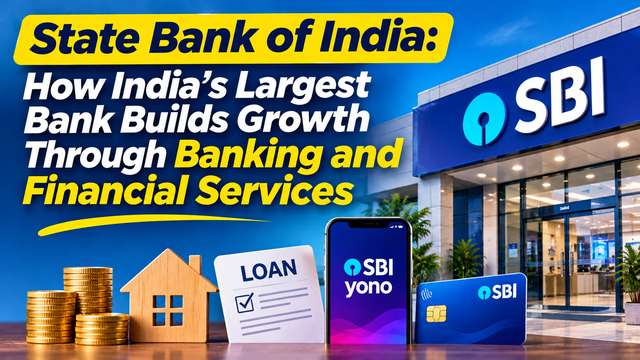
State Bank of India is more than a large public-sector lender. It is a nationwide financial institution with businesses spanning retail banking, corporate finance, agriculture, international banking, payments, insurance and asset management. Its size gives it a significant role in India’s financial system, but the strength of the business comes from something more fundamental: its ability to attract deposits across the country and deploy those funds through a broad lending and financial services network.
SBI serves customers ranging from first-time savings account holders and small farmers to large companies, government departments and international businesses. Its extensive branch network, established customer relationships and digital platform give it a reach that few Indian banks can match. The challenge is to turn that reach into profitable growth while managing credit risk, funding costs and the expense of running a very large banking operation.
What State Bank of India Does
SBI’s main business is accepting deposits and providing loans. Its personal banking operations cover savings and current accounts, fixed deposits, home loans, personal loans, education loans, vehicle finance, credit cards and other banking services. These products serve salaried customers, families, pensioners and small business owners.
Corporate banking is another major activity. SBI provides working capital finance, term loans, project finance, trade finance, cash management and other services to large companies and institutions. Its international banking operations support Indian businesses with overseas activities and foreign companies operating in India.
Also Read: Infosys: How India’s IT Giant Is Building Its Business Around Digital Transformation and AI
The bank also has a substantial rural and agricultural banking franchise. It lends to farmers, agricultural businesses, small enterprises and self-help groups. SME lending connects the bank to businesses that need working capital, equipment finance and support for expansion. Treasury operations, foreign exchange services and investment activities contribute to the bank’s broader income.
SBI’s reach is supported by its digital platform, YONO, which brings banking, payments, lending and selected financial services together through a mobile interface. Digital channels are increasingly important for customer acquisition, transactions and service delivery, while branches remain essential for cash services, relationship banking and customers who need in-person support.
Customers and How SBI Makes Money
SBI earns most of its income from the difference between the interest it receives on loans and investments and the interest it pays on deposits and borrowings. This difference is known as net interest income. A bank’s ability to maintain this spread depends on the rates it charges borrowers, the cost of deposits, the mix of loans and the pace at which lending and deposit rates change.
For example, home loans, vehicle loans and business loans generate interest income over time. Savings accounts and fixed deposits provide funding, with different interest costs depending on the type and tenure of the deposit. A strong low-cost deposit base can help the bank protect its margins, although competition for deposits can increase funding costs.
SBI also earns non-interest income from fees and commissions. These include transaction charges, payment services, guarantees, letters of credit, distribution of insurance and investment products, card-related services and other banking activities. Treasury income and foreign exchange transactions also contribute, although these can vary with market conditions.
The SBI Group extends beyond the bank itself. Its subsidiaries and associated businesses operate in life insurance, general insurance, credit cards, mutual funds, investment banking and other financial services. SBI Life Insurance, SBI General Insurance, SBI Cards and SBI Funds Management give the group access to customers beyond traditional lending. These businesses add diversification, although their performance and contribution to the parent bank’s results need to be assessed separately.
Financial Strength and Latest Results
SBI reported a net profit of ₹23,038 crore for the second quarter of FY2026-27, up 14.28% year on year. Net interest income increased 14.69% to ₹49,143 crore, while operating profit rose 7.28% to ₹34,226 crore. The bank’s domestic net interest margin improved to 3.11%, indicating that it maintained a healthy spread between lending income and funding costs during the quarter.
The balance sheet continued to expand. Gross advances stood at approximately ₹52.08 lakh crore at the end of September 2026, up 17.84% from a year earlier. Deposits reached approximately ₹62.78 lakh crore, growing 12.27%. Loan growth was particularly strong in agriculture, SME and corporate lending, while retail personal advances also recorded double-digit growth.

Also Read: Suzlon Energy: How India’s Wind Power Company Is Building a Larger Renewable Energy Business
Asset quality remained a major positive. Gross non-performing assets declined to 1.39% and net NPAs stood at 0.36%. The credit cost ratio was 0.22%, reflecting lower loan-loss provisioning pressure than a year earlier. Capital adequacy stood at 16.09%, providing a buffer to support further balance-sheet expansion.
| Q2 FY2026-27 measure | Reported figure |
|---|---|
| Net profit | ₹23,038 crore |
| Net interest income | ₹49,143 crore |
| Operating profit | ₹34,226 crore |
| Gross advances | ₹52.08 lakh crore |
| Deposits | ₹62.78 lakh crore |
| Gross NPA ratio | 1.39% |
| Net NPA ratio | 0.36% |
| Capital adequacy ratio | 16.09% |
The reported profit should be read with some care. The quarter included a substantial gain from the sale of part of SBI’s stake in SBI Funds Management. This was a non-recurring benefit, so investors should distinguish reported profit from the bank’s underlying operating performance. Net interest income, operating profit, margins and credit costs provide a better view of the earnings power of its core banking operations.
Growth Drivers
India’s expanding credit market gives SBI a broad opportunity across home loans, consumer finance, agriculture, small businesses and corporate investment. Its established presence in smaller towns and rural markets is particularly important because many customers and businesses in these areas continue to deepen their use of formal banking services.
Digital banking is another growth driver. YONO and other digital channels can reduce transaction costs, improve customer convenience and support cross-selling. Better use of customer data and technology may also help the bank identify lending opportunities, improve service and strengthen fraud prevention.
Also Read: Reliance Industries: How India’s Conglomerate Is Building Growth Beyond Oil and Petrochemicals
The bank’s corporate and infrastructure lending franchise could benefit from investment in manufacturing, transport, energy and other large projects. At the same time, its subsidiaries provide opportunities to earn fees and participate in the wider financial services market without relying entirely on interest income.
Competition and Risks
SBI competes with large private-sector banks such as HDFC Bank, ICICI Bank, Axis Bank and Kotak Mahindra Bank, as well as other public-sector lenders. Private banks often compete aggressively through digital services, customer experience and targeted lending products. SBI’s scale and reach are advantages, but maintaining service quality and operating efficiency across a large network remains important.
The biggest risk for any bank is deterioration in loan quality. Strong credit growth can support earnings, but weak underwriting or an economic slowdown can lead to higher defaults and provisions. Corporate lending, unsecured personal loans and loans to smaller businesses require close monitoring as economic conditions change.
Deposit competition is another challenge. If loans grow faster than deposits, banks may need to attract more expensive funding, which can put pressure on net interest margins. Changes in RBI policy rates, deposit repricing and competition for savings can all affect profitability.
Also Read: Bharat Electronics: How India’s Defence Electronics Giant Is Building a Bigger Technology Business
Technology and cybersecurity risks are becoming increasingly important. A large digital customer base creates opportunities, but also exposes the bank to fraud, data breaches, system outages and sophisticated cyberattacks. SBI must continue investing in technology, controls and customer protection.
What Investors Should Watch
For SBI, deposit growth and the cost of funding deserve as much attention as loan growth. Investors should monitor the CASA ratio, deposit mix and net interest margin to understand whether the bank is growing its lending business without sacrificing profitability. A sustained gap between advances and deposits would also be worth watching.
Asset quality remains equally important. Gross and net NPAs, slippages, credit costs and provision coverage can indicate whether the current growth is being achieved without taking excessive lending risk. Investors should also separate recurring banking earnings from gains arising from stake sales or other exceptional transactions.
Capital adequacy, return on assets and return on equity provide further insight into how efficiently SBI uses its balance sheet. The performance of subsidiaries matters too, but should not distract from the core bank’s ability to generate stable earnings.
Also Read: Kalyan Jewellers: How India’s Jewellery Retailer Is Growing Beyond Its Traditional Markets
State Bank of India has a powerful position in India’s banking system, supported by its deposit franchise, broad customer base and diversified financial services group. Its recent results show healthy credit growth and improving asset quality. The long-term investment case, however, depends on maintaining deposit strength, protecting margins, controlling credit risk and converting its scale into consistent returns.
Financial Disclaimer: This article is for educational and informational purposes only. It is not investment advice or a recommendation to buy or sell any security. Investors should review company disclosures, financial statements, risks and valuations and consult a qualified financial adviser before making investment decisions.
SEO Setup
Focus Keyword: State Bank of India Business Model
Slug: `state-bank-of-india-business-model-sbi-analysis`
Meta Description: State Bank of India business model, loans, deposits, financial results, asset quality, growth drivers and risks explained.
WordPress Tags: State Bank of India, SBI, SBI Business Model, SBI Share, SBI Share Price, SBI Stock Analysis, SBI Financial Results, SBI Q2 Results, SBI Bank Results, SBI Net Profit, SBI Net Interest Income, SBI NPA, SBI Asset Quality, SBI Home Loan, SBI Personal Loan, SBI Corporate Banking, SBI YONO, SBI Life Insurance, SBI Cards, SBI Mutual Fund, Indian Banking Sector, Public Sector Banks, Banking Stocks India, Indian Financial Services, Nifty 50 Stocks, Indian Stock Market, Onetrader
Also Read: Sai Life Sciences: The Hyderabad Pharma Research Company Building a Global Drug Development Business
Featured Image Title: State Bank of India: How India’s Largest Bank Builds Growth Through Banking and Financial Services
Image Alt Text: State Bank of India business analysis featuring an SBI bank branch, digital banking services, financial transactions and lending operations.
I’ll create the title-only 16:9 image and compress it below 50 KB.
Also Read: Tonbo Imaging: The Indian Defence Technology Company Building Eyes for Modern Warfare








Keep learning with OneTrader
Explore structured lessons and practical guides to build your market knowledge.

Need a laugh after all that money talk?
Paisa LOL: India's funniest finance page, with memes, comics, jokes and long funny stories.