
India’s logistics industry plays a critical role in connecting manufacturers, wholesalers, distributors, and retailers across the country. As India’s manufacturing sector expands and supply chains become increasingly organized, transportation companies with extensive networks and reliable delivery capabilities are gaining importance. Among the established players in this industry, VRL Logistics Limited has built a recognizable position through its large commercial vehicle fleet, nationwide branch network, and focus on road-based goods transportation.
Unlike technology-driven logistics aggregators that primarily connect customers with third-party transport operators, VRL Logistics follows a more asset-intensive business model. The company operates a substantial fleet of commercial vehicles, giving it greater direct control over transportation capacity, service quality, and fleet maintenance. Understanding this operating model is essential to evaluating the company’s competitive position, growth opportunities, and business risks.
How VRL Logistics Makes Money
VRL Logistics primarily earns revenue by transporting goods for businesses across India. Its core service is goods transportation, particularly less-than-truckload (LTL) or parcel transportation, where shipments belonging to multiple customers are consolidated into vehicles moving along established routes.
For example, a textile manufacturer in Surat may need to send a relatively small shipment to a distributor in Hyderabad. Instead of hiring an entire truck, the manufacturer can use a parcel transportation service that combines shipments from multiple customers. This allows transportation capacity to be shared and helps customers avoid paying for unused truck space.
Also Read: ITC Farm-to-Food Business Model: Sourcing, Brands and Cash Flow
VRL’s transportation network supports this consolidation model through its booking offices, transshipment facilities, and delivery locations. The company also provides transportation solutions for customers requiring larger shipment capacity.
Its business economics depend on shipment volumes, freight realization, vehicle utilization, route density, and operating costs. Higher shipment density on established routes can improve the amount of revenue generated per vehicle journey, while weak utilization can put pressure on profitability.
From One Truck to a Nationwide Logistics Network
VRL Logistics traces its origins to 1976, when founder Dr. Vijay Sankeshwar started the business in Gadag, Karnataka, with a single truck. The company initially expanded across Karnataka before gradually establishing operations in other Indian states. Over several decades, it developed from a regional transportation operator into one of India’s prominent organized road logistics businesses.
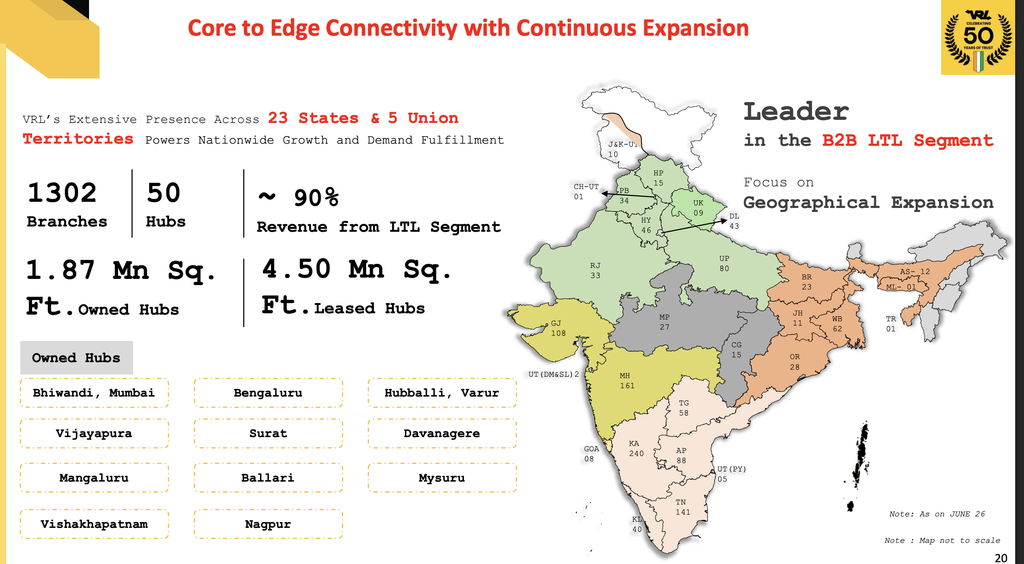
Today, VRL’s operations are supported by thousands of goods transportation vehicles, a broad network of branches, and strategically located transshipment hubs. This infrastructure allows the company to collect shipments from numerous locations, consolidate goods, and transport consignments across long distances. Its established presence is particularly relevant for small and medium-sized businesses that require dependable transportation without maintaining their own distribution fleets.
Also Read: Jio Platforms Stock Analysis: Growth, Valuation, Financials, Risks and Future Outlook
Why Its Own Fleet Is a Competitive Advantage
One of VRL Logistics’ distinguishing characteristics is its ownership of a large commercial vehicle fleet. While asset-light logistics businesses often depend heavily on hired trucks, VRL can directly manage significant portions of its transportation operations.
Fleet ownership provides greater control over vehicle availability, maintenance standards, scheduling, and operational reliability. It also creates opportunities to improve fuel procurement, standardize vehicle specifications, and reduce dependence on external transport providers.
However, owning vehicles requires substantial investment. Trucks depreciate over time and generate expenses even when transportation demand weakens. Consequently, VRL must continuously balance fleet capacity with freight volumes to maintain healthy returns on invested capital.
The Importance of Branches and Transshipment Hubs
VRL’s branch network is an important component of its business model. Customers can book consignments at different locations, while transshipment hubs help consolidate and redirect shipments toward their destinations.
Also Read: ServiceNow: From IT Ticketing to the AI Agent Operating System for Enterprises
A well-developed network becomes more efficient when shipment density increases. Greater volumes can support direct transportation between important commercial centres, reducing unnecessary handling and intermediate transfers.
Management has emphasized improving direct vehicle movement, reducing transit times, and optimizing transshipment operations. These improvements can simultaneously strengthen customer service and reduce operating costs, making network efficiency a central driver of profitability.
Industries and Customers Driving Transportation Demand
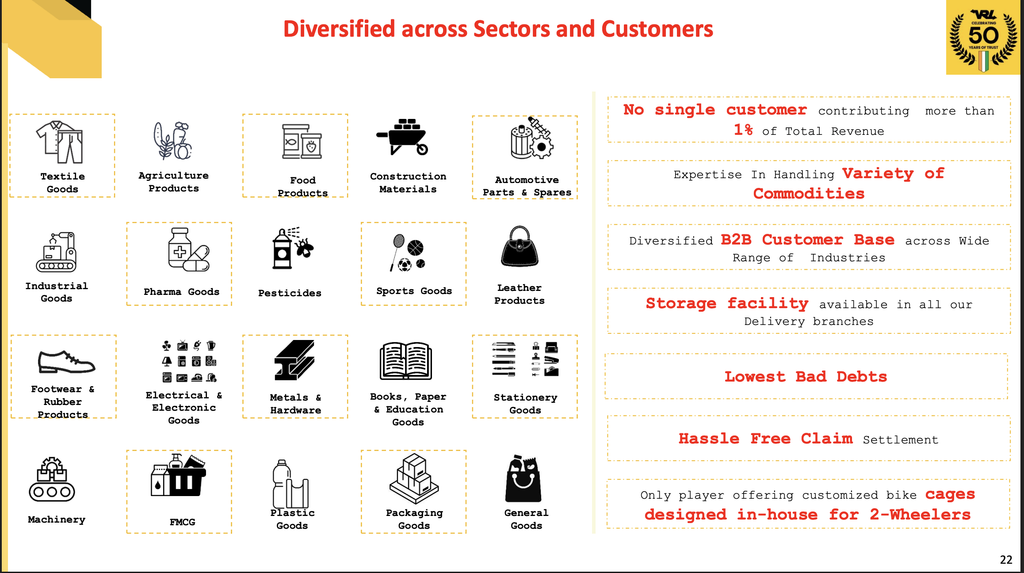
VRL serves businesses across several industries, including textiles, pharmaceuticals, engineering goods, electrical equipment, construction materials, agricultural products, and general merchandise.
These industries generate different transportation requirements. Textile traders frequently move packaged goods between manufacturing and wholesale markets, while engineering companies may require transportation of heavier industrial products. Consumer goods distributors need regular replenishment across numerous destinations.
Also Read: Eternal: From Zomato to a Multi-Business Consumer Platform Built Around Blinkit
Serving diverse industries can reduce dependence on any single customer category. Nevertheless, overall freight demand remains sensitive to manufacturing activity, wholesale trade, inventory cycles, and broader economic conditions.
Growth Opportunities in India’s Organized Logistics Industry
India’s logistics market remains fragmented, with numerous regional transport operators and small fleet owners competing across different routes. Larger organized companies have opportunities to attract customers seeking consistent service, shipment visibility, wider geographic coverage, and standardized transportation processes.
For VRL Logistics, potential growth can come from increasing freight volumes at existing branches, expanding into underpenetrated regions, improving customer retention, and winning profitable transportation contracts.
The company also offers full-truckload services alongside its core parcel business. However, expansion must be evaluated through profitability rather than shipment growth alone. Adding low-margin freight can increase revenue without necessarily improving shareholder returns.
Also Read: ESDS Software Solution: Can Strong AI and Cloud Growth Justify a Premium Valuation?
Technology, Fleet Efficiency and Operating Margins
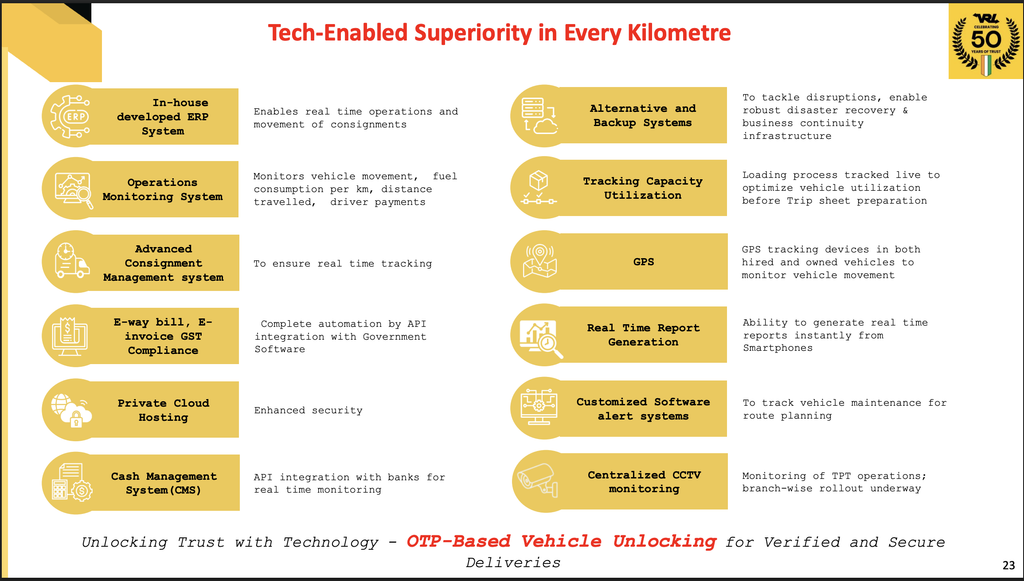
Technology can play an increasingly important role in transportation efficiency. Shipment tracking, digital booking systems, route planning, and operational data analysis can improve coordination across a geographically distributed logistics network.
For VRL, operating profitability is particularly sensitive to fuel expenditure, employee costs, vehicle maintenance, freight rates, and utilization. Better routing and fuller vehicles can improve economics, while fuel inflation or aggressive price competition can compress margins.
The company’s FY2025–26 investor commentary highlighted cost optimization, freight realization, and working-capital management as important operating priorities. These factors demonstrate why evaluating logistics companies requires more than examining revenue growth
Key Business Risks Investors Should Understand
Despite its established network, VRL operates in a competitive, cost-sensitive industry. Regional transport operators, organized logistics companies, and technology-enabled platforms compete for freight volumes and customer relationships.
Also Read: Policybazaar: From Insurance Comparison Website to India’s Digital Insurance Distribution Powerhouse
Fuel-price volatility remains a major concern because diesel is a significant transportation expense. Labour availability, driver costs, highway disruptions, vehicle replacement expenditure, and regulatory changes can also affect operations.
Another important consideration is the trade-off between freight pricing and shipment volumes. Higher transportation rates may improve margins but can cause price-sensitive customers to shift business elsewhere. Investors should therefore assess volume growth, freight realization, operating cash flow, debt, and return on capital together.
VRL Logistics represents an established, asset-intensive road transportation business whose performance depends on the efficiency of its network and the profitability of the goods it carries. Its scale and operating infrastructure provide competitive strengths, but converting those advantages into sustainable earnings requires disciplined pricing, reliable service, and consistent fleet utilization.
Financial Disclaimer: This article is for educational and informational purposes only and does not constitute investment advice or a recommendation to buy, sell, or hold any security. Onetrader.in is not a SEBI-registered investment adviser or research analyst. Investors should conduct independent research and consult a qualified financial adviser before making investment decisions.
Also Read: NSE Stock Analysis: Growth, Valuation, Financials, Risks and Future Outlook

Continue the conversation
Discuss investing, markets and personal finance with the OurPaisa Community.