
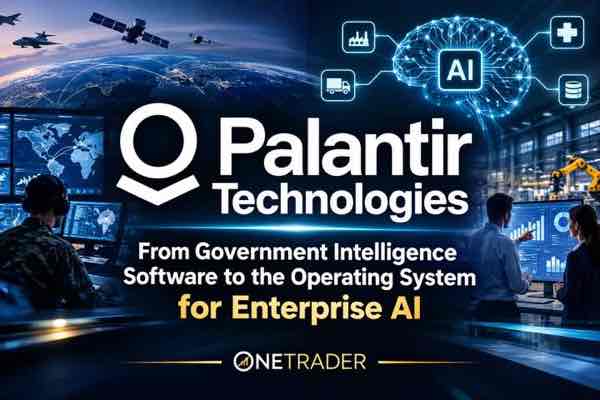
Palantir Technologies has emerged as one of the most closely watched companies in the artificial intelligence industry. But its business is fundamentally different from companies developing AI chips or large language models. Palantir focuses on connecting data, software and operational decisions so organizations can use artificial intelligence in real-world environments. What began as intelligence software for government agencies has evolved into a platform serving defense organizations, manufacturers, healthcare institutions and commercial enterprises.
How Palantir Built Its Business
Founded in 2003, Palantir initially developed software to help intelligence agencies investigate complex relationships across large datasets. Government organizations often possessed enormous amounts of information but struggled to connect it efficiently. Palantir developed systems that could integrate information from different sources while maintaining strict security permissions.
That experience eventually became relevant to commercial businesses. Manufacturers, hospitals and logistics companies face similar problems involving disconnected databases, operational systems and decision-making processes. Palantir expanded into these industries by adapting its underlying technology to enterprise operations.
Four Platforms Powering the Business
Palantir operates through four principal software platforms: Gotham, Foundry, Apollo and Artificial Intelligence Platform, commonly called AIP.
Also Read: 401(k) Vesting Explained: Employer Match and Job Changes
Gotham supports defense and intelligence operations by integrating information from multiple sources to improve situational awareness and mission planning. Foundry helps commercial organizations connect business data, develop analytical applications and coordinate operational workflows.
Apollo manages software deployment and updates across cloud infrastructure, private environments and other computing systems. AIP connects artificial intelligence models with enterprise information and operational processes, allowing organizations to develop AI-powered applications and agents.
Together, these platforms allow Palantir to serve customers with different requirements while building upon a shared technology architecture.
The Ontology: Palantir’s Competitive Advantage
One of Palantir’s most important technologies is its Ontology, which connects organizational data with the real-world objects, relationships and actions that information represents.
Also Read: Crack Spreads Explained: How US Refinery Margins Work
Consider a manufacturing company operating several factories. Traditional analytics software might display production numbers, inventory levels and equipment performance. Palantir’s Ontology can connect those datasets to specific machines, suppliers, production schedules and business decisions.
This allows employees and AI systems to understand how changes in one part of an organization affect another.
The competitive opportunity lies in turning fragmented information into an operational system rather than another reporting dashboard. Once business processes become deeply integrated with the platform, replacing it may require significant technical and organizational effort.
AIP: Turning Artificial Intelligence Into Action
Palantir’s Artificial Intelligence Platform represents a major expansion opportunity.
Also Read: Bitcoin Custody Explained: Wallets, Private Keys and Access Risks
Many companies can access powerful AI models, but connecting those models to confidential business information and operational systems remains difficult. AIP provides tools for developing AI agents, connecting approved information sources and introducing controls over how artificial intelligence interacts with business processes.
For example, an industrial company could use AI to investigate production delays, evaluate alternative suppliers and recommend operational adjustments. Human supervisors can retain oversight of sensitive decisions.
Palantir’s opportunity is therefore not necessarily to build the most powerful AI model. It is to provide the infrastructure that allows organizations to use different AI models securely within their existing operations.
Government Contracts and Commercial Expansion
Government customers remain an important part of Palantir’s business. Defense and intelligence organizations require software capable of operating in demanding environments where security, reliability and data integration are essential.
Also Read: Why Treasury Yields Affect US Stocks: Valuations, Earnings and Risk
Commercial expansion offers a different growth opportunity. Manufacturers can use Palantir to coordinate production, healthcare organizations can improve resource planning, and energy companies can connect operational information across complex infrastructure.
Palantir typically earns revenue through customer contracts granting access to its software platforms. These arrangements generally extend across multiple years, creating opportunities for recurring revenue and deeper customer relationships.
Its ability to expand existing deployments while attracting new commercial customers is central to the long-term business model.
Why the Business Could Become More Valuable
Palantir benefits from an important industry shift: companies increasingly want AI systems that deliver measurable operational improvements rather than isolated demonstrations.
Also Read: Eaton Business Model: Powering Data Centers, Industry and Aerospace
Its software combines data integration, business logic, AI applications and operational execution. This integrated approach could become attractive to organizations that want to deploy AI without developing every supporting component internally.
However, enterprise adoption requires successful implementation, customer training and ongoing proof that the software creates economic value.
Competition and Business Risks
Palantir competes with major cloud providers, enterprise software companies, data-platform specialists and organizations developing their own AI infrastructure.
Its software can involve complex deployments, and customers may resist dependence on a single technology provider. Government contracting also introduces political, budgetary and procurement risks.
Also Read: 3 US Payment Stocks to Watch: Visa, Mastercard and American Express
Data privacy, surveillance concerns and responsible AI deployment remain particularly important given the sensitive environments in which Palantir operates.
Investors must also distinguish business growth from stock valuation. A strong company can still represent a risky investment when its share price reflects exceptionally high expectations.
Palantir’s Next Business Transformation
Palantir’s evolution reflects a broader transformation in enterprise technology. Organizations increasingly need software that connects information, intelligence and execution.
The company began by helping government agencies understand complicated datasets. It expanded into commercial operations through Foundry and is now using AIP to connect artificial intelligence with operational decisions.
Also Read: How Investment Fees Affect Returns: The Costs US Investors Should Check
Its long-term opportunity depends on whether it can make this technology essential across a growing number of industries. Rather than simply providing another AI application, Palantir is attempting to become part of the infrastructure through which organizations operate.
Financial Disclaimer: This article is for educational and informational purposes only. It is not investment advice or a recommendation to buy or sell securities. Onetrader is not a SEBI-registered investment adviser or research analyst. Investors should conduct independent research before making investment decisions.

Continue the conversation
Discuss investing, markets and personal finance with the OurPaisa Community.