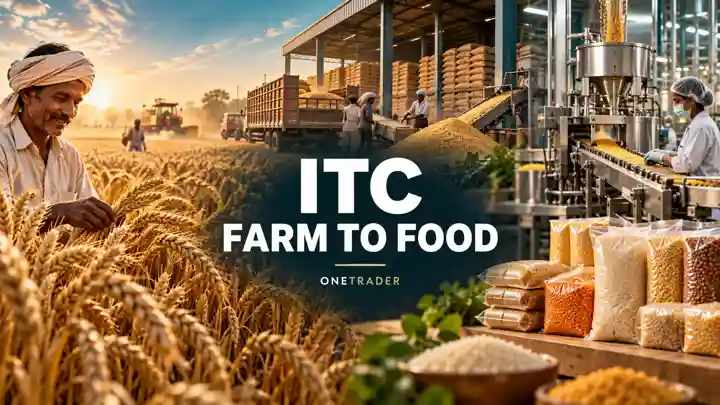
ITC’s farm-to-food business model is easier to understand by following an ingredient than by counting its brands. Agricultural procurement, packaged foods and packaging sit within the same corporate ecosystem. That combination can create advantages, but owning several businesses does not automatically produce better returns. The important issue is whether shared capabilities improve sourcing reliability, product quality and cash generation without adding unnecessary complexity.
Where the connection begins
On its agriculture business page, ITC describes a procurement network spanning more than 20 crop value-chain clusters across 22 states. It also explicitly connects agricultural sourcing with the needs of its foods business, including potatoes for Bingo! chips. These disclosures establish a practical relationship between the businesses. They do not establish how much profit any individual linkage contributes.
The commercial logic is straightforward. A manufacturer needs ingredients with consistent specifications, available when production requires them. A sourcing operation can connect farmers and suppliers with that demand. Better coordination could reduce rejected inputs, improve availability or support more predictable planning. These are potential operating benefits, rather than savings that investors should assume without evidence in financial disclosures.
Turning ingredients into branded products
ITC’s foods portfolio includes brands such as Aashirvaad, Sunfeast, Bingo! and YiPPee!, covering staples, biscuits, snacks and noodles among other categories. Procurement is only the beginning of that value chain. Formulation, manufacturing, quality control, packaging and distribution must convert raw ingredients into products that consumers repeatedly choose. A recognised brand can support demand, but it still has to deliver acceptable quality and value.
Also Read: How to Analyse Earnings Quality: Profit, Cash Flow and Debt
Consider the economics of a packaged staple. Selling more units helps only if the contribution remaining after ingredients, conversion, packaging and distribution is sufficient. Promotions may lift volumes while reducing that contribution. A premium variant may improve the mix but sell more slowly. Investors therefore need to distinguish growth supported by repeat purchases from growth bought through temporary discounts or heavier advertising.
Packaging adds another capability
ITC’s paperboards business supplies packaging and graphic boards, specialty products and paper-based alternatives to single-use plastics. This provides another relevant capability within the group. However, a useful strategic fit is not proof that every internal supply arrangement is cheaper than an outside alternative. Packaging businesses also face their own production costs, investment requirements and competitive pressures.

The analytical test is whether the relationship improves the finished product’s economics. Stronger packaging might reduce damage or help presentation; more expensive packaging might erode margins. Those effects need to be assessed against their cost. A diversified business model deserves credit for demonstrated operating improvements, rather than simply for having several connected divisions.
Working capital can absorb the benefits
A farm-to-food chain also has a timing problem. Ingredients may be purchased before products are manufactured and sold, while customers may pay later. Inventory and receivables can therefore absorb cash even when the income statement reports a profit. Seasonal procurement, changes in commodity prices and slow-moving finished goods can widen the gap between accounting earnings and cash available to shareholders.
Also Read: ServiceNow: From IT Ticketing to the AI Agent Operating System for Enterprises
This is why segment growth should be read alongside the cash-flow statement and balance sheet. Persistent inventory accumulation requires an explanation: it might reflect planned stocking, disruption or weaker sell-through. None of those conclusions follows from inventory alone. Our earnings-quality analysis explains how to connect reported profit with operating cash flow and financing needs.
What would strengthen the investment case
The strongest evidence would be sustained sales growth accompanied by improving operating profitability, disciplined working capital and sensible investment. Those outcomes would suggest that procurement capabilities and consumer brands are reinforcing each other economically. Conversely, growth accompanied by weaker cash conversion or repeatedly rising capital requirements would warrant closer scrutiny, even if the strategic story remains attractive.
ITC’s own business descriptions support the existence of sourcing and manufacturing connections. The assessment here is that their value depends on execution and measurable returns. A farm-to-food model offers several routes to competitive advantage; financial results must show which routes are actually working. That distinction helps readers evaluate a business without turning a plausible strategy into an automatic buy recommendation.
Disclaimer: This article is for educational and informational purposes only and is not investment advice or a recommendation to buy or sell securities. Business conditions and disclosures can change. Verify current information and consult a qualified adviser before making investment decisions.
Also Read: Eternal: From Zomato to a Multi-Business Consumer Platform Built Around Blinkit
More useful tools from OurPaisa
Explore calculators, everyday tools and practical resources.