
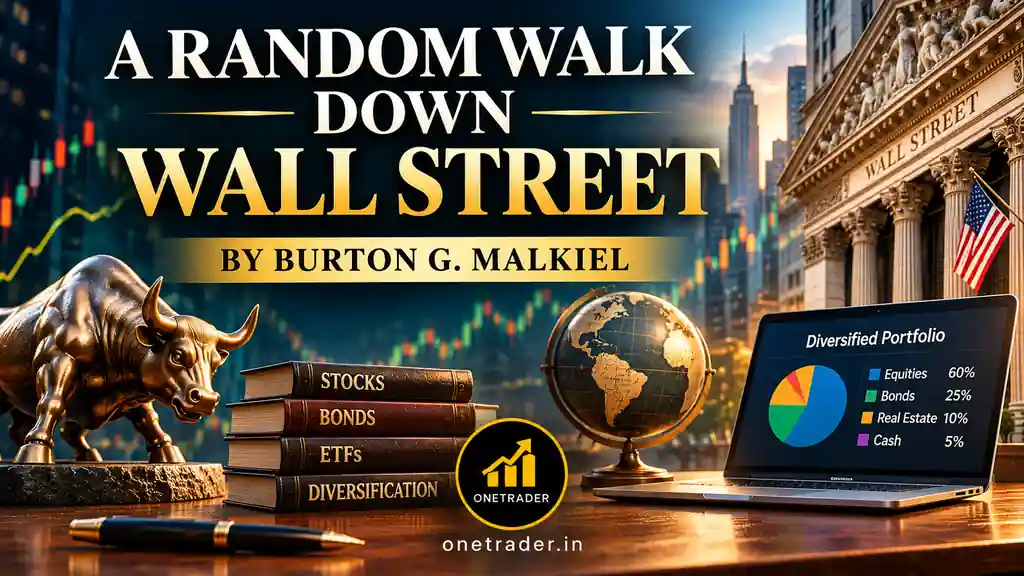
Investors spend enormous amounts of time trying to find the next winning stock, identify market turning points and discover strategies that can consistently outperform the market. Financial media regularly features forecasts, stock recommendations and confident explanations of why a particular sector is ready to rise. Yet many investors who follow these predictions struggle to achieve satisfactory long-term results.
In A Random Walk Down Wall Street, economist Burton G. Malkiel challenges the idea that investors can reliably outperform the market through frequent forecasting, stock selection or complicated investment strategies. First published in 1973, the book examines how stock prices behave, why speculative bubbles develop, how professional investors perform and why a diversified, low-cost investment approach can be effective for ordinary investors.
The book’s central argument is that short-term market movements are difficult to predict consistently. Information is quickly reflected in share prices, and investors competing to identify mispriced securities face a challenging task. Malkiel therefore argues that most individuals are better served by building diversified portfolios, investing regularly, controlling costs and staying focused on long-term financial goals.
This does not mean that companies have no underlying value or that every stock is equally attractive. It means that consistently identifying opportunities the market has overlooked is much harder than it appears.
Also Read: Common Stocks and Uncommon Profits by Philip Fisher: Complete Book Summary and Investing Lessons
In Simple Words
Malkiel’s message is that investors do not need to predict every market movement or constantly search for winning stocks to build wealth. A diversified portfolio, low investment costs, regular contributions and patience can provide a sensible foundation for long-term investing.
Why Stock Prices Are Difficult to Predict
The title A Random Walk Down Wall Street refers to the difficulty of predicting short-term stock price movements. A random walk does not mean that stock prices move without any economic reason or that businesses have no real value. It describes how difficult it can be to forecast the next price movement using information that is already widely available.
When a company announces strong earnings, investors may expect its shares to rise. But if the market was already anticipating those results, the information may have been reflected in the price before the announcement. The stock may even decline if the reported performance falls short of expectations. What matters is not simply whether the news is good or bad, but how it compares with what investors had already priced in.
Malkiel uses this idea to question the ability of investors and professional analysts to consistently identify future winners. A person may correctly understand a company’s business and still fail to predict how its share price will behave over the next few weeks or months.
Also Read: The Dhandho Investor by Mohnish Pabrai: Complete Book Summary and Investing Lessons
For long-term investors, this distinction is important. A good business can experience a prolonged period of weak share-price performance, while an expensive company can continue rising longer than expected. Rather than building a portfolio around short-term forecasts, investors need an approach that does not depend on getting every market prediction right.
The Two Ways Investors Think About Stock Prices
Malkiel discusses two broad ways of understanding stock prices: the firm-foundation theory and the castle-in-the-air theory.
The firm-foundation approach focuses on the underlying value of a business. Investors examine earnings, dividends, assets, growth prospects and other financial characteristics to estimate what a company is worth. A share price is considered attractive when it is meaningfully below a reasonable estimate of its intrinsic value.
The castle-in-the-air approach focuses more on what other investors are likely to believe and pay for a stock in the future. Under this view, investors may purchase shares because they expect other market participants to become more enthusiastic about the company. Popular themes, exciting growth stories and market excitement can influence prices even when the underlying business performance does not justify the optimism.
Also Read: The Warren Buffett Way by Robert G. Hagstrom: Complete Book Summary and Investing Lessons
Both perspectives help explain market behaviour, but Malkiel warns against allowing enthusiasm to replace sound investment judgment. A company can attract enormous attention and still disappoint investors if its valuation assumes unrealistic future growth.
This distinction becomes particularly important during periods when investors become excited about a new technology, industry or business model. The underlying opportunity may be genuine, but that does not mean every company associated with it will become a successful investment.
Market Bubbles and the Danger of Following the Crowd
One of the most engaging parts of the book examines speculative bubbles and the way investors become caught up in collective excitement. Malkiel discusses historical episodes such as the Dutch tulip mania and the South Sea Bubble, along with later periods of market speculation.
These episodes demonstrate how prices can become detached from reasonable expectations of future value. As prices rise, early investors make money and attract the attention of others. More participants enter the market, often because they fear missing an opportunity. Rising prices then appear to confirm the original optimism, encouraging even more buying.
Also Read: One Up On Wall Street by Peter Lynch: Complete Book Summary and Investing Lessons
The process can continue until expectations become impossible to sustain. When confidence changes, investors rush to sell, and prices can fall sharply.
The important lesson is that an investment can be connected to a promising business or industry and still be overpriced. A growing sector does not guarantee attractive returns for every company operating within it.
Indian investors can recognize similar behaviour when a particular theme attracts intense market attention. Renewable energy, electric vehicles, artificial intelligence and other developing industries may offer genuine long-term opportunities. However, investors should distinguish the potential of an industry from the valuation of individual companies. Buying simply because a sector is popular can expose a portfolio to significant losses when expectations change.
Can Professional Investors Consistently Beat the Market?
A major argument in A Random Walk Down Wall Street concerns the difficulty of consistently outperforming the market. Professional fund managers have access to research teams, financial data, company management and investment resources that individual investors may not possess. Yet having more information and expertise does not automatically produce better returns.

Also Read: The Intelligent Investor by Benjamin Graham: Book Summary
Malkiel examines the challenges of active management, including the difficulty of identifying mispriced securities, the effect of investment expenses and the problem of maintaining performance over time. A fund that performs exceptionally well during one period may not repeat that performance in the future.
Investment costs matter because they reduce the portion of returns that remains with investors. Management fees, transaction expenses and other charges can gradually make a meaningful difference, particularly when investments are held for many years.
Consider a hypothetical investment portfolio earning an average gross return of 10% annually. If one investment option charges 0.2% in annual expenses and another charges 1.5%, the difference in costs affects the amount compounded over time.
The following illustration shows the effect of investing ₹10 lakh for 20 years, assuming the same gross annual return and expenses deducted from the return each year.
Also Read: Poor Charlie’s Almanack Part 2 – Charlie Munger’s Mental Models for Investing
| Particulars | Lower-cost option | Higher-cost option |
|---|---|---|
| Initial investment | ₹10 lakh | ₹10 lakh |
| Gross annual return | 10% | 10% |
| Annual expenses | 0.2% | 1.5% |
| Approximate net annual return | 9.8% | 8.5% |
| Value after 20 years | ₹64.8 lakh | ₹51.1 lakh |
These are illustrative calculations, not actual fund performance or a return forecast. Taxes, tracking differences and other expenses are not included. The example shows why investment costs deserve attention even when the difference appears small.
Malkiel’s argument is not that no active investor can outperform. Rather, consistently identifying those who will outperform in advance is difficult. Investors should therefore be cautious about selecting funds solely because of recent performance.
The Case for Index Funds
One of the book’s most influential recommendations is the use of index funds. Instead of attempting to select individual winners, an index fund seeks to track a chosen market index by holding securities that represent it.
This approach reduces dependence on individual stock predictions and can provide broad diversification through a single investment. It also generally avoids the research and trading expenses associated with many actively managed strategies.
Also Read: Poor Charlie’s Almanack Book Summary (Part 1)
The underlying idea is straightforward. If consistently beating the market is difficult, investors can participate in the market’s overall performance rather than repeatedly trying to identify the next outperforming stock or fund manager.
For Indian investors, index funds and exchange-traded funds tracking indices such as the Nifty 50 and Nifty Next 50 provide examples of this approach. They allow investors to participate in a broad group of companies instead of relying entirely on a small number of individual stock selections.
However, index investing is not risk-free. An index fund can fall significantly when the broader market declines. Its returns also depend on the index it tracks, the cost of the fund and the investor’s holding period.
The choice of index matters as well. A broad large-cap index and a mid-cap index have different company compositions and risk characteristics. Investors should understand what they are buying rather than assuming that every index fund provides the same level of diversification.
Diversification and Modern Portfolio Theory
Malkiel explains why diversification is one of the most useful tools available to investors. Holding several investments can reduce the impact of poor performance in any one company or asset, provided the investments do not all behave identically.
An investor who places most of their savings in one stock faces substantial company-specific risk. A product failure, regulatory problem, management issue or loss of market share can damage the investment. A diversified portfolio spreads exposure across different companies and, where appropriate, different asset classes.
Modern Portfolio Theory provides a framework for understanding how investments with different return patterns can be combined. The aim is not simply to own a large number of securities. It is to construct a portfolio in which the investments contribute different sources of risk and return.
| Portfolio component | General role |
|---|---|
| Equity funds or stocks | Long-term growth potential |
| Debt funds or bonds | Income and portfolio stability |
| Gold | An additional asset with different market drivers |
| Cash or liquid investments | Liquidity and short-term financial needs |
The appropriate allocation depends on the investor’s goals, time horizon and ability to withstand losses. Adding more assets does not automatically create a better portfolio if all the investments are exposed to similar risks.
For example, holding several technology stocks may appear diversified because the portfolio contains multiple companies. But if those companies depend on similar market conditions, their prices may fall together. Diversification should consider business sectors, asset classes and the underlying risks rather than the number of holdings alone.
Risk and Return Must Be Considered Together
Malkiel also discusses the relationship between risk and expected return. Investments with the potential for higher returns often involve greater uncertainty, and investors should understand the possibility of losses before choosing an asset allocation.
Stocks have historically offered attractive long-term growth potential, but their prices can be volatile. Bonds and other debt investments may provide more predictable income, although they carry interest-rate, credit and inflation risks. Cash offers liquidity but may lose purchasing power over time if inflation exceeds the return earned.
The important question is not simply which investment has the highest expected return. It is whether the investor can tolerate the risks involved and remain invested through difficult periods.
A young investor with a long investment horizon may be able to accept greater equity exposure than someone who needs the money within a few years. But age alone does not determine risk capacity. Income stability, existing savings, debt obligations and future financial commitments also matter.
Malkiel’s approach encourages investors to choose an allocation they can realistically maintain. A portfolio that looks attractive during a rising market but causes panic during a correction is unlikely to serve its owner well.
Behavioural Finance and Common Investor Mistakes
Although financial theory assumes that investors make rational decisions, actual market participants are influenced by emotions and psychological biases. Malkiel discusses behavioural finance and the ways human judgment can lead to poor investment decisions.
Overconfidence can encourage investors to believe they possess an ability to predict markets that they do not actually have. Herd behaviour can lead people to purchase popular stocks simply because others are making money. Loss aversion can make investors reluctant to sell a declining investment, even when the original reasons for owning it have disappeared.
These behaviours often become stronger during volatile markets. Investors may become enthusiastic after a prolonged rally and increase exposure when valuations are already high. During a correction, the same investors may sell in panic after prices have fallen substantially.
A disciplined investment process can help reduce the influence of these reactions. Regular investing, diversification and periodic portfolio reviews provide a structure that is less dependent on daily market sentiment.
The goal is not to eliminate emotions. It is to avoid allowing temporary excitement or fear to determine long-term financial decisions.
A Practical Approach to Building a Long-Term Portfolio
Malkiel’s book moves beyond market theory and discusses how ordinary investors can organize their investments. His practical approach emphasizes matching the portfolio to the investor’s financial needs, using diversified investments and maintaining a consistent saving habit.
The first step is understanding the purpose of the money. Retirement savings, a house purchase, children’s education and short-term financial requirements have different time horizons. Money needed soon should not be exposed to the same market risk as capital intended for long-term growth.
The second step is deciding on an asset allocation. Investors should consider how much exposure they can reasonably maintain in equities, debt and other assets. This decision should reflect both financial capacity and emotional tolerance for market declines.
Regular investing can help investors avoid the pressure of choosing a perfect market entry point. Investing a fixed amount at regular intervals means that more units are purchased when prices are lower and fewer when prices are higher. This approach does not guarantee profits or prevent losses, but it can encourage consistent participation without requiring constant market predictions.
Periodic rebalancing is another useful discipline. If equities rise significantly, their share of the portfolio may become larger than originally intended. Rebalancing involves adjusting the portfolio to bring it closer to the desired allocation, while considering taxes and transaction costs.
Applying the Book’s Lessons to Indian Investors
Malkiel’s approach can be applied to Indian investors without copying the asset allocations or investment products discussed in other markets. The principles of diversification, cost control, regular investing and long-term planning remain relevant.
An investor building a long-term equity portfolio could consider diversified index funds as a core holding, while deciding whether actively managed funds or individual stocks have a meaningful role. The choice should depend on the investor’s understanding, research ability and willingness to monitor those investments.
Investors should also avoid confusing a collection of funds with genuine diversification. Several mutual funds may hold many of the same large companies. Looking at the underlying holdings can reveal whether the portfolio is concentrated in a small group of businesses despite having multiple fund names.
The role of debt investments should also be considered. Investors may use suitable debt instruments to meet shorter-term needs or reduce overall portfolio volatility, depending on their financial situation. Emergency savings and money required for near-term expenses should not depend on equity market performance.
Finally, investment costs deserve regular attention. Expense ratios, transaction costs and taxes may appear small individually, but they affect the amount of wealth that compounds over time.
The Biggest Lesson From A Random Walk Down Wall Street
The most important lesson from Burton Malkiel’s book is that successful investing does not require constant activity or an ability to forecast every market movement. Trying to identify every winning stock, time every correction and select the next top-performing fund can become an expensive and exhausting exercise.
A more dependable foundation comes from understanding risk, diversifying investments, controlling costs and maintaining a long-term plan. Index funds provide one way to participate in market returns without depending entirely on stock selection. Asset allocation helps ensure that the portfolio reflects the investor’s financial needs, while regular contributions and periodic reviews encourage consistency.
Malkiel does not suggest that markets are perfectly predictable or that investors should ignore business fundamentals. His argument is that consistently taking advantage of market mispricing is difficult, particularly after costs and taxes. Investors should recognize those limitations before building a strategy around the expectation of outperforming everyone else.
For long-term investors, the book offers a useful reminder: wealth creation is not always about finding the most complicated investment strategy. Often, the harder task is following a sensible plan through market excitement, corrections and periods when doing very little feels uncomfortable.
Financial Disclaimer
The content published on Onetrader is for educational and informational purposes only. It is not investment advice, financial advice or a buy/sell recommendation. Onetrader is not SEBI registered. Stock market investments involve risk, and past performance does not guarantee future results. Readers should conduct their own research and consider their financial goals, risk tolerance and financial situation before making any investment decision.





Keep learning with OneTrader
Explore structured lessons and practical guides to build your market knowledge.

Need a laugh after all that money talk?
Paisa LOL: India's funniest finance page, with memes, comics, jokes and long funny stories.
