
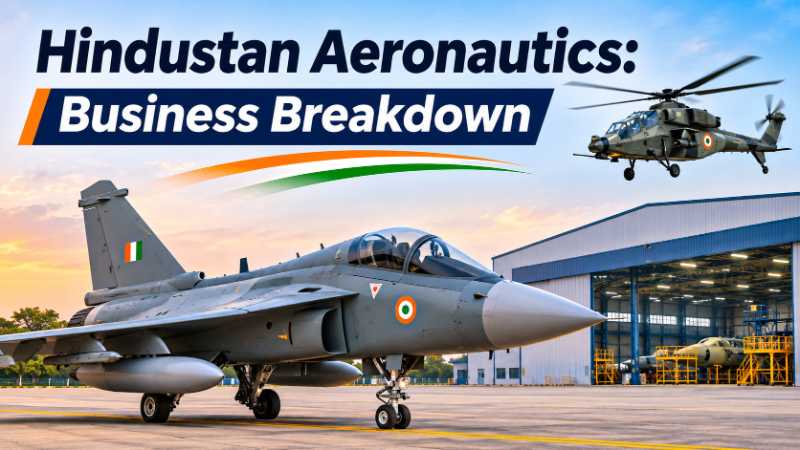
Explore HAL's business model, defence orders, financial performance, Tejas and Prachand programmes, growth drivers and risks.
- Hindustan Aeronautics Limited (HAL) is one of India’s most strategically important defence manufacturing companies, with operations spanning military aircraft, helicopters, engines and aviation support services.
- HAL’s primary customers are India’s defence establishments, particularly the Indian Air Force, Indian Army and Indian Navy.
- HAL’s growth prospects are closely linked to India’s expanding domestic defence manufacturing requirements and its ability to execute large aircraft and helicopter contracts.
What Hindustan Aeronautics Does
Hindustan Aeronautics Limited (HAL) is one of India’s most strategically important defence manufacturing companies, with operations spanning military aircraft, helicopters, engines and aviation support services. As a Navratna defence PSU and a constituent of the Nifty Next 50 index, the company plays a central role in India’s efforts to strengthen domestic aerospace capabilities and reduce dependence on foreign defence equipment.
HAL’s business covers the design, development, manufacturing, repair and upgrade of military aviation platforms. Its portfolio includes the Light Combat Aircraft (LCA) Tejas, the Light Combat Helicopter (LCH) Prachand, the Advanced Light Helicopter (ALH) Dhruv and other aircraft and aviation systems.
The company also manufactures engines and associated equipment, while providing maintenance, repair and overhaul services for aircraft already operating with defence customers. This makes HAL more than an aircraft manufacturer. Its involvement can continue throughout a platform’s operational life through servicing, component replacement, repairs and upgrades.
Military aerospace manufacturing requires specialised engineering, technical expertise, manufacturing infrastructure and long-term relationships with defence organisations. HAL’s established capabilities give it an important position in this industry, particularly as India increasingly prioritises indigenous defence production.
Customers and How Hindustan Aeronautics Makes Money
HAL’s primary customers are India’s defence establishments, particularly the Indian Air Force, Indian Army and Indian Navy. Its business is closely connected to their requirements for fighter aircraft, helicopters, engines and aviation support.
The company generates revenue through manufacturing and supplying military aircraft and helicopters under government procurement contracts. These contracts generally involve multiple years of production and deliveries, providing visibility into future manufacturing activity.
Fighter aircraft manufacturing is a major part of this business. The Tejas programme is an important example, with HAL responsible for manufacturing aircraft under contracts awarded by the government. Similarly, helicopter programmes such as Prachand and Dhruv contribute to its manufacturing business.
HAL also earns revenue from maintenance, repair and overhaul activities. Military aircraft require regular inspections, servicing, repairs and technical support throughout their operational lives. Since HAL manufactures and supports several platforms used by Indian defence forces, it has an established role in maintaining their operational readiness.
This service business is important because revenue opportunities do not end when an aircraft is delivered. Existing fleets continue to require maintenance and replacement components, creating demand alongside new manufacturing contracts.
The company’s business model therefore combines large aircraft and helicopter programmes with recurring support requirements. However, its dependence on government procurement also means that contract schedules, customer requirements and manufacturing execution directly influence financial performance.
Growth Drivers
HAL’s growth prospects are closely linked to India’s expanding domestic defence manufacturing requirements and its ability to execute large aircraft and helicopter contracts.

The Tejas Mk1A programme is one of the company’s most important growth drivers. HAL received an order for 83 aircraft in 2021, valued at approximately Rs 48,000 crore. A second contract for 97 Tejas Mk1A aircraft was signed on September 25, 2025, for more than Rs 62,000 crore. Deliveries under this second contract are scheduled from September 2027 to September 2033.
The programme provides a substantial manufacturing pipeline and supports India’s objective of developing domestic fighter aircraft capabilities. HAL completed the original 40-aircraft Tejas Mk1 order in September 2026, marking an important milestone in its indigenous aircraft manufacturing programme.
The Prachand Light Combat Helicopter programme represents another major opportunity. HAL secured an order for 156 helicopters worth Rs 62,700 crore, with deliveries scheduled to begin in 2028. This programme strengthens its position in military helicopter manufacturing and adds another significant source of future production activity.
Other contracts include an order for 34 Dhruv helicopters and 12 Su-30MKI aircraft under a production line restart programme. Together, these programmes provide business opportunities beyond fighter aircraft manufacturing.
Expanding production capacity will be essential to meeting these commitments. HAL operationalised its third Tejas production line and second HTT-40 production line at Nashik during FY26. These additions support the company’s efforts to increase manufacturing capacity and manage multiple programmes.
The broader opportunity comes from India’s emphasis on indigenous defence manufacturing. As domestic aerospace capabilities become increasingly important to defence procurement, HAL is positioned to participate in the development and production of critical military platforms.
Competition and Risks
Despite its established position, HAL operates in a technically demanding industry where manufacturing quality, delivery reliability and engineering capabilities are critical.
International aerospace manufacturers remain important competitors and suppliers in the global defence market. At the same time, India’s private defence companies are expanding their participation in aerospace manufacturing and related technologies.
HAL benefits from its experience, established infrastructure and involvement in major government programmes. However, maintaining its competitive position requires continuous investment in technology, manufacturing processes and engineering capabilities.
Execution risk remains one of its biggest challenges. Large defence contracts require coordination between suppliers, manufacturing facilities, testing teams and defence customers. Delays in critical components can affect production schedules even when customer orders are secured.
The Tejas Mk1A programme has experienced delays because of GE F404 engine supply constraints. This highlights the importance of supply-chain reliability and the risks associated with dependence on external suppliers for critical components.
HAL’s dependence on government procurement also creates exposure to changes in defence priorities, contract schedules and budgetary decisions. A large order book provides visibility, but timely execution remains essential to converting contracts into financial performance.
What Investors Should Watch
Investors tracking HAL should focus on a few important business indicators rather than relying only on order announcements.
The first is Tejas Mk1A execution. Deliveries under the 97-aircraft contract are scheduled to begin in September 2027. The progress of manufacturing, engine availability and adherence to delivery schedules will be important in determining how quickly HAL converts this programme into revenue.
The second is the Prachand helicopter programme. Deliveries of the 156 helicopters are scheduled to begin in 2028, making production readiness and execution progress important indicators of future business growth.
Investors should also monitor the company’s order book conversion. HAL has substantial contractual visibility, but actual revenue growth depends on completing production and delivering aircraft and helicopters according to agreed schedules.
Operating margins deserve continued attention as well. Increasing manufacturing activity should be accompanied by effective cost management and production efficiency. The company’s ability to protect profitability while scaling operations will be important for long-term financial performance.
Also Read: Brainbees Solutions: How FirstCry Is Building Growth Through an Omnichannel Parenting Platform
Finally, HAL’s FY27 revenue growth guidance of 10% to 12% provides a benchmark against which investors can evaluate subsequent quarterly results.
Conclusion
Hindustan Aeronautics occupies an important position in India’s defence aerospace industry, with capabilities across fighter aircraft, helicopters, engines and aviation support services. Its established manufacturing infrastructure and large order book provide a foundation for continued business growth.
The Tejas Mk1A and Prachand programmes are central to its future manufacturing pipeline, while Dhruv and Su-30MKI orders provide additional opportunities. Expanded production facilities also support the company’s ability to execute multiple programmes.
However, the long-term opportunity depends on timely deliveries, reliable component supplies, manufacturing efficiency and sustainable profitability. For investors, HAL offers exposure to India’s indigenous defence aerospace ambitions, but execution will ultimately determine how effectively the company converts its large order pipeline into financial growth.
Also Read: Apollo Hospitals: How India’s Healthcare Giant Is Building Growth
Financial Disclaimer: This article is for educational and informational purposes only. It is not investment advice or a recommendation to buy or sell Hindustan Aeronautics shares. Investors should conduct independent research before making financial decisions.








Keep learning with OneTrader
Explore structured lessons and practical guides to build your market knowledge.

Need a laugh after all that money talk?
Paisa LOL: India's funniest finance page, with memes, comics, jokes and long funny stories.
