
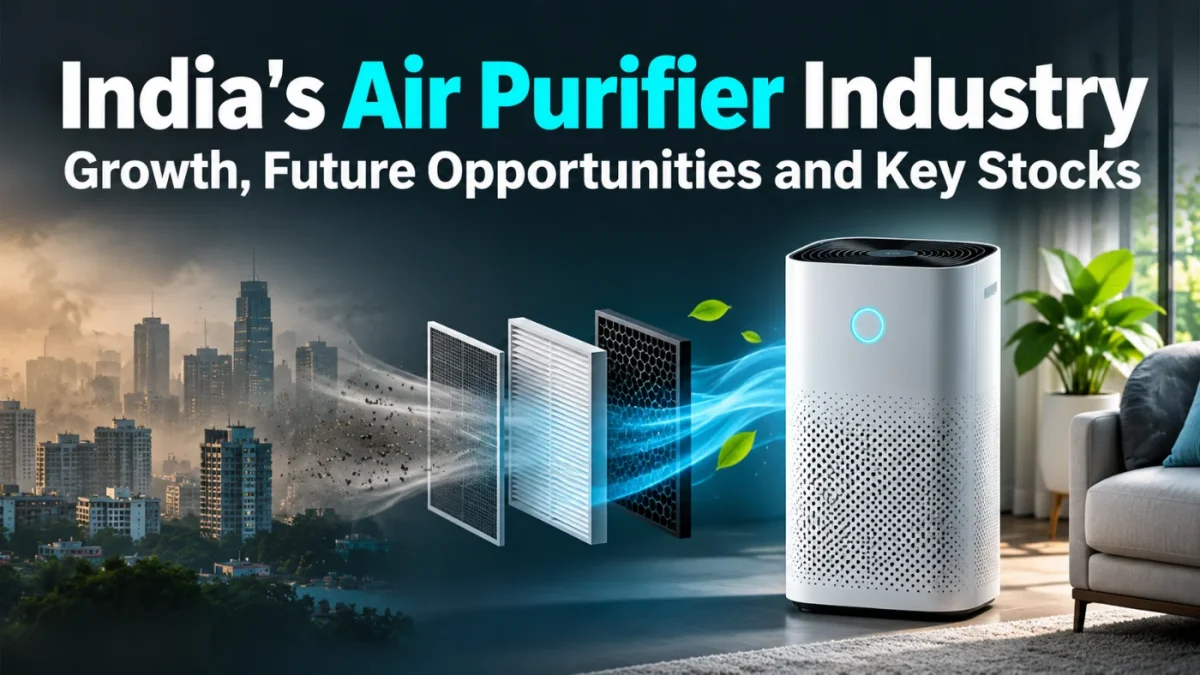
India’s air purifier industry is emerging as an interesting opportunity within the consumer durables and indoor air quality market. Rising pollution, increasing health awareness and growing household purchasing power are encouraging consumers to invest in cleaner indoor environments.
The opportunity extends beyond companies selling air purifiers. Consumer appliance manufacturers, HVAC companies, filtration equipment suppliers and component manufacturers could also benefit as adoption expands across homes, offices, hospitals and industrial facilities.
In simple words
India’s air purifier market is growing as households and businesses become more concerned about indoor air quality. Investors can track companies involved in air purifiers, HVAC systems, filtration technology and replacement filters to understand this opportunity.
Also Read: AI Chip Stocks Fall: Why Nvidia, AMD and Broadcom Face a Tougher Market Despite Long-Term Growth
India’s Air Purifier Market Size and Growth
India’s air purifier market remains relatively small compared with established household appliance categories. However, low penetration and rising awareness provide room for expansion.
One industry estimate places the market at ₹320 crore in FY25 and projects it to reach ₹1,000 crore by FY30.
| Market indicator | Estimate |
|---|---|
| Market size FY25 | ₹320 crore |
| Projected market FY30 | ₹1,000 crore |
| Estimated CAGR | 26% |
| Units sold FY25 | 3 lakh |
| Projected units FY30 | 7.36 lakh |
The projected growth reflects opportunities in both new device sales and recurring replacement-filter purchases. Actual growth will depend on consumer adoption, affordability and demand beyond the winter pollution season.
Why Is Demand for Air Purifiers Rising?
Three factors are supporting the industry’s growth.
Also Read: India’s Water and Wastewater Treatment Industry: Growth, Future Opportunities and Key Stocks
1. Rising air pollution: Vehicle emissions, construction dust, industrial activity and seasonal pollution contribute to poor air quality across Indian cities. Delhi-NCR remains a major market, while demand is expanding into other metropolitan areas.
2. Health awareness: Consumers are becoming more conscious of indoor dust, PM2.5 particles, allergens and respiratory health. Air purifiers are increasingly being considered alongside water purifiers and other household appliances.
3. Rising disposable income: Better purchasing power, online availability and products across different price ranges are making air purifiers accessible to more households.
Demand is also expanding beyond residential customers. Hotels, offices, hospitals and educational institutions are increasingly considering indoor air quality solutions. The Economic Times
Also Read: India’s Cold Chain and Refrigeration Industry: Growth, Future Opportunities and Key Stocks
How the Air Purifier Industry Works
The industry has three major segments.
- Consumer segment: Portable air purifiers for homes, apartments and individual rooms.
- Commercial segment: Air purification and ventilation systems for offices, hospitals, hotels and shopping centres.
- Industrial segment: Dust collection, cleanroom filtration and specialised air management systems for factories and manufacturing facilities.
Most residential purifiers combine a fan with multiple filtration stages. A pre-filter captures larger particles, a HEPA filter captures fine airborne particles, and activated carbon helps reduce odours and certain gases.
An important feature of this business is recurring revenue. Replacement filters require periodic purchases depending on usage and pollution exposure. Manufacturers with strong after-sales networks can generate revenue beyond the original appliance sale.

Commercial and industrial installations also create opportunities for maintenance contracts and integrated HVAC solutions.
Also Read: AI Agents: The Future of How We Use Computers and the Internet
Key Listed Companies and Who Could Benefit
India has limited pure-play listed air purifier companies. The opportunity is spread across consumer appliances, HVAC systems and component manufacturing.
| Listed company | Business exposure | Potential benefit |
|---|---|---|
| Eureka Forbes | Air and water purifiers | Direct consumer exposure |
| Blue Star | Air purifiers and HVAC | Direct and commercial |
| Voltas | Air conditioning and HVAC | Indirect |
| Havells India | Consumer electricals | Adjacent |
| Amber Enterprises | AC components and manufacturing | Indirect |
Eureka Forbes: Its Aquaguard brand and growing air purifier portfolio provide direct exposure to household purification demand. Its established distribution and service network are additional advantages.
Blue Star: Offers air purifiers alongside residential and commercial HVAC products. Its institutional and project businesses provide exposure beyond household appliances.
Voltas: Could benefit from increasing investments in commercial cooling and indoor air management.
Also Read: Why India’s Middle Class Is the Next Big Growth Engine
Havells India: Offers broader exposure through consumer appliances and electrical products, rather than being a direct air purifier investment.
Amber Enterprises: Provides manufacturing and component exposure through the air conditioning supply chain. Its benefit from air purifier growth would be indirect.
The distinction is important: Eureka Forbes and Blue Star offer more direct exposure, while the remaining companies have broader businesses that may benefit indirectly.
Competition and Imports
The Indian market includes domestic and international brands such as Philips, Xiaomi, Honeywell, Dyson, Panasonic and Eureka Forbes.
Also Read: Robotics & Industrial Automation in India: The Next Big Manufacturing Opportunity
Competition is based on pricing, filtration performance, room coverage, product design and after-sales service.
Imported products and components remain important, particularly for specialised filter materials, sensors, motors and electronic components.
This creates opportunities for domestic manufacturers to develop local sourcing and production capabilities. However, import dependence also exposes companies to currency movements, logistics costs and supply-chain disruptions.
Companies that combine competitive pricing, reliable filtration and affordable replacement filters could develop stronger market positions.
Also Read: Data Centre Infrastructure in India: Growth Opportunities
Government and Policy Angle
Government initiatives to improve air quality indirectly support awareness of indoor pollution.
The National Clean Air Programme targets pollution reduction across identified Indian cities through monitoring and city-level action plans. Press Information Bureau
Product standards are also becoming important. India’s BIS standard IS 17531:2021 covers portable electric indoor air purifiers. A 2025 Quality Control Order introduced requirements for conformity with this standard and use of the Standard Mark. BIS
These measures can encourage better product quality and consumer confidence while creating incentives for manufacturers to strengthen compliance and manufacturing capabilities.
Also Read: Defence & Aerospace Manufacturing: India’s Next Major Industrial Growth Story
Major Risks Facing the Industry
- Seasonal demand: Sales can increase sharply during winter pollution episodes and weaken during cleaner months.
- Price competition: Aggressive discounting can reduce manufacturers’ margins.
- Replacement filter costs: Expensive or unavailable filters can discourage repeat purchases.
- Import dependence: Imported components expose manufacturers to currency and supply-chain risks.
- Product quality: Poor filtration performance and exaggerated claims can damage consumer trust.
- Low penetration: Adoption remains limited, and consumers may continue viewing air purifiers as optional appliances.
What Should Investors Watch?
Investors tracking this industry should focus on five important indicators.
| Indicator | What to monitor |
|---|---|
| Market growth | Annual sales and household adoption |
| Recurring revenue | Replacement-filter sales |
| Manufacturing | Local sourcing and production |
| Commercial demand | Hospital, office and industrial orders |
| Profitability | Revenue growth, margins and cash flow |
For individual stocks, investors should also examine how much revenue comes from purification-related products. Growth in the overall industry does not automatically translate into significant earnings growth for diversified companies.
Valuation is equally important. A company with limited direct exposure should not receive a premium simply because the air purifier industry is expanding.
Long-Term Outlook: An Emerging Consumer Durables Opportunity
India’s air purifier industry has an attractive long-term growth opportunity, supported by pollution concerns, urbanisation and rising health awareness.
Also Read: Semiconductor & Electronics Manufacturing: India’s Next Big Industrial Opportunity
The market could gradually move beyond seasonal household purchases towards broader adoption across homes, offices, hospitals and commercial buildings.
Recurring filter sales and maintenance services could improve business economics, while domestic manufacturing may create opportunities for component suppliers and technology providers.
Among listed companies, Eureka Forbes and Blue Star offer relatively direct exposure. Voltas, Havells and Amber Enterprises provide broader adjacent opportunities through their existing businesses.
The investment takeaway: India’s air purifier industry is an emerging opportunity within the consumer durables and indoor air quality ecosystem. Investors should focus on companies that can convert rising demand into sustainable revenue, recurring sales and stronger profitability. The strongest long-term businesses will likely combine trusted brands, reliable products, competitive manufacturing and effective after-sales service.
Also Read: India’s Power & Renewable Energy Sector: Growth, Demand, Future Scope and Key Stocks
Financial Disclaimer
This article is intended for educational and informational purposes only and does not constitute investment advice or a recommendation to buy or sell any security. The companies discussed have different levels of exposure to the air purifier industry, and their financial performance depends on several business factors. Investors should independently evaluate financial statements, valuations, business risks and investment objectives before making investment decisions. Past performance does not guarantee future returns.






Keep learning with OneTrader
Explore structured lessons and practical guides to build your market knowledge.

Need a laugh after all that money talk?
Paisa LOL: India's funniest finance page, with memes, comics, jokes and long funny stories.
