
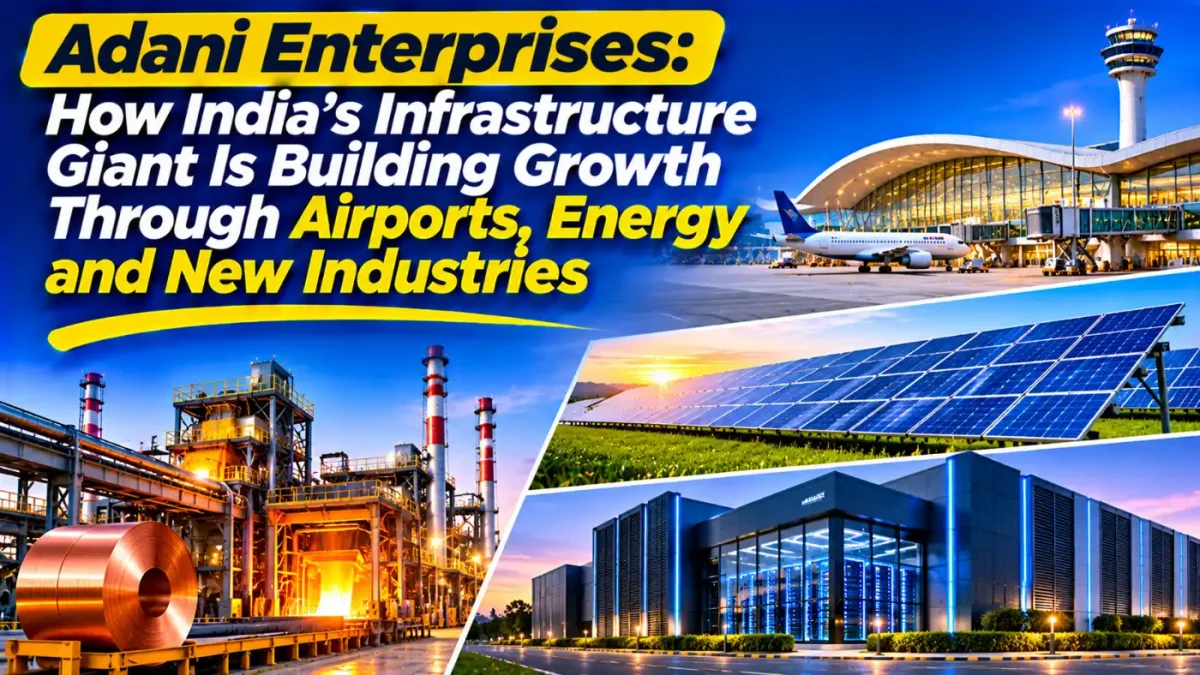
Adani Enterprises is the flagship incubating company of the Adani Group.
- Adani Enterprises operates as a platform for developing businesses in infrastructure and emerging industries.
- Adani Enterprises serves a diverse customer base.
- India’s infrastructure investment is a major opportunity.
Adani Enterprises is the flagship incubating company of the Adani Group. Unlike a conventional business focused on one industry, it develops large infrastructure and industrial businesses, invests in their expansion and, in some cases, separates mature operations into independently listed companies.
Its portfolio spans airports, new energy, copper, roads, data centres, mining services and integrated resource management. This structure gives the company exposure to several long-term investment themes in India, but it also makes financial analysis more complex. Investors need to assess the performance, capital requirements and risks of each major business rather than relying only on consolidated revenue growth.
What Adani Enterprises Does
Adani Enterprises operates as a platform for developing businesses in infrastructure and emerging industries.
Airports: Through Adani Airport Holdings, it operates airports including Mumbai, Ahmedabad, Lucknow, Jaipur, Guwahati, Thiruvananthapuram and Mangaluru. Its activities include passenger services, cargo handling, retail, parking, food and beverage, and airport-related commercial development. The Navi Mumbai International Airport adds a major expansion opportunity.
Also Read: Apollo Hospitals: How India’s Healthcare Giant Is Building Growth
New energy: Through the Adani New Industries ecosystem, the company is developing manufacturing and supply-chain capabilities in solar modules, solar cells, wind turbines and related equipment. It is also investing in green hydrogen and associated technologies.
Copper and industrial materials: Its copper business is developing domestic smelting and refining capacity, supporting demand from power networks, renewable energy, electric vehicles and industrial applications.
Roads and infrastructure: The company develops and operates road projects, including assets structured through concession arrangements. It also provides mining services and operates in integrated resource management, which includes sourcing and supplying commodities to industrial customers.
Data centres: Through AdaniConnex, it is developing data-centre infrastructure for cloud providers, technology companies and other large customers. This business is positioned to benefit from rising demand for data storage, computing and digital infrastructure.
Also Read: Trent: How Westside and Zudio Are Driving Growth

Adani Enterprises has historically developed businesses that later became separate listed group companies, including Adani Ports, Adani Energy Solutions and Adani Green Energy. This business-incubation model is central to understanding its role within the group.
Customers and How Adani Enterprises Makes Money
Adani Enterprises serves a diverse customer base. Airport users include airlines, passengers, cargo operators and retailers. New-energy businesses supply solar modules and wind equipment to renewable energy developers and other industrial buyers. The copper business serves manufacturers and customers requiring refined copper for electrical and industrial applications.
Its data-centre customers include hyperscale cloud operators and businesses requiring large-scale digital infrastructure. Roads and mining services generate revenue through project agreements, operating contracts and services provided to government agencies and commercial customers. Integrated resource management earns income through commodity sourcing, handling and supply arrangements.
Revenue therefore comes from several different models. Airports generate aeronautical income from airlines and non-aeronautical income from passengers, retail, parking and commercial activities. Manufacturing businesses earn revenue from product sales. Data centres generate income from contracted capacity and infrastructure services, while roads and mining services earn project and operating revenue.
This diversity can reduce dependence on a single industry, but the businesses have different margins, investment cycles and cash-flow profiles. A growing business may require substantial capital for years before reaching stable profitability.
Growth Drivers
India’s infrastructure investment is a major opportunity. Airport expansion, road development, logistics infrastructure and urban growth can create demand for the company’s operating businesses. Rising passenger traffic and commercial activity can support airport revenue beyond passenger charges through retail, parking, cargo and other services.
The energy transition provides another growth avenue. Solar manufacturing, wind equipment, green hydrogen and copper are connected to the expansion of renewable energy, electricity networks and electric mobility. The ramp-up of its copper operations demonstrates how an incubated business can begin contributing meaningfully as capacity and sales increase.
Data centres are a further opportunity. Cloud computing, artificial intelligence and digital services require reliable facilities with substantial power and connectivity. New customer contracts and additional capacity can support long-term revenue, although execution and utilisation will determine returns.
The company’s business-incubation model also offers potential value creation. Developing an infrastructure business, expanding its operations and eventually separating it when mature can make its value more visible to investors. The success of this approach depends on disciplined investment, viable business economics and transparent capital allocation.
Competition and Risks
Adani Enterprises faces different competitors in each business. Airports compete with other airport operators and infrastructure developers. Solar and wind manufacturing businesses face domestic and international manufacturers, including established equipment suppliers. Copper operations compete with domestic and global producers, while data centres compete with specialist operators and international technology infrastructure companies.
Capital intensity is a central risk. Airports, roads, copper plants, renewable manufacturing and data centres require large upfront investments. Delays, cost overruns or slower-than-expected customer demand can affect returns and increase financing needs.
Commodity prices and global supply chains can also influence profitability. The copper business is exposed to input availability, treatment and refining charges, metal prices and operating efficiency. New-energy manufacturing faces technology changes and competition that can put pressure on product prices.
The group’s complex structure requires careful assessment of debt, cash flows and financial commitments across subsidiaries and joint ventures. Investors should also consider regulatory approvals, environmental requirements, governance standards, related-party transactions and the possibility that delays in one major project could affect the wider group.
What Investors Should Watch
Segment-level EBITDA and cash generation are more useful than consolidated revenue alone. Investors should examine whether airports, copper, new energy, roads and data centres are generating operating profits that justify their capital requirements.
Debt, interest costs and capital expenditure deserve close attention. New projects can increase future earnings, but the company must maintain funding flexibility and ensure that investment returns exceed the cost of capital.
The progress of the Navi Mumbai airport, copper capacity ramp-up, solar manufacturing expansion and data-centre contracts will provide important evidence of execution. Investors should distinguish commissioned capacity and contracted orders from projects that are still under development.
The company’s incubation and demerger strategy is another key factor. Any future separation of businesses should be evaluated on the value retained by Adani Enterprises, the capital released, the liabilities transferred and the interests of shareholders.
Financial Disclaimer: This article is for educational and informational purposes only. It is not investment advice or a recommendation to buy or sell any security. Investors should review company disclosures, financial statements, segment performance, debt, risks and valuations and consult a qualified financial adviser before making investment decisions.






Keep learning with OneTrader
Explore structured lessons and practical guides to build your market knowledge.

Need a laugh after all that money talk?
Paisa LOL: India's funniest finance page, with memes, comics, jokes and long funny stories.
