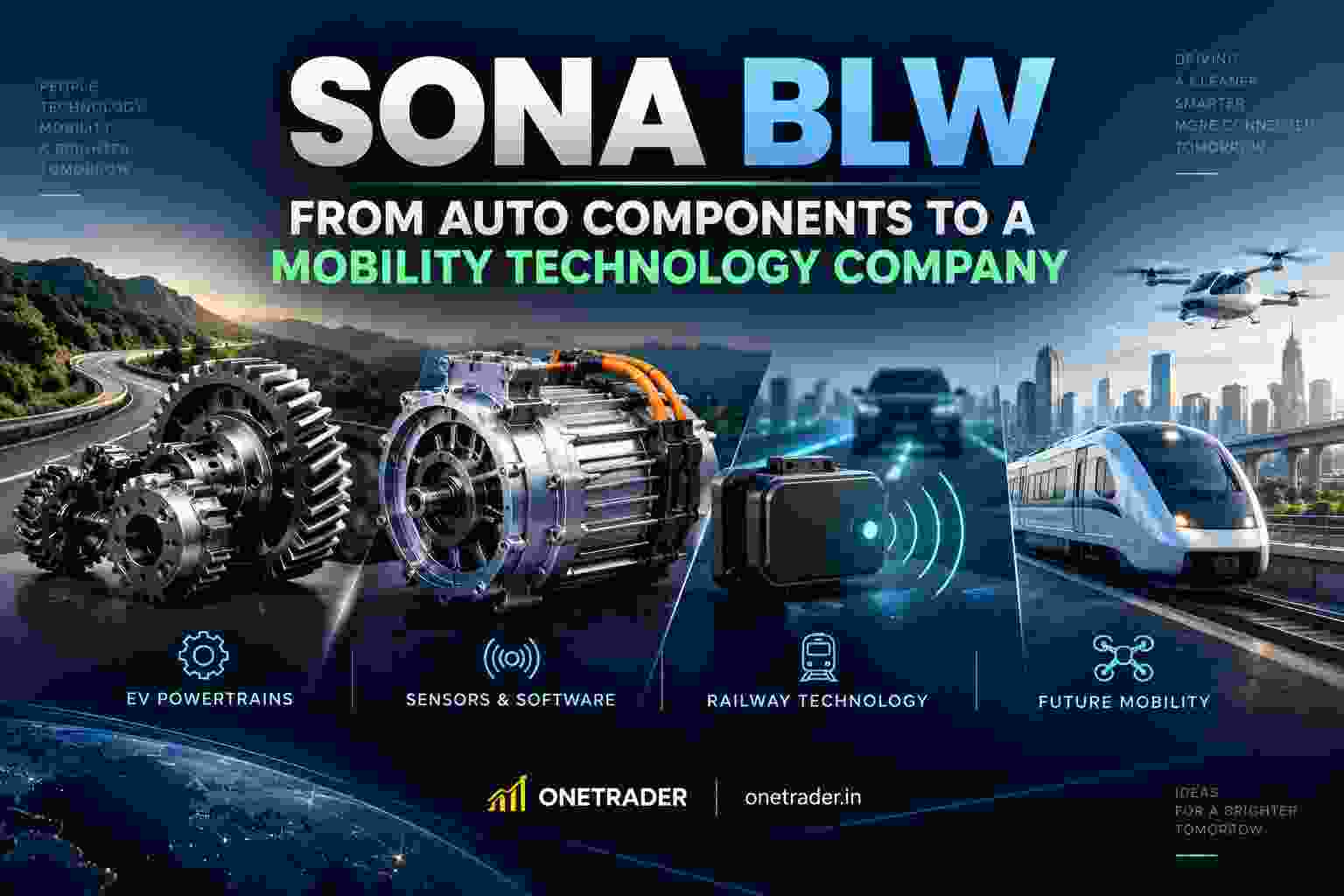
The automobile industry is undergoing one of the biggest technological transformations in its history. Vehicles are becoming electric, connected and increasingly software-driven, while new forms of transportation such as drones, electric aircraft and autonomous machines are creating entirely new component requirements. In this changing environment, companies that can move beyond traditional mechanical components and develop complete mobility technologies could have a much larger opportunity ahead.
Sona BLW Precision Forgings, popularly known as Sona Comstar, is positioning itself around exactly this transition. The company started with precision-forged drivetrain components but has steadily expanded into electric powertrains, motors, sensors, software and railway systems. Today, Sona Comstar describes itself as a global mobility technology company serving electric, personalised, intelligent and connected mobility applications.
From Precision Gears to Mobility Technology
Sona Comstar’s foundation remains its precision-engineered drivetrain business. The company pioneered precision-formed bevel gear technology in India and has built deep expertise in differential gears, differential assemblies and other drivetrain components used across passenger vehicles, commercial vehicles and off-highway applications.
These components may not be visible to consumers, but they are mission-critical parts of a vehicle’s powertrain. Precision, durability and consistency are essential because these components operate under significant mechanical loads. Sona’s precision forging capabilities therefore form an important technological foundation for the company. Its product portfolio includes differential gears, differential assemblies, starter motors and other drivetrain systems.
Also Read: Avalon Technologies: The EMS Company Quietly Building India’s Next Manufacturing Engine
The company’s evolution accelerated after it acquired Comstar Automotive in 2019. That transaction added motor capabilities and helped Sona move from being primarily a precision-forging specialist toward a broader powertrain technology company. The later acquisition of NOVELIC added radar sensing, embedded software and perception capabilities, further widening the technology platform.
EVs Are Changing the Opportunity
Electrification is one of the most important parts of Sona Comstar’s strategy. Electric vehicles require a different powertrain architecture from conventional internal-combustion vehicles, creating opportunities for companies that can supply traction motors, motor controllers, e-drive systems and other electric powertrain components.
Sona already develops traction motors and related systems for electric vehicles across different vehicle categories. Its capabilities extend to electric passenger vehicles, commercial vehicles, electric two-wheelers and three-wheelers, as well as off-highway applications. The company has also developed e-drive solutions such as e-axles and e-transmissions for commercial and smaller electric mobility applications.
This is strategically important because Sona is not simply replacing an old product with an electric version. It is attempting to increase its technological participation in the vehicle by moving toward motors, controllers, integrated driveline systems and other higher-value components.
Also Read: IREDA: The Green Financing Powerhouse Funding India’s Renewable Energy Boom
The Technology Platform Is Getting Wider
One of the most interesting parts of the Sona Comstar story is its technology roadmap. The company uses the term EPIC Mobility, representing Electrified, Personalised, Intelligent and Connected mobility.
The strategy is to move from individual components toward subassemblies, assemblies and eventually complete systems. This means the company wants to capture more value by combining mechanical engineering with electrical systems, electronics, software and functional safety.
This shift changes the way Sona should be viewed. Instead of being only an auto-component manufacturer, it is trying to become a technology supplier capable of solving increasingly complex mobility problems for global OEMs.
NOVELIC Brings Radar and Software
The acquisition of a majority stake in NOVELIC was an important step in this transformation. NOVELIC is a Serbia-based technology company specialising in millimetre-wave radar sensors, perception systems and embedded electronics and software.
Also Read: Anlon Healthcare: The Small Pharma Company Building a Bigger Global Opportunity
Its capabilities cover applications such as advanced driver-assistance systems, autonomous driving, automated guided vehicles and industrial automation. NOVELIC also develops hardware, embedded software, algorithms, machine learning, FPGA and functional-safety solutions.
This gives Sona access to technologies that sit much further up the mobility technology stack. Radar and perception systems can become important not only in passenger vehicles but also in autonomous machines, robotics and industrial applications.
The strategic benefit is the combination of Sona’s mechanical and powertrain expertise with NOVELIC’s electronics and software capabilities. That combination can potentially allow the company to develop more integrated mobility systems rather than supplying isolated components.
The Railway Opportunity
Sona Comstar has also moved beyond automotive mobility through its acquisition of the Railway Equipment Division of Escorts Kubota. The business became part of Sona Comstar from June 1, 2025.
Also Read: Piramal Pharma: The Pharma Platform Building Its Next Growth Engine
The railway business brings an entirely different product portfolio. It includes braking systems, suspension systems, couplers, automatic plug doors, roof-mounted package units, vacuum evacuation systems, electric panels and other railway equipment.
These products serve passenger coaches, locomotives, freight wagons and electric multiple-unit trains across domestic and international markets. The business also has specialised railway certifications and manufacturing infrastructure.
The significance of this move goes beyond diversification. Railway systems are safety-critical products, meaning engineering expertise, certification and reliability are important barriers to entry. Sona is therefore entering a market where its engineering and manufacturing capabilities can potentially be applied to a new transportation platform.
Beyond Cars: Drones and eVTOLs
Sona’s technology roadmap becomes even more interesting when looking at the applications it is targeting beyond traditional vehicles.
Also Read: Lodha Developers: The Real Estate Giant Building Its Next Growth Engine?
The company has been developing powertrain technologies for eVTOL aircraft and drones. Electric vertical take-off and landing aircraft require highly efficient, lightweight and reliable propulsion systems, making motor and power electronics expertise directly relevant.
Drones create another potential application for compact electric propulsion systems. These markets are still developing, so they should not be viewed as established revenue engines today. However, they demonstrate how Sona is attempting to use its core engineering capabilities across emerging forms of mobility.
Robotics Could Become Another Long-Term Platform
The company has also started exploring robotics. Its technology roadmap includes industrial robots, autonomous mobile robots and humanoid robots.
This is an interesting extension because robotics requires many of the same underlying capabilities that are becoming important in intelligent mobility: motors, actuators, sensors, controllers, embedded software and precision mechanical systems.
Also Read: DMart The Retail Giant Facing Its Biggest Growth Test Yet?
Sona has disclosed that it is developing components for humanoid robots intended for complex and repetitive industrial tasks. At this stage, this should be viewed as an emerging technology initiative rather than a mature business, but it illustrates the company’s broader strategy of applying its engineering platform to new markets.
Global Scale Is an Important Part of the Model
Sona Comstar has built a global manufacturing and customer network rather than remaining primarily an India-focused supplier. Its current platform includes manufacturing and assembly facilities across India, the United States, Mexico and China, along with multiple R&D centres.
More than half of its sales are for international markets, giving the company exposure to global OEMs and mobility markets.
This international presence is important for an auto-component company because global OEM relationships can create long production programmes once a supplier is selected and its component is validated. The engineering and qualification process can also create barriers to switching suppliers, particularly for mission-critical components.
Also Read: Priority Jewels The Small Jewellery Manufacturer With a Big Growth Opportunity?
R&D Is Central to the Business
Sona Comstar’s competitive position is closely linked to engineering rather than simply manufacturing capacity.
The company operates multiple R&D and engineering centres and has developed capabilities covering precision forging, mechanical systems, motors, electronics, radar sensing, embedded software and functional safety. Its technology roadmap explicitly aims to move from components toward increasingly integrated systems.
This matters because mobility technology is evolving quickly. A company that remains dependent on a single generation of components can eventually lose relevance as vehicle architectures change. Sona’s strategy is to continuously add capabilities so that it can participate in the next generation of mobility.
What Could Create the Moat?
Sona Comstar’s potential moat comes from the combination of engineering expertise, precision manufacturing, customer relationships, technology development and global scale.
Also Read: ESDS Software Solution The AI Data Centre Stock Nobody Is Talking About?
Its legacy products require high manufacturing precision, while its newer businesses require capabilities in motors, electronics, sensors and software. Bringing these capabilities together is not something a new competitor can easily replicate overnight.
The company also has long-standing relationships with global automotive manufacturers. Once a component is designed into a vehicle platform and successfully validated, the supplier becomes part of the OEM’s production ecosystem. That can create meaningful customer stickiness, particularly for safety-critical and mission-critical systems.
The Next Phase of the Business
The most important transformation at Sona Comstar is the shift from being a component manufacturer toward becoming a broader mobility technology company.
Its traditional drivetrain business provides the engineering foundation. EV motors and powertrain systems expand its participation in electrification. NOVELIC brings sensing and software. The railway business adds a new transportation segment. Emerging programmes in eVTOLs, drones and robotics provide longer-term opportunities.
Also Read: Lumino Industries The Power Infrastructure Stock Riding India’s Electricity Boom?
The company’s FY2025–26 annual report explicitly describes this transition as moving from roads to rails and emerging mobility platforms, while its technology roadmap identifies drones, eVTOLs, autonomous machines, industrial robots and humanoids as potential areas of expansion.
The interesting question is therefore not simply how many automotive components Sona Comstar can manufacture. It is whether the company can successfully turn its mechanical, electrical, electronics and software capabilities into a broader technology platform for the future of movement.
The Risks to Watch
The biggest business risk is execution because Sona is simultaneously expanding across several technology platforms. Moving from automotive components into railways, radar, software, aerospace mobility and robotics requires different customer relationships, certifications and development cycles.
The EV transition also creates both opportunity and risk. Electric vehicles can increase demand for certain Sona products, but vehicle architectures are evolving rapidly and competition in electric powertrain components is increasing.
Also Read: Star Health Insurance The Hidden Profit Recovery Story in Indian Insurance?
The newer businesses also carry greater uncertainty than the company’s established drivetrain operations. eVTOLs, drones and humanoid robotics have significant long-term potential, but commercial adoption and customer demand are still developing.
Another important factor is the ability to maintain its technological edge. As mobility becomes increasingly software-defined, mechanical engineering alone will not be sufficient. Sona will need to continue investing in electronics, software, sensing, systems engineering and functional safety to remain competitive.
The Bigger Story
Sona BLW Precision Forgings is gradually becoming a very different company from the one it was when it began as a precision-forging business.
Today, its platform spans drivetrain components, electric motors, sensors, embedded software and railway systems, while its technology roadmap extends toward drones, eVTOLs, autonomous machines, industrial robotics and humanoid robots.
Also Read: Augmont Enterprises: Gold Platform, Products and Future Growth
That makes Sona Comstar an interesting business to watch from a long-term mobility perspective. Its established precision-engineering capabilities provide the foundation, while electrification, intelligent sensing, software and new mobility platforms represent the next layers of its evolution.
The key question for the coming years will be whether Sona can successfully convert this expanding technology portfolio into deeper OEM relationships and a larger role in the global mobility ecosystem.
Disclaimer: This article is for educational and informational purposes only. It is not investment advice or a recommendation to buy or sell any security. Onetrader is not a SEBI-registered investment adviser. Investors should conduct their own research or consult a qualified financial professional before making investment decisions.
Also Read: Gland Pharma The Injectable Pharma Giant Entering Its Next Growth Cycle?