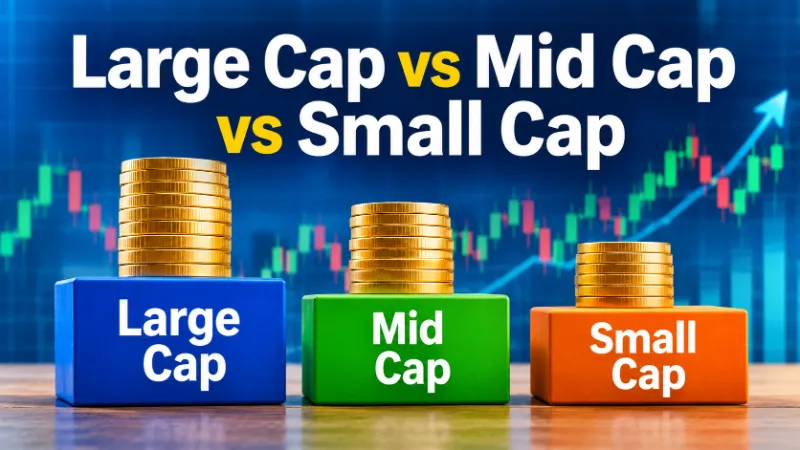
Indian investors are entering the final stretch of 2026 with a familiar question: should the next investment rupee go into large-cap stocks, mid-cap companies or small caps? The answer has become more complicated after months of uneven returns, changing valuations and a recent recovery in the broader market.
The three segments offer very different opportunities. Large caps provide exposure to established companies with deeper financial resources and greater market liquidity. Mid caps offer a balance between business maturity and growth potential. Small caps can deliver faster earnings growth, but their share prices are often more sensitive to liquidity, investor sentiment and disappointing results.
The latest market movement has improved the outlook for all three groups, although not equally. On Wednesday, November 11, Indian equities opened sharply higher after the Diwali holiday break. Softer crude oil prices, renewed foreign investment and stronger corporate earnings expectations helped lift the benchmarks, while mid-cap and small-cap indices also advanced. The recovery has improved sentiment, but it does not remove the need to assess valuations and earnings quality separately.
For investors planning for 2027, the more useful question is not which segment will rise the most in a single rally. It is which group offers the most attractive balance between potential returns, valuation risk and the ability to withstand another market correction.
Also Read: Wipro Stock Analysis: Can the Recent Rally Turn Into a Lasting Recovery?
Where Large Caps, Mid Caps and Small Caps Stand
The latest completed regular trading session before Wednesday’s opening was Monday, November 9. The market was closed on Tuesday for Balipratipada. The following levels provide a common reference point for comparing the three segments.
| Market segment | Representative index | November 9 close | Price-to-earnings ratio |
|---|---|---|---|
| Large caps | Nifty 50 | 25,044.65 | 20.7 |
| Mid caps | Nifty Midcap 100 | 61,022.55 | 27.3 |
| Small caps | Nifty Smallcap 100 | 19,185.05 | 34.7 |
The valuation gap is significant. Investors are paying substantially more for each rupee of earnings in the small-cap segment than in the large-cap market. Mid caps sit between the two, although individual companies can trade at valuations far above or below their segment’s average.
These ratios do not establish that large caps are automatically cheap or that small caps must fall. Different industries have different growth rates and profitability. However, the gap means that mid-cap and small-cap companies generally need stronger future earnings growth to justify their current valuations.
Wednesday’s opening rally added another layer to the comparison. The Nifty 50 rose to around 25,338 shortly after the market opened, while the Sensex advanced above 82,200. Mid-cap and small-cap indices also moved higher. These were opening levels, not completed-session closing prices, and the direction could change during the trading day.
How the Three Segments Have Performed Through the Rally and Correction
The earlier market rally benefited from strong domestic investment, optimism around India’s economic growth and expectations that corporate earnings would continue expanding. Large caps attracted investors looking for established businesses, while mid caps and small caps gained from expectations of faster growth in manufacturing, infrastructure, financial services and domestic consumption.
The correction exposed the differences between these segments. Large caps generally benefited from deeper liquidity and stronger institutional participation. Mid caps faced pressure as investors reassessed growth expectations, while small caps proved more vulnerable when investors reduced exposure to expensive and less liquid shares.
The recent recovery has not erased these differences. Large caps have regained support from heavyweight banks and other index constituents. Mid caps have participated as investors returned to growth-oriented companies, while small caps have also recovered, although their valuations leave less room for earnings disappointments in many cases.
The important distinction is that a falling index does not affect every company equally. Some businesses have maintained earnings growth throughout the correction, while others have experienced slower sales, weaker margins or lower returns on capital. The quality of individual companies increasingly matters when broad market momentum becomes less reliable.
Also Read: LG Electronics India Stock Analysis: Financial Performance, Valuation, Growth Prospects and Risks
Large Cap Stocks: Stability, Liquidity and More Moderate Expectations
Large caps remain the natural starting point for investors who want broad exposure to the Indian equity market without taking excessive company-specific risk. The Nifty 50 includes established businesses across banking, information technology, energy, automobiles, consumer goods and industrials.
Their scale often provides advantages during uncertain periods. Large companies generally have better access to capital, more diversified operations and greater institutional ownership. Their shares also tend to trade with deeper liquidity, making it easier for investors to enter or exit positions.
Valuation is another consideration. At approximately 20.7 times trailing earnings, the Nifty 50 trades at a lower earnings multiple than the representative mid-cap and small-cap indices. That does not guarantee superior returns, but it offers a more moderate starting valuation relative to those groups.
The outlook for large caps in 2027 will depend on earnings growth from major banks, domestic consumption, infrastructure investment and technology services. If corporate profits improve while valuations remain controlled, the segment could deliver steady returns without requiring investors to pay increasingly higher multiples.
Also Read: Jio Platforms IPO 2026: Telecom Leadership, Broadband Expansion and Future Growth Opportunities
The downside is that the largest companies are already widely followed and often face fewer opportunities for dramatic expansion than smaller businesses. If earnings growth disappoints or foreign investors resume heavy selling, large caps can still experience substantial declines.
For investors prioritising resilience and liquidity, large caps remain a strong foundation. Their potential advantage in 2027 may be a more balanced relationship between earnings expectations and valuation rather than the highest possible return.
Mid Cap Stocks: The Balance Between Growth and Valuation
Mid caps occupy an interesting position between established market leaders and smaller emerging businesses. Many have moved beyond their early growth stages but still have room to expand market share, enter new regions, increase manufacturing capacity or develop additional products.
This creates a potentially attractive combination. A mid-cap company may have a more established customer base and operating structure than a small business while retaining greater growth opportunities than a mature large-cap company.
Also Read: VRL Logistics: Inside India’s Road Transport Giant and Its Expanding Logistics Business
The valuation picture, however, requires attention. The Nifty Midcap 100 traded at roughly 27.3 times earnings in the latest valuation data. Investors are paying a meaningful premium over large caps, which means future returns will depend on companies delivering sufficient earnings growth.

Several areas could support mid caps in 2027. Manufacturing expansion, infrastructure spending, financial services, healthcare, industrial automation and domestic consumption could create opportunities for companies with strong competitive positions. Businesses that expand revenue while maintaining healthy margins and disciplined capital allocation may justify higher valuations over time.
The risks are equally important. Mid-cap companies can be more dependent on a limited number of products, customers or domestic markets. Some may also require substantial borrowing or capital expenditure to sustain expansion. If economic growth slows or project execution weakens, earnings estimates can fall quickly.
Mid caps may offer an attractive middle ground for investors willing to accept volatility in exchange for growth potential. The key is to avoid treating the entire segment as one investment opportunity. Companies with consistent cash generation and sensible valuations may be better placed than those whose share prices already assume several years of strong growth.
Also Read: Jio Platforms Stock Analysis: Growth, Valuation, Financials, Risks and Future Outlook
Small Cap Stocks: Higher Growth Potential, Higher Expectations
Small caps often attract investors looking for businesses that could become the next generation of market leaders. These companies may operate in specialised manufacturing, niche financial services, engineering, healthcare, consumer products or emerging industrial categories.
A smaller starting base can allow revenue and profits to grow rapidly when a company finds new customers or expands production. That potential is one reason small caps can outperform during strong market cycles.
But small-cap investing also carries additional risks. Many companies have limited trading liquidity, narrower revenue sources and less financial flexibility during difficult periods. Their share prices can fall sharply when investors exit crowded positions or when earnings fail to match expectations.
Valuation is a particular concern. The Nifty Smallcap 100 traded at approximately 34.7 times earnings in the latest data, significantly above the large-cap multiple. This leaves less room for companies to deliver merely average growth.
Also Read: ESDS Software Solution: Can Strong AI and Cloud Growth Justify a Premium Valuation?
The segment could perform well in 2027 if economic activity strengthens, credit remains available, domestic investment expands and smaller businesses convert capacity additions into higher profits. A broader market rally could also encourage investors to take more risk.
The opposite scenario could be uncomfortable. If earnings growth slows, financing costs rise or investors become less willing to pay premium valuations, small caps may experience both falling profits and lower valuation multiples. That combination can produce sharper losses than those seen in large caps.
Small caps therefore require more selective investing, careful assessment of debt and cash flows, and realistic expectations about liquidity. High potential returns are possible, but they are not a substitute for business quality.
What Today’s Market Recovery Means for Each Group
Wednesday’s early advance was supported by lower crude oil prices, renewed foreign buying and stronger sentiment following the holiday break. The move also reflected improved appetite for Indian equities after a period of uncertainty over global conditions and corporate earnings.
Also Read: NSE Stock Analysis: Growth, Valuation, Financials, Risks and Future Outlook
Lower oil prices can be beneficial for India by reducing pressure on inflation, transport costs and the country’s import bill. Renewed foreign investment can support large, liquid stocks first, while sustained confidence may eventually encourage greater participation in mid caps and small caps.
However, a single opening rally cannot establish a new market trend. Investors need to watch whether buying continues through the session and over subsequent weeks, and whether gains are supported by a wider improvement in earnings expectations.
For large caps, sustained foreign inflows and stronger banking earnings could provide support. For mid caps, improving industrial demand and reliable earnings growth would be important. For small caps, a broad recovery in market participation may help, but valuations and liquidity will remain decisive.
The market will be healthier if participation broadens alongside improving earnings. A rally driven primarily by sentiment, with little change in company profits, would be less convincing.
Also Read: Tempsens Instruments IPO: Should Investors Consider the Issue?
Valuations and the Returns Investors Can Reasonably Expect
Valuation is likely to play a central role in determining which segment performs best in 2027. Large caps start from a lower earnings multiple, while mid caps and small caps require higher growth to support their more expensive valuations.
This does not mean the Nifty 50 must outperform. A small-cap company that grows earnings rapidly can justify a premium, while a large-cap company with stagnant profits can deliver poor returns despite a lower valuation.
Investors should also distinguish between index valuation and individual stock valuation. An index may appear expensive because of a few high-multiple constituents, while some companies within the same segment may offer more reasonable entry points. The reverse can also occur.
For 2027, the most useful approach is to assess expected earnings growth against the price being paid. Revenue expansion, operating margins, return on capital, debt levels and cash conversion can help investors determine whether a company’s valuation is supported by its fundamentals.
Also Read: Suraksha Diagnostics Stock: Q1 Growth, Margins and Expansion Plans
The starting valuation also influences downside risk. When expectations are high, even good results may not be enough to push a stock higher if investors had anticipated something better.
Large Caps vs Mid Caps vs Small Caps: Outlook for 2027
The outlook for the next year depends on the path of corporate earnings, domestic economic growth, interest rates, global demand and investor flows. Each segment offers a different balance of opportunity and risk.
| Factor | Large caps | Mid caps | Small caps |
|---|---|---|---|
| Relative valuation | Lower | Higher | Highest |
| Growth potential | Moderate to strong | Strong | Potentially very strong |
| Typical liquidity | Higher | Moderate | Lower |
| Earnings visibility | Generally stronger | Varies by company | Often less predictable |
| Main opportunity | Stable earnings and reasonable valuations | Business expansion and market-share gains | Rapid growth from a smaller base |
| Main risk | Slower growth or global shocks | High expectations and execution problems | Expensive valuations, liquidity and earnings volatility |
### Large Cap Scenario for 2027
In a positive scenario, steady earnings growth, stronger domestic demand and continued foreign inflows could support a further advance. A moderate starting valuation may also help limit the risk of excessive multiple expansion.
Also Read: Sky Gold & Diamonds: Strong Growth Meets Improving Margins
In a weaker scenario, global economic pressure, disappointing earnings or renewed foreign selling could lead to further declines. Large caps would not be immune to a broad market correction, but their liquidity and diversified business exposure may help some companies withstand pressure better.
### Mid Cap Scenario for 2027
In a positive scenario, mid caps could outperform if economic growth accelerates and companies deliver earnings growth above large-cap levels. Businesses with strong order books, expanding market share and disciplined capital allocation may benefit the most.
In a weaker scenario, premium valuations could compress if earnings fall short. Companies with high debt, weak cash conversion or ambitious expansion plans may be particularly vulnerable.
Also Read: Indian Defence Stocks in 2026: Growth Opportunity or Valuation Risk?
### Small Cap Scenario for 2027
In a positive scenario, strong domestic investment, improved credit conditions and rapid profit growth could support substantial gains in selected small-cap companies. The segment could benefit disproportionately if investors become more confident about the economic outlook.
In a weaker scenario, expensive valuations and limited liquidity could amplify losses. A slowdown in earnings, tighter financing conditions or a reversal in market sentiment could trigger a sharper correction than in the large-cap segment.
These are conditional scenarios rather than price targets. Actual returns will depend on the economic environment, earnings delivery and valuations when investors enter the market.
Also Read: REIT vs INViTs
How Investors Can Approach the Three Segments in 2027
Investors do not necessarily need to choose only one segment. A portfolio can combine large caps for its core exposure with selected mid caps for additional growth and a smaller allocation to carefully researched small-cap companies.
The appropriate balance depends on the investor’s time horizon, financial goals, tolerance for losses and ability to remain invested during market corrections. Investors who may need their money soon should be cautious about relying heavily on volatile smaller companies.
Regular investments can reduce the pressure of choosing a single entry point, but they do not eliminate valuation risk or guarantee positive returns. Diversification across sectors and companies also matters because different businesses can respond differently to the same economic conditions.
Above all, investors should resist the temptation to increase small-cap exposure simply because prices have started rising again. A recovering market can create opportunities, but it can also encourage investors to pay too much for future growth.
Also Read: Top Space-Tech Stocks in India – A Hidden Multibagger Opportunity (2025-2045)
Final Outlook
Indian equities enter the final weeks of 2026 with improving sentiment, but the outlook for 2027 remains dependent on earnings and valuations. Large caps offer a comparatively moderate valuation base and greater liquidity. Mid caps provide opportunities for businesses expanding beyond their current scale. Small caps offer the possibility of faster growth, but their higher valuation multiples and greater sensitivity to market conditions demand additional caution.
If earnings growth strengthens across the economy, all three segments could deliver positive returns, with the strongest performers determined by the companies that exceed expectations without becoming excessively expensive. If growth disappoints or global risks intensify, the more highly valued segments could face greater pressure.
The key for investors is to avoid treating market capitalisation as a substitute for research. Large caps are not automatically safe, mid caps are not automatically better growth investments, and small caps are not automatically the route to higher returns.
For 2027, disciplined valuation, earnings quality and sensible risk management are likely to matter more than chasing whichever segment has recently produced the strongest rally.
Also Read: Dr. Agarwal’s Health Care Ltd — Business Model, Management Vision & Future Growth (2025–2030)
Financial Disclaimer: This article is for educational and informational purposes only and does not constitute investment advice or a recommendation to buy or sell any security. Stock market investments involve risks, including possible loss of capital. Investors should conduct their own research and consult a qualified financial adviser before making investment decisions. Onetrader is not registered with SEBI as an investment adviser or research analyst.








Keep learning with OneTrader
Explore structured lessons and practical guides to build your market knowledge.

Need a laugh after all that money talk?
Paisa LOL: India's funniest finance page, with memes, comics, jokes and long funny stories.