
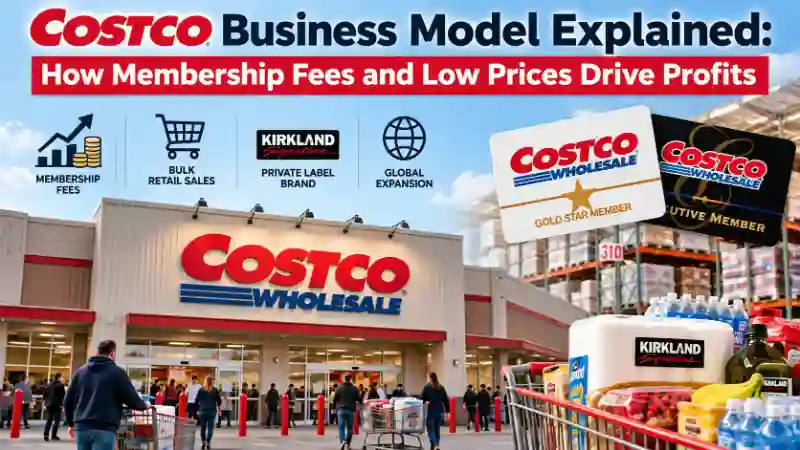
Costco Wholesale Corporation is one of the largest retailers in the world, but its business model differs significantly from traditional supermarket chains. Instead of relying primarily on high product margins, Costco combines annual membership fees, bulk purchasing, competitive pricing, and rapid inventory turnover to generate revenue and profits.
For investors researching Costco stock (NASDAQ: COST), understanding this membership-driven retail model is essential. The company’s ability to attract loyal customers, negotiate supplier prices, and maintain operating efficiency has helped establish its position in the competitive US retail industry.
How Costco Makes Money
Costco operates membership-only warehouse stores that sell groceries, household essentials, electronics, clothing, furniture, and other products. Customers generally pay an annual membership fee to access its warehouses and membership benefits.
The company generates revenue from two primary sources: merchandise sales and membership fees. Merchandise accounts for the overwhelming majority of total revenue, while membership income provides an important contribution to operating profitability.
Also Read: Stock Market Today: Wall Street Ends Mixed as Chip Stocks Drag Nasdaq (October 12, 2026)
For fiscal 2026, ended August 30, Costco reported approximately $303.2 billion in total revenue, including $297.2 billion in merchandise sales and $5.9 billion in membership fees.
Unlike traditional retailers that may emphasize higher margins on individual products, Costco focuses on selling large quantities at competitive prices.
Membership Fees: Costco’s Recurring Revenue Advantage
Membership fees are central to Costco’s financial model because they generate revenue independently of individual shopping transactions.
In the United States, Costco’s standard Gold Star membership costs $65 annually, while Executive membership costs $130 annually. Executive members receive additional benefits, including an eligible-purchase reward subject to program conditions.
Also Read: US Stocks to Watch Today: Amazon, Bristol Myers and Bank Earnings in Focus (October 12, 2026)
This structure encourages repeat visits because customers who have already paid for membership have an incentive to use the warehouses regularly.
High renewal rates strengthen revenue visibility and reduce the need to acquire an entirely new customer base each year. Membership revenue also supports Costco’s ability to maintain relatively low merchandise margins.
However, membership income is not entirely equivalent to profit. The company still incurs expenses associated with administering memberships and delivering associated benefits.
Why Costco Sells Products at Low Margins
Costco’s pricing strategy depends on selling large volumes rather than maximizing profit on every individual item.
Also Read: S&P 500 Today: Wall Street Ends Record Week at 7,811.54
The company purchases merchandise in substantial quantities, giving it negotiating power with suppliers. Its warehouses also carry a relatively limited assortment compared with many traditional supermarkets.
Fewer product variations simplify purchasing, inventory management, storage, and distribution. Products frequently arrive in bulk packaging, reducing handling requirements.
Rapid inventory turnover is particularly important because merchandise that sells quickly requires less storage time and can improve working capital efficiency.
Costco’s merchandise gross margin has been roughly 11% in recent fiscal years, illustrating its relatively low-margin approach to retailing.
Also Read: US Stock Market Week Ahead: CPI, Bank Earnings and Fed Speakers (October 12–16, 2026)

Kirkland Signature: Costco’s Private-Label Strategy
Kirkland Signature is Costco’s private-label brand, covering products such as groceries, household goods, clothing, and personal care items.
Private-label products allow Costco to control product specifications, packaging, and pricing while reducing dependence on national brands.
The company works with manufacturers to develop products intended to deliver competitive quality and value.
Kirkland Signature also strengthens customer loyalty because many products are available exclusively through Costco.
However, private-label expansion introduces risks involving supplier quality, product recalls, manufacturing disruptions, and consumer preferences.
Gasoline, Pharmacy, and Additional Services
Costco operates businesses beyond traditional warehouse merchandise.
Its gasoline stations attract customers seeking competitively priced fuel, potentially encouraging additional warehouse visits. Gasoline revenue can fluctuate significantly with changes in energy prices, even when sales volumes remain relatively stable.
Pharmacy, optical, hearing aid, food court, and other services broaden Costco’s customer offering.
Also Read: 401(k) Vesting Explained: Employer Match and Job Changes
These services support the membership proposition by giving households additional reasons to maintain their subscriptions.
Costco also operates e-commerce platforms, although physical warehouses remain central to its distribution and shopping model.
Costco’s Profitability and Operating Efficiency
Costco’s profitability depends on maintaining strong sales volumes while controlling merchandise, labor, distribution, and administrative expenses.
In fiscal 2026, the company reported approximately $11.7 billion in operating income and $9.2 billion in net income.
Also Read: Crack Spreads Explained: How US Refinery Margins Work
Its warehouse format supports efficiency through simplified store layouts, bulk merchandise displays, and relatively limited product selection.
Employee compensation and retention also influence operations. Experienced employees can improve productivity and customer service, although higher wages increase operating expenses.
Costco must balance competitive prices, employee investment, and infrastructure spending without significantly weakening profitability.
International Expansion and Growth Opportunities
Costco operates internationally, including in Canada, Mexico, Japan, South Korea, Australia, and several European markets.
Also Read: Bitcoin Custody Explained: Wallets, Private Keys and Access Risks
International expansion allows the company to reach new members while applying its established warehouse model.
However, purchasing habits, real estate costs, regulations, currency movements, and local competition vary across countries.
For UK investors, Costco provides exposure to a US-listed retailer with international operations, although the shares trade in US dollars and therefore introduce GBP/USD currency exposure.
Future growth depends on warehouse openings, comparable sales, membership expansion, and digital commerce.
Also Read: Why Treasury Yields Affect US Stocks: Valuations, Earnings and Risk
Competitive Advantages and Business Risks
Costco competes with Walmart, Sam’s Club, Amazon, Target, supermarkets, and other retailers.
Its competitive strengths include membership loyalty, purchasing scale, private-label products, and an established reputation for value.
Nevertheless, inflation, changing consumer spending, supplier costs, wage pressures, tariffs, and competition can affect performance.
Warehouse expansion also requires substantial investment, while maintaining attractive prices may constrain merchandise margins.
Also Read: Eaton Business Model: Powering Data Centers, Industry and Aerospace
Costco’s business performance ultimately depends on sustaining customer loyalty, membership renewals, efficient operations, and strong merchandise sales across changing economic conditions.
OneTrader Disclaimer: This article is intended for educational and informational purposes only and does not constitute investment advice, financial recommendations, or a solicitation to buy or sell securities. Onetrader.in is not a SEBI-registered investment adviser. Investors should conduct independent research and consult qualified financial professionals before making investment decisions.





Keep learning with OneTrader
Explore structured lessons and practical guides to build your market knowledge.