
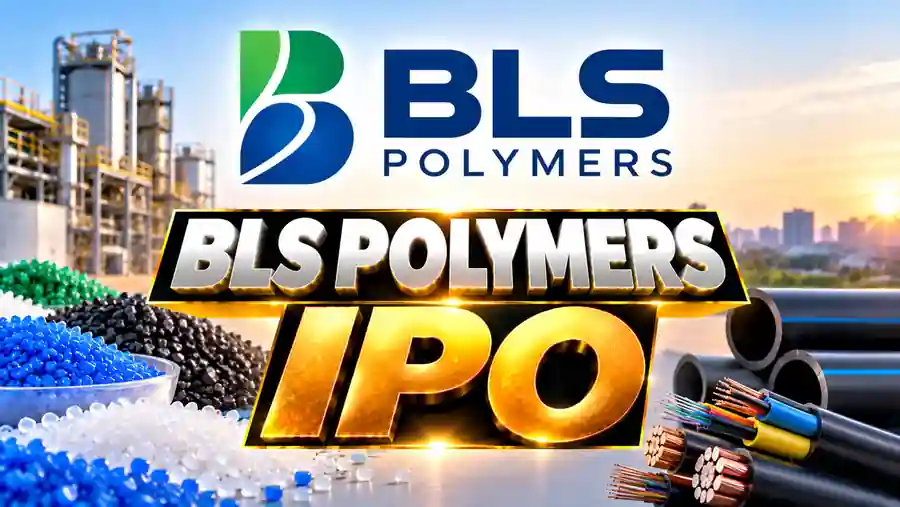
BLS Polymers Limited, an Indian manufacturer of specialised polymer compounds, is preparing to launch its ₹255 crore initial public offering on October 27, 2026. The company supplies customised polymer materials used in power cables, telecommunications infrastructure, railway systems and pipeline protection applications.
The BLS Polymers IPO will open on October 27 and close on October 29, 2026, with a price band of ₹142–₹150 per equity share. The proposed listing on BSE and NSE is scheduled for November 3, 2026.
The public offering consists entirely of a fresh issue of 1.70 crore equity shares. Unlike an Offer for Sale, a fresh issue allows the company to receive the proceeds, after issue-related expenses, for its stated business requirements.
BLS Polymers IPO Details
| IPO Details | Information |
|---|---|
| Company Name | BLS Polymers Limited |
| IPO Type | Mainboard IPO |
| Issue Type | Book Built, Fresh Issue Only |
| IPO Open Date | October 27, 2026 |
| IPO Close Date | October 29, 2026 |
| Price Band | ₹142–₹150 |
| Face Value | ₹10 per share |
| Total Issue Size | Up to ₹255 crore |
| Fresh Issue | 1.70 crore shares |
| Offer for Sale | Nil |
| Lot Size | 100 shares |
| Minimum Retail Investment | ₹15,000 at upper price |
| Anchor Investor Date | October 26, 2026 |
| Expected Allotment Date | October 30, 2026 |
| Refund and Demat Credit | November 2, 2026 |
| Expected Listing Date | November 3, 2026 |
| Listing Exchanges | BSE and NSE |
| Lead Manager | Unistone Capital Private Limited |
The company has reserved 35% of the issue for retail investors, 15% for non-institutional investors and 50% for qualified institutional buyers, including the anchor investor portion.
Also Read: Bombay Coated & Special Steels IPO Details: Dates, Issue Size, Financials, GMP and Business Model
What Does BLS Polymers Do?
BLS Polymers manufactures customised polymer compounds designed to meet specific performance requirements in industrial applications. These materials are used primarily in electrical cables, telecommunications networks, railway infrastructure and pipeline coating systems.
Polymer compounding involves combining base polymers with additives and other materials to achieve properties such as electrical insulation, mechanical strength, heat resistance, flame retardancy and protection against environmental exposure.
The company’s product portfolio includes high-density polyethylene (HDPE), medium-density polyethylene (MDPE), linear low-density polyethylene (LLDPE), cross-linked polyethylene (XLPE), polyvinyl chloride (PVC), halogen-free flame-retardant (HFFR) compounds and specialised adhesive coating materials.
These compounds serve as important components in products manufactured by cable producers and industrial infrastructure suppliers.
Also Read: SFC Environmental Technologies IPO Details: Price Band, Dates, Financials, GMP and Business Model
Rather than manufacturing finished power transmission systems or telecommunications networks, BLS supplies specialised materials that other manufacturers use in their production processes.
Power and Electrical Cable Applications
Power transmission and distribution infrastructure requires cables capable of operating under different electrical, mechanical and environmental conditions.
BLS Polymers manufactures compounds used for insulation, sheathing and jacketing of electrical cables. These layers help protect conductors and maintain cable performance during operation.
The performance requirements of polymer compounds vary depending on voltage, installation conditions, temperature exposure and applicable technical specifications.
Also Read: EAAA India Alternatives IPO Details: Price Band, Dates, Financials, GMP and Business Model
Materials used in power cables may need to provide electrical insulation, resistance to moisture and durability under mechanical stress.
Demand for these products is influenced by electricity infrastructure development, industrial investment, grid modernisation and cable manufacturing activity.
However, growth in power infrastructure spending does not automatically translate into equivalent revenue growth for polymer compound suppliers. Sales depend on customer orders, product specifications, pricing and competition.
Telecommunications and Railway Applications
Telecommunications infrastructure represents another market for BLS Polymers.
Also Read: Jio Platforms IPO Details: Price Band, Dates, Issue Size, Financials, GMP and Business Model
Fibre-optic and telecommunications cables require protective materials that help maintain performance during installation and long-term operation.
Polymer compounds are used in cable jackets and related components to provide protection against moisture, physical damage and environmental conditions.
The company’s products also serve railway-related applications where cables and electrical systems must meet technical performance requirements.
Expansion of telecommunications networks, broadband infrastructure and railway electrification can create opportunities for manufacturers supplying specialised cable materials.
Also Read: Paras Healthcare IPO Details: IPO Date, Issue Size, Financials, GMP and Business Model
Nevertheless, the company’s actual sales depend on procurement decisions by cable manufacturers and infrastructure suppliers rather than directly on the total value of infrastructure projects.
Pipeline Coating and Industrial Applications
BLS Polymers also manufactures materials used in protective coatings for oil, gas and water pipelines.
Its product range includes HDPE and adhesive coating compounds used in three-layer polyethylene coating systems, commonly known as 3LPE.
These coating systems are designed to protect steel pipelines against corrosion, moisture and other environmental conditions.

Also Read: Tonbo Imaging India IPO Details: Price Band, Dates, Financials, GMP and Business Model
Protective coatings play an important role in extending pipeline service life and reducing deterioration caused by exposure to surrounding soil, water and chemicals.
The company’s exposure to pipeline applications provides diversification beyond the cable manufacturing industry.
However, this segment remains influenced by industrial investment cycles, infrastructure project activity, raw material costs and competition among compound suppliers.
Manufacturing Facility and Expansion Plans
BLS Polymers operates a manufacturing facility in Goa, where it produces polymer compounds for its industrial customers.
Also Read: Zetwerk Manufacturing Business IPO Details: Price Band, Dates, Financials, GMP and Business Model
The company plans to use part of its IPO proceeds to expand the existing manufacturing facility and increase the production capacity of certain products.
Additional capacity could support larger customer orders and allow the company to serve demand across its product portfolio.
However, manufacturing expansion involves expenditure on equipment, infrastructure and commissioning activities. The financial benefits depend on successful implementation and the company’s ability to secure sufficient orders.
Capacity utilisation, production efficiency, raw material availability and product quality will remain important operating considerations.
Also Read: Bonfiglioli Transmissions IPO Details
BLS Polymers Financial Performance
BLS Polymers reported growth in revenue and profitability during FY2026.
| Financial Metric | FY2025 | FY2026 |
|---|---|---|
| Revenue from Operations | ₹328.44 crore | ₹349.43 crore |
| EBITDA | ₹39.66 crore | ₹46.60 crore |
| Profit After Tax | ₹21.13 crore | ₹27.01 crore |
Revenue from operations increased approximately 6.4% in FY2026, while profit after tax grew approximately 27.8%.
EBITDA increased approximately 17.5%, indicating stronger operating earnings growth than revenue growth during the financial year.
For the quarter ended June 30, 2026, the company reported revenue from operations of ₹107.03 crore, EBITDA of ₹16.21 crore and profit after tax of ₹10.23 crore.
Also Read: Sahajanand Medical Technologies IPO Details
These results suggest an improvement in profitability, although one quarter’s performance should not be treated as representative of the entire financial year.
Raw material prices, product mix, manufacturing utilisation and customer pricing arrangements can influence margins in the polymer compounding industry.
Use of IPO Proceeds
BLS Polymers intends to use the net proceeds from the fresh issue for manufacturing expansion, working capital and general corporate purposes.
The expansion programme focuses on increasing production capacity at its Goa facility. This investment is intended to support the manufacture of existing polymer compound products.
Also Read: Fusion CX IPO Details: Price Band, Dates, Financials and Key Risks
Working capital will help finance raw material purchases, inventory, customer receivables and other operational requirements.
Polymer manufacturing businesses often need to maintain sufficient raw material inventory to fulfil customer orders. Changes in polymer prices and payment collection periods can influence their funding requirements.
Because the offering consists entirely of newly issued shares, the company will receive the issue proceeds after applicable expenses.
IPO Valuation and Financial Ratios
At the upper price band of ₹150, the BLS Polymers IPO represents an issue size of ₹255 crore.
Also Read: HD Fire Protect IPO Details
The company’s FY2026 profit after tax was ₹27.01 crore, compared with ₹21.13 crore in FY2025.
Using the company’s reported operating results, its FY2026 EBITDA margin was approximately 13.3%, while its net profit margin was approximately 7.7%.
These figures indicate improved profitability, but valuation analysis must also consider the enlarged share capital following the fresh issue.
The company’s earnings are influenced by polymer raw material costs, product mix, manufacturing utilisation and pricing arrangements with customers.
Also Read: Vishal Nirmiti IPO Details
A comparison with other specialty polymer and industrial material manufacturers should account for differences in products, end-use markets, manufacturing capabilities and profitability.
Growth Opportunities
BLS Polymers operates in industrial markets linked to infrastructure development and manufacturing activity.
Electricity transmission and distribution investments require specialised cables, while telecommunications infrastructure uses protective compounds in network cables.
Railway modernisation and industrial pipeline construction provide additional end-use markets for polymer materials.
Also Read: Nityas Gems & Jewellery IPO Details
The company’s ability to develop customised compounds may support its participation in applications requiring particular technical specifications.
Expansion of its Goa manufacturing facility could increase production capacity and provide opportunities to serve additional demand.
However, future growth depends on customer orders, successful expansion, competitive pricing and the availability of suitable raw materials.
Key Risks
Raw material price volatility is an important risk for BLS Polymers. Changes in polymer input costs may affect margins if the company cannot pass increased costs to customers promptly.
Also Read: SRIT India IPO Details
Customer-order dependence is another consideration. The company does not maintain long-term purchase commitments with all customers and relies on orders placed periodically.
This arrangement can expose revenue to fluctuations in customer demand and procurement schedules.
Manufacturing expansion also carries execution risks, including equipment installation delays, cost overruns and lower-than-expected capacity utilisation.
Certain industrial applications require technical qualifications and customer approvals. Failure to maintain necessary approvals could restrict participation in specific markets.
Also Read: Shah Investor’s Home IPO Details
Working-capital requirements may increase as the business expands, particularly if inventory and receivables grow faster than operating cash flows.
BLS Polymers IPO GMP
As of October 22, 2026, a sufficiently reliable and independently corroborated grey market premium for the BLS Polymers IPO could not be established.
The grey market premium is an unofficial indicator of demand ahead of listing. It is not published by BSE or NSE and can fluctuate significantly.
The IPO’s financial performance, manufacturing operations, planned expansion, valuation and disclosed risks are more substantive considerations than unofficial listing-premium estimates.
Also Read: AceVector IPO Details: Price Band, Dates, Financials, GMP and Key Risks
Financial Disclaimer: This article is published by Onetrader.in for educational and informational purposes only. It does not constitute investment advice, a recommendation to subscribe to or avoid an IPO, or a guarantee of listing gains or future returns. Onetrader is not registered with SEBI as an investment adviser or research analyst. Investors should read the company’s Red Herring Prospectus, assess the associated risks and consult a qualified financial professional before making investment decisions.






Keep learning with OneTrader
Explore structured lessons and practical guides to build your market knowledge.