Estimated reading time: 3 minutes
Thank you for reading this post, Please install our onetrader.in web application for regular updates!
The Anatomy of a Clean Breakout: How to Avoid False Traps and Fakeouts
For breakout traders, few experiences are more frustrating than identifying a classic resistance level, watching the price surge past it with aggressive momentum, and eagerly jumping into a long position—only for the asset to reverse sharply and trap buyers. This phenomenon, famously known as a “bull trap” or fakeout, is the primary reason why retail traders struggle to maintain consistency. Breakouts fail constantly because many participants trade them as isolated events rather than structural market phases. Mastering the mechanics of a true breakout requires looking beyond the immediate price action to evaluate the volume, consolidation structure, and retest confirmation underlying the move.
Recognizing Pre-Breakout Compression and Volatility Contraction
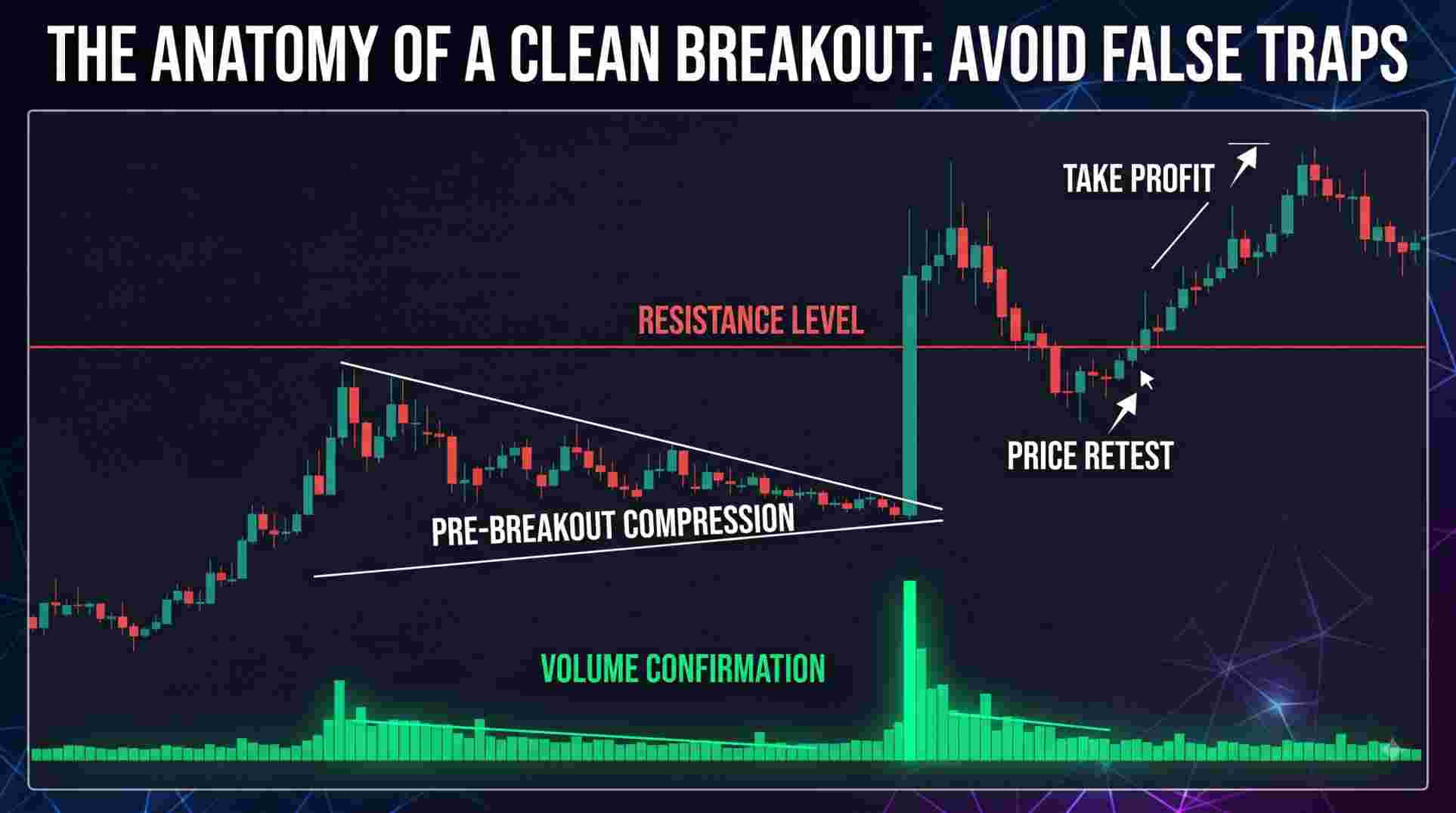
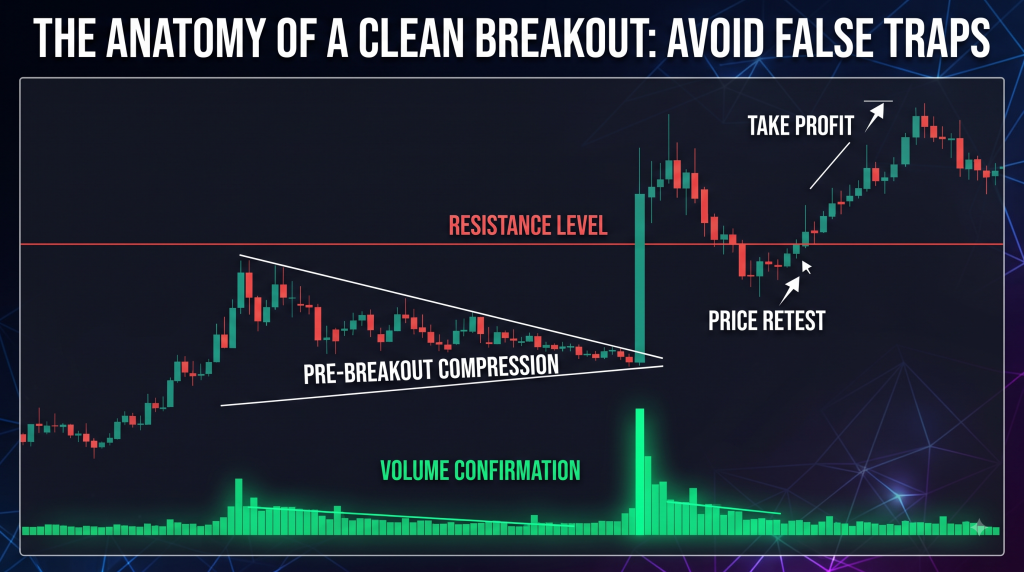
A high-probability breakout rarely occurs out of nowhere; it is almost always preceded by a period of tightening price action and declining volatility. When an asset forms a symmetrical triangle, a tight flag, or an ascending base near a major resistance barrier, it indicates that supply and demand are reaching a critical equilibrium. During these compression phases, impulsive traders get shaken out, and institutional players quietly build or accumulate their positions. Recognizing this buildup before the explosive move happens is what separates professional traders from reactive chasers. If a breakout occurs without a prior compression or coiling phase, the odds of a failed follow-through increase exponentially.
The Crucial Role of Volume Confirmation During the Breakout Candle
Volume is the ultimate lie detector in technical analysis, and it plays a decisive role in validating whether a breakout has true institutional backing. When a stock or crypto asset breaches a key resistance level, the breakout candle must be accompanied by a surge in trading volume that significantly exceeds the daily average. High volume signifies that large capital blocks are aggressively entering the market, eager to absorb whatever selling pressure remains at that ceiling. Conversely, if an asset breaks out on meager or declining volume, it reveals a lack of conviction, warning smart traders that the move is likely driven by retail FOMO rather than smart money commitment.
Executing the Breakout Retest Strategy for Lower Risk
Even with strong volume and clean compression, chasing a breakout candle at its absolute high creates an unfavorable risk-to-reward ratio, leaving your stop-loss vulnerable to normal market volatility. A far safer and statistically reliable approach is the breakout-and-retest strategy. Once the breakout occurs, institutional algorithms and patient traders often wait for the price to pull back and test the former resistance level, which now acts as a newly flipped support zone. Entering when the price successfully bounces off this retest allows you to place a tight stop-loss just beneath the structure, transforming a high-risk chase into a structured, low-risk execution.
Also Read: Volume Profile Trading Strategy for Better Trading