
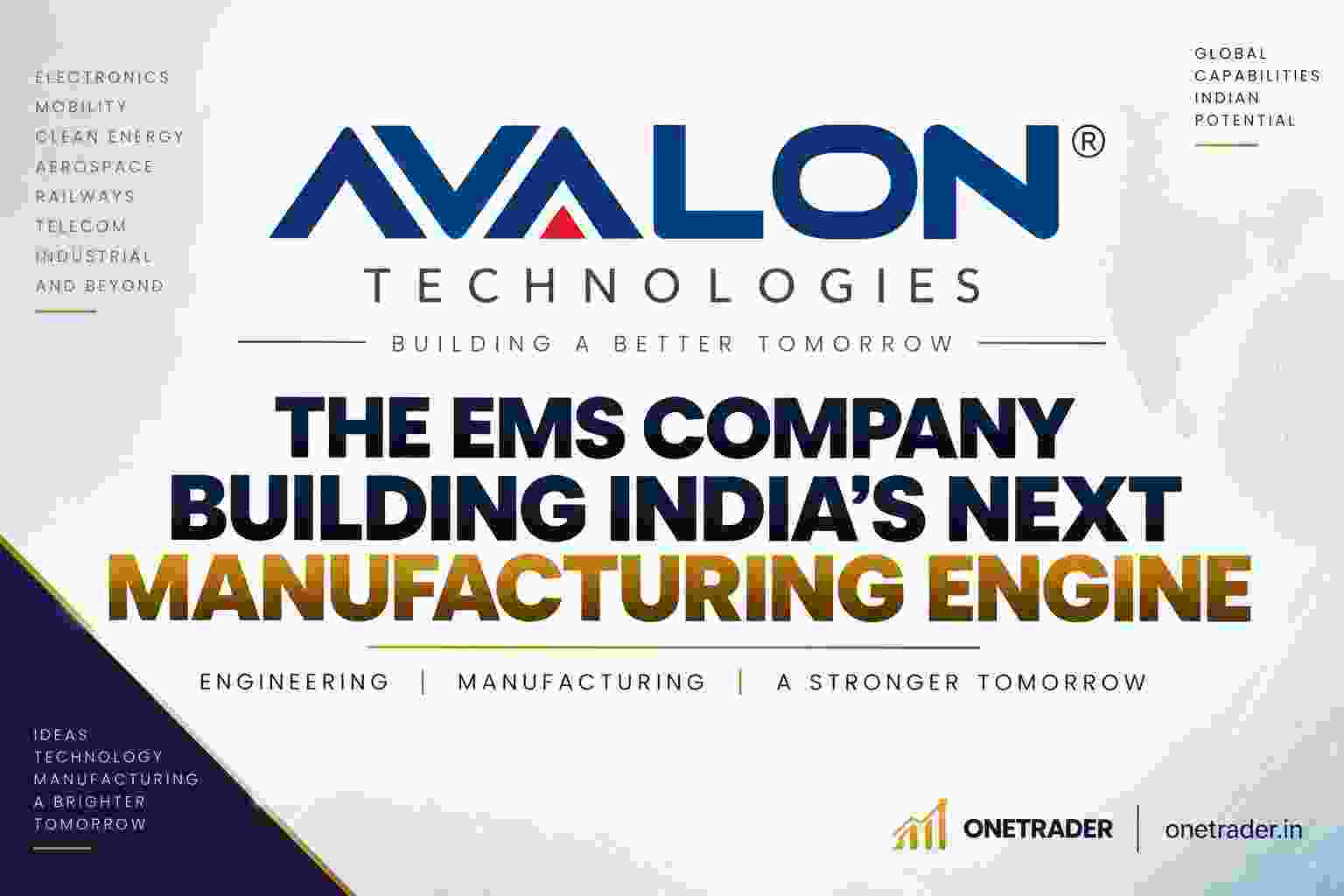
When people talk about India’s manufacturing opportunity, the conversation usually revolves around semiconductor fabrication, electronics brands, automobile companies or large industrial factories. But there is another part of the manufacturing ecosystem that can become increasingly important as global companies diversify their supply chains: Electronics Manufacturing Services, or EMS. These companies may not sell products under their own consumer brands, but they design, engineer, manufacture, assemble, test and manage products for other companies.
Avalon Technologies operates in this space, but describing it simply as an electronics contract manufacturer misses a much bigger part of its business. Avalon has built an integrated manufacturing platform covering design, engineering, new-product introduction, printed circuit board assembly, system integration, cable and wire harnesses, sheet-metal fabrication, machining, plastics, magnetics, aerospace components and supply-chain services. Its customers can effectively use Avalon as an external manufacturing and engineering partner rather than building every capability internally.
That distinction is important because the opportunity in EMS is not simply about assembling more circuit boards. The deeper opportunity is to become embedded in a customer’s product lifecycle, from the early design stage through prototyping, production, system integration and lifecycle management. Avalon is positioning itself around exactly this model.
Avalon’s Business Is Bigger Than PCB Assembly
At its simplest level, an EMS company manufactures electronic products for other companies. A customer may have the product design, intellectual property and end-market relationship but decide that manufacturing is better handled by a specialised partner.
Also Read: IREDA: The Green Financing Powerhouse Funding India’s Renewable Energy Boom
Avalon takes that relationship further. Its capabilities include PCB assembly, cable and wire harness assembly, system integration and box builds, mechanical enclosures, sheet-metal work, aerospace metal, machining, plastics, magnetics and logistics. It also provides design-for-manufacturing services, rapid prototyping, thermal engineering, reliability analysis and new-product introduction.
This creates a vertically integrated model. Instead of treating manufacturing as one isolated activity, Avalon can participate in multiple stages of bringing a product from an engineering concept to commercial production.
For a customer, this can reduce the number of suppliers involved in a project and potentially simplify production management. For Avalon, the strategic benefit is that a successful customer relationship can become broader over time. A company that initially uses Avalon for PCB assembly could potentially add box-build assembly, cable harnesses, mechanical components, testing, supply-chain management and lifecycle services later.
That creates an important business dynamic: the value of the customer relationship can increase as Avalon becomes more deeply integrated into the product.
Also Read: Sona BLW: From Auto Components to a Mobility Technology Company
The Company Operates Where Electronics Meet Physical Manufacturing
One of Avalon’s more important characteristics is its combination of electronics and mechanical manufacturing.
Electronic products increasingly require far more than a circuit board. A sophisticated product can contain PCBs, cables, connectors, metal enclosures, plastic components, thermal-management systems, power electronics and software-controlled modules. The final product may also require testing and system integration before it reaches the customer.
Avalon’s capabilities allow it to participate across several of these layers. Its system-integration operations include complete box builds, cabinets, enclosures, rack-mounted systems, functional testing and electromechanical assemblies.
This matters particularly in high-complexity industries where customers cannot simply select the lowest-cost manufacturer. Reliability, traceability, quality systems, engineering capability and the ability to handle complex production requirements can become more important than labour cost alone.
Also Read: Anlon Healthcare: The Small Pharma Company Building a Bigger Global Opportunity
Avalon describes its model as high-mix, flexible-volume manufacturing. That means it is designed to handle products where there may be many different configurations and production volumes can vary rather than focusing only on extremely large, standardised consumer-electronics runs.
Why High-Mix Manufacturing Can Be Valuable
A factory producing millions of identical low-complexity products operates differently from a manufacturer handling smaller quantities of technically complex products.
High-mix manufacturing requires engineering knowledge, production flexibility, quality control and the ability to switch between different products and configurations. Customers operating in aerospace, medical, industrial equipment, railways, communications or advanced power electronics may value these capabilities because production mistakes can have much larger consequences.
Avalon’s current positioning is strongly aligned with this segment. Its website identifies aerospace and defence, industrial, rail, clean energy, mobility, communication, semiconductor equipment and other technology-driven markets among the industries it serves.
Also Read: Piramal Pharma: The Pharma Platform Building Its Next Growth Engine
This creates a different competitive environment from purely commodity electronics assembly. The deeper Avalon moves into engineering-intensive and regulated applications, the more important certifications, manufacturing processes, customer qualification and production history can become.
Clean Energy Is Becoming a Major Manufacturing Opportunity
One of Avalon’s most interesting exposure areas is clean energy.
The company works with solar, energy-storage, electric-mobility and hydrogen-related applications. Its clean-energy capabilities include manufacturing support for solar inverters, solar trackers, battery systems, charging systems, DC converters, battery-management systems and other power-electronics products. Avalon also highlights manufacturing support for hydrogen-related power-conversion equipment.
This is strategically relevant because the energy transition is creating an entirely new generation of electronic equipment.
Also Read: Lodha Developers: The Real Estate Giant Building Its Next Growth Engine?
The move from conventional electricity infrastructure toward solar, batteries, electric vehicles, charging networks and distributed energy systems increases the amount of electronics embedded within energy infrastructure. Inverters convert electricity between different forms, battery-management systems monitor and control battery packs, charging systems manage power delivery, and sophisticated control electronics increasingly sit inside energy equipment.
For Avalon, the opportunity is therefore not simply “renewable energy.” It is the increasing electronics intensity of the energy system.
Electric Mobility Expands the Addressable Market
The same trend is visible in mobility.
Avalon supports automotive and electric-mobility applications including electronic dashboards, digital cockpits, telematics control units and battery-management systems. Its broader mobility exposure also extends into rail and aerospace.
Also Read: DMart The Retail Giant Facing Its Biggest Growth Test Yet?
Electric vehicles are particularly relevant to EMS companies because electrification increases the importance of power electronics, sensors, control systems, battery electronics and communication modules.
The opportunity can extend beyond passenger cars. Commercial vehicles, charging infrastructure, industrial mobility and other electrified transportation applications can all require increasingly sophisticated electronic systems.
Avalon’s model gives it the ability to serve customers developing these products without needing to become the owner of the final vehicle or energy platform.
Aerospace and Defence Add a Different Layer of Complexity
Aerospace is another area where Avalon’s manufacturing capabilities become more significant.
Also Read: Priority Jewels The Small Jewellery Manufacturer With a Big Growth Opportunity?
The company manufactures sheet-metal fabrications, machined components and injection-moulded plastics for aerospace applications and identifies aircraft seating, cargo systems, smoke detectors, engine-related parts and other applications within its aerospace capabilities. Avalon also highlights AS9100D certification and NADCAP accreditation for fusion and resistance welding.
The significance here is not simply the size of the aerospace market. Aerospace manufacturing requires specialised processes, documentation, quality control and certifications. Once a supplier becomes qualified for a particular application, replacing that supplier can involve considerable validation and operational work.
That can contribute to longer customer relationships and higher barriers to entry compared with generic electronics assembly.
Railways Give Avalon Another Industrial Growth Avenue
Railway manufacturing provides another example of Avalon moving into specialised applications.
Also Read: ESDS Software Solution The AI Data Centre Stock Nobody Is Talking About?
The company works across railway electronics and metal components and identifies applications such as signalling systems, passenger-information systems, braking systems, battery boxes, HVAC and rolling-stock-related equipment. It also states that it is an RDSO-approved manufacturer for relevant railway applications.
India’s railway modernisation and the broader global push toward smarter transportation systems create demand for electronics, control systems and specialised components.
For Avalon, railway exposure also contributes to diversification. The company does not have to depend entirely on one end market such as consumer electronics or automotive production.
Communication Infrastructure Is Another Important Market
Avalon also participates in communication infrastructure, including products associated with 5G equipment, antennas, remote radio heads and baseband units. Its capabilities extend to satellite-enabled products and digital infrastructure, including tracking, vision and communication systems.
Also Read: Lumino Industries The Power Infrastructure Stock Riding India’s Electricity Boom?
This is another market where product complexity can work in favour of specialised manufacturing partners.
Telecom equipment has to meet demanding requirements around reliability, thermal performance, signal integrity, testing and production quality. Satellite-related equipment can impose even more stringent requirements because products may have to operate in difficult environments.
Avalon’s role in these markets demonstrates the breadth of its manufacturing platform and its attempt to participate in several structural technology trends simultaneously.
The Real Competitive Advantage Could Be Integration
The most important part of Avalon’s business may not be any single manufacturing capability.
Also Read: Star Health Insurance The Hidden Profit Recovery Story in Indian Insurance?
Its potential advantage comes from combining many capabilities under one platform.
A customer can potentially move from product design and prototyping to PCB assembly, mechanical fabrication, cable harnesses, system integration, testing, volume production and lifecycle management through the same manufacturing ecosystem. Avalon describes this as supporting customers across the product lifecycle, from concept and design to new-product introduction and mass production.
This creates the possibility of switching costs.
If Avalon becomes involved during the engineering and prototype stage, the relationship can become operationally important when the product enters commercial production. The manufacturer learns the product, its bill of materials, production requirements, testing procedures and quality specifications. As volumes increase, that accumulated knowledge can become valuable to both sides.
Also Read: Augmont Enterprises: Gold Platform, Products and Future Growth
Avalon has also highlighted long-term customer relationships and examples where its engineering and manufacturing teams became involved in increasingly complex PCB and production requirements. One company case study describes Avalon supporting complex PCB assembly with reported yields above 98% for a customer serving major semiconductor companies.
The broader lesson is that EMS can become a relationship-driven business when the manufacturer is involved deeply enough in the customer’s product.
India Plus Global Manufacturing
Avalon’s strategy is not based only on manufacturing in India.
Its current website describes 16 facilities across the US and India, more than 3,700 global service staff and over 615,000 square feet of manufacturing facilities, alongside more than 25 years of manufacturing experience.
Also Read: Gland Pharma The Injectable Pharma Giant Entering Its Next Growth Cycle?
The company also operates through Avalon Technology & Services, Sienna ECAD Technologies and ABV Electronics in the US, giving it a combination of Indian and American manufacturing and engineering capabilities.
This geographic structure can matter for global customers.
An OEM may want engineering or production close to its existing operations in the United States while also benefiting from India’s manufacturing ecosystem. Avalon can potentially offer local, global or hybrid manufacturing models depending on customer requirements. The company explicitly promotes a “build local, scale global” approach and describes Make-in-India, Make-in-USA and hybrid manufacturing models.
That becomes particularly relevant as multinational companies rethink supply chains and seek alternatives to concentrated manufacturing bases.
Also Read: Burger King India The Turnaround Story Nobody Is Watching?
Sienna Strengthens the Engineering and Manufacturing Platform
Avalon’s corporate structure includes Sienna ECAD Technologies in India and ABV Electronics in the United States. The US operations provide a bridge into American customers and manufacturing requirements, while the Indian operations add engineering and manufacturing capacity.
The importance of this structure is strategic. A global EMS company needs more than factories; it needs customer access, engineering capabilities, supply-chain management, quality systems and the ability to support products across different geographic markets.
Avalon’s US presence therefore can be viewed as part of its customer-proximity strategy rather than simply an overseas manufacturing footprint.
Where the Next Growth Could Come From
Avalon’s opportunity sits at the intersection of several long-term manufacturing trends.
Also Read: BlueStone Jewellery The Missed Gem?
The first is the global outsourcing of electronics manufacturing. Companies increasingly have to decide which activities should remain internal and which can be handled by specialised manufacturing partners. As product complexity rises, outsourcing can extend beyond basic assembly into design-for-manufacturing, testing, system integration and lifecycle management.
The second is India’s emergence as a manufacturing and electronics-production destination. If more global companies build supply chains in India, local EMS providers can potentially benefit from the resulting demand for production, engineering and component integration.
The third is electronics penetration across traditional industries. Automobiles, energy systems, railways, aerospace, industrial equipment and communication infrastructure are all becoming more electronics-intensive. This expands the potential addressable market for companies capable of manufacturing complex electronic and electromechanical systems.
The fourth is the shift toward higher-value manufacturing. Avalon’s capabilities in aerospace, railways, medical electronics, clean energy, semiconductor equipment and industrial products suggest a strategy of moving toward applications where engineering capability and manufacturing quality are important rather than competing purely on low-cost assembly.
Also Read: Electronics Mart India: Can the Company Behind Bajaj Electronics Become a Powerhouse?
What Could Make the Business Difficult
The opportunity does not remove the fundamental risks of contract manufacturing.
Avalon remains dependent on customers, production programmes and the broader electronics manufacturing cycle. If a major customer reduces orders, delays a product launch or changes its manufacturing strategy, the impact can be meaningful.
Working-capital requirements can also be important because manufacturing businesses often need to purchase components and maintain inventory before receiving customer payments. Supply-chain disruptions, component shortages and commodity-price movements can affect operations even when end-market demand remains healthy.
Customer concentration is another issue to watch. Long-term relationships can be valuable, but reliance on a small number of large customers can also create bargaining and volume risks.
Also Read: The Hidden AI Stock That Could Power India’s Digital Government
The business is also capital-intensive as it expands manufacturing capacity and adds specialised capabilities. New facilities must achieve sufficient utilisation to generate attractive returns. Expansion therefore has to be matched by customer programmes and production volumes.
Finally, moving into higher-value industries brings higher expectations. Aerospace, medical, automotive and other regulated markets require strict quality systems, certifications and process discipline. A manufacturing failure can have consequences far beyond a normal production delay.
Avalon’s Bigger Story
Avalon Technologies is best understood not simply as a PCB assembler or an electronics contract manufacturer, but as an increasingly integrated manufacturing and engineering partner.
Its business model connects design, engineering, prototyping, PCB assembly, mechanical manufacturing, cable harnesses, system integration, testing, logistics and lifecycle management. Around this platform, the company is building exposure to clean energy, electric mobility, aerospace and defence, railways, communication infrastructure, industrial technology, medical electronics and semiconductor-related equipment.
Also Read: Tata Capital Business Model & Long-Term Growth Strategy (2026 Analysis)
That breadth is important because the future of manufacturing is increasingly about the convergence of electronics, software, power systems and physical engineering. Solar equipment needs electronics. Electric vehicles need sophisticated control systems. Railways need signalling and communication systems. Aerospace requires high-reliability electronic and mechanical components. Industrial machines are becoming connected and automated.
Avalon sits in the middle of many of these transitions.
The central question for the business is therefore not simply how many circuit boards it can assemble. It is whether Avalon can continue moving deeper into customers’ product lifecycles, win increasingly complex programmes, expand its global manufacturing footprint and convert its broad engineering and manufacturing capabilities into long-duration customer relationships.
If that happens, Avalon’s evolution could look very different from that of a traditional contract manufacturer. It could increasingly become a strategic manufacturing partner for companies that need to design, industrialise and scale complex technology products across multiple industries.
Also Read: NTPC Green Energy Ltd Complete Business Analysis:2035
Financial Disclaimer
This article is intended for educational and informational purposes only. It does not constitute investment advice, a recommendation to buy or sell any security, or a guarantee of future returns. Investors should conduct their own research and consider their financial objectives, risk tolerance and investment horizon before making any investment decision.