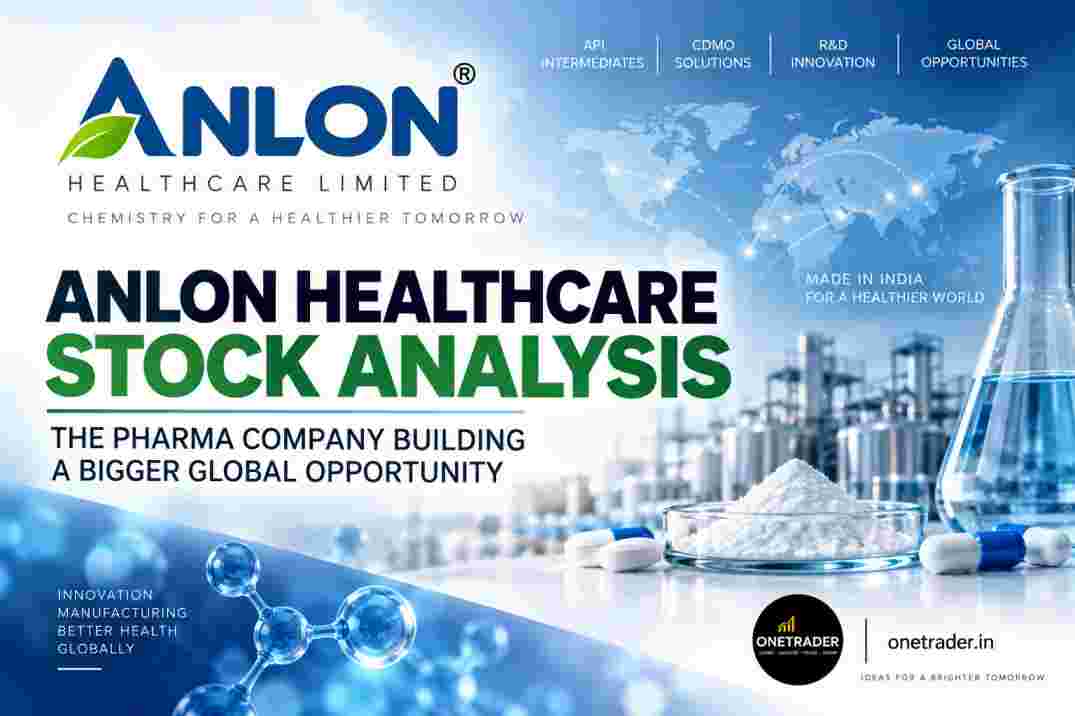
India’s pharmaceutical opportunity is expanding beyond finished medicines. As global drug companies look for reliable manufacturing partners outside China, the demand for high-purity pharmaceutical intermediates, active pharmaceutical ingredients and specialised chemical manufacturing is creating opportunities for smaller Indian companies with strong technical capabilities.
Anlon Healthcare is one such company. Based in Rajkot, Gujarat, Anlon manufactures pharmaceutical intermediates and active pharmaceutical ingredients that are used across finished medicines, nutraceuticals, personal care products and animal healthcare. But the company’s longer-term story is moving beyond its existing API portfolio toward custom manufacturing, CDMO opportunities, higher-value products and a broader global manufacturing platform.
What Does Anlon Healthcare Actually Do?
At its core, Anlon Healthcare is a specialised chemical manufacturer. The company produces high-purity pharmaceutical intermediates that act as important building blocks in API manufacturing, as well as APIs that eventually become part of finished pharmaceutical formulations such as tablets, capsules, ointments and syrups.
Its products also extend beyond traditional pharmaceuticals into nutraceuticals, personal care and veterinary applications. The company’s commercialised portfolio includes more than 65 products across these categories, while its broader R&D pipeline includes products at pilot and laboratory stages.
Also Read: Piramal Pharma: The Pharma Platform Building Its Next Growth Engine
This creates a business model where Anlon is not dependent on a single molecule or therapeutic category. Its portfolio covers areas including anti-inflammatory, analgesic, antipyretic, antihistamine, anticoagulant and other therapeutic applications.
The API and Intermediate Business
Pharmaceutical intermediates and APIs remain the foundation of Anlon’s business.
An intermediate is essentially a chemical building block used during the manufacturing process of an API. The API is the active substance that ultimately provides the therapeutic effect in a finished medicine.
This positioning gives Anlon an important place within the pharmaceutical supply chain. Instead of competing directly with finished-drug brands, the company supplies specialised ingredients to pharmaceutical manufacturers.
Also Read: Lodha Developers: The Real Estate Giant Building Its Next Growth Engine?
The company has developed capabilities in several specific chemistries and manufactures products according to major pharmacopoeia standards including Indian, British, European, Japanese and United States standards. This regulatory and quality infrastructure becomes increasingly important when serving customers in regulated international markets.
Moving Toward CDMO
The more interesting part of the Anlon story is its move toward custom manufacturing and CDMO.
Traditional API manufacturing generally involves established products with known manufacturing processes. CDMO work can be more specialised because customers approach the manufacturer with specific molecules or chemistry requirements that need development, scale-up, validation and eventually commercial manufacturing.
Anlon is already developing molecules for global innovator companies under its custom-manufacturing business. Recent company updates indicate that three molecules are being developed for two global innovator customers, with validation and commercialisation milestones expected across FY27 and FY28.
Also Read: DMart The Retail Giant Facing Its Biggest Growth Test Yet?
If these projects progress successfully, they could change the nature of Anlon’s business by adding longer-term customer relationships and more specialised manufacturing opportunities.
That is an important transition because the company would increasingly participate in the development and manufacturing process rather than simply supplying standard products.
R&D Is Becoming a Competitive Advantage
For a specialised chemical manufacturer, R&D is more than a support function. It can determine whether the company is able to develop new molecules, improve manufacturing processes and respond to customer-specific requirements.
Anlon has built multiple in-house R&D laboratories and maintains a pipeline of products at different stages of development. Its earlier investor disclosures highlighted 65 commercial products, 28 products at pilot scale and 49 molecules under laboratory development.
Also Read: Priority Jewels The Small Jewellery Manufacturer With a Big Growth Opportunity?
This pipeline provides the company with opportunities to continually introduce new products rather than depending indefinitely on its existing portfolio.
The company’s strategy of filing additional Drug Master Files, or DMFs, is also important. DMFs provide regulatory information about the manufacturing process and product quality that can support approvals in international markets.
The China+1 Opportunity
One of the biggest external opportunities for Anlon is the global pharmaceutical industry’s China+1 strategy.
Pharmaceutical companies have increasingly been looking to diversify their supply chains rather than depending excessively on a single manufacturing geography. India is one of the countries benefiting from this trend because of its chemical manufacturing capabilities, pharmaceutical ecosystem and growing regulatory infrastructure.
Also Read: ESDS Software Solution The AI Data Centre Stock Nobody Is Talking About?
Anlon is positioning its manufacturing platform to capture this opportunity by expanding capacity and targeting regulated export markets. The company has also highlighted its intention to build globally compliant capacity that can compete with established low-cost API suppliers.
The opportunity is particularly relevant for high-purity intermediates and specialised APIs where customers place greater importance on quality, reliability and regulatory compliance rather than simply the lowest possible price.
Regulatory Capability Matters
Pharmaceutical manufacturing is a heavily regulated business. A company may have manufacturing capacity, but without the necessary regulatory approvals and quality systems, that capacity cannot easily serve important global markets.
Anlon has been expanding its regulatory footprint through DMF filings and international compliance approvals. Its investor disclosures have highlighted 21 DMF filings across major regulated markets and regulatory progress in markets including Europe and the United States.
Also Read: Lumino Industries The Power Infrastructure Stock Riding India’s Electricity Boom?
The company’s manufacturing facility has also received international regulatory recognition, including ANVISA approval with zero observations according to company disclosures.
This regulatory infrastructure can become a competitive asset because customers looking for alternative suppliers need confidence that the manufacturer can consistently meet stringent quality requirements.
Capacity Expansion Could Change the Scale
Anlon’s existing manufacturing facility is approaching high utilisation, making additional capacity an important part of its growth strategy.
The company has planned a significant expansion that is expected to increase manufacturing capacity. Its earlier investor presentation described a proposed 700 MTPA expansion that would take total capacity toward 1,100 MTPA.
Also Read: Star Health Insurance The Hidden Profit Recovery Story in Indian Insurance?
More recent company updates indicate that further organic capacity expansion is also being planned at the Anlon site, with approximately 1,200 MT of additional capacity targeted through the new project.
Capacity expansion by itself is not a competitive advantage. The real value comes if Anlon can fill that capacity with higher-value products, export orders and long-term customer programmes.
That is why the company’s CDMO pipeline and DMF portfolio are important alongside the physical expansion.
Backward Integration Adds Another Layer
Anlon has also been expanding through acquisitions.
Also Read: Augmont Enterprises: Gold Platform, Products and Future Growth
The acquisition of Apiqo Organics is intended to strengthen backward integration by bringing production of certain intermediates in-house. This can potentially improve supply-chain control and reduce dependence on external suppliers for important raw materials.
The acquisition of Bizotic Lifescience adds further manufacturing capacity and regulatory capabilities to the broader group. Together, these acquisitions are helping Anlon expand its manufacturing footprint and product capabilities.
Backward integration can become particularly useful in specialty chemicals because reliable access to critical intermediates can improve manufacturing flexibility and reduce supply-chain uncertainty.
New Opportunities Beyond Traditional APIs
Anlon is also exploring businesses beyond its existing API and intermediate portfolio.
Also Read: Gland Pharma The Injectable Pharma Giant Entering Its Next Growth Cycle?
The company has been developing capabilities in peptides and biosimilars through Anlon Biologics. The subsidiary is intended to focus on peptides for human, cosmetic and nutraceutical applications as well as other biological products.
Anlon is also entering surgical implants through Anlon Medicare, covering areas such as trauma, spine and joint implants. This represents a broader extension into the healthcare ecosystem and connects with the company’s existing exposure to pain-management products.
The company has additionally discussed expansion into industrial and fine chemicals, potentially creating another avenue for diversification.
These businesses are still developing, so they should be viewed as future opportunities rather than established growth engines.
Also Read: Burger King India The Turnaround Story Nobody Is Watching?
What Creates the Moat?
Anlon is still much smaller than India’s large pharmaceutical companies, so its competitive advantage cannot come simply from scale.
Its potential moat comes from a combination of specialised chemistry, customer-specific manufacturing capabilities, regulatory approvals, R&D expertise and relationships with pharmaceutical customers.
The company has also highlighted process expertise in specific chemistries, including methylation and Friedel-Crafts chemistry. Such process knowledge can become valuable when a manufacturer develops efficient and reliable production methods for specialised molecules.
Over time, the combination of chemistry expertise and regulatory approvals can make it more difficult for customers to replace a qualified supplier quickly.
Also Read: BlueStone Jewellery The Missed Gem?
What Could Drive the Next Phase?
Anlon’s next phase could be driven by several interconnected developments.
The first is the expansion of its API and intermediate portfolio. The company has planned additional products across new therapeutic categories and further DMF filings.
The second is CDMO commercialisation. Successful validation and commercialisation of the molecules currently under development could give Anlon a stronger presence in custom manufacturing.
The third is capacity expansion. Additional manufacturing capacity gives the company room to scale if customer demand develops as expected.
Also Read: Electronics Mart India: Can the Company Behind Bajaj Electronics Become a Powerhouse?
The fourth is the China+1 opportunity. Global pharmaceutical companies seeking diversified supply chains could provide opportunities for Indian manufacturers with the necessary quality and regulatory capabilities.
Finally, businesses such as peptides, biologics, surgical implants and fine chemicals could create additional long-term optionality.
The Risks to Watch
The main business risk is execution. Anlon is simultaneously expanding capacity, adding products, developing CDMO projects and entering new healthcare segments. Managing all of these initiatives while maintaining consistent quality will be important.
CDMO projects also carry development risk. A molecule moving through development or validation does not automatically guarantee successful commercialisation.
Also Read: The Hidden AI Stock That Could Power India’s Digital Government
Regulatory risk is another important factor because international pharmaceutical customers require strict compliance. Any significant quality or regulatory issue could affect customer relationships and market access.
The company also needs to ensure that new capacity is matched by sustainable demand. Building manufacturing infrastructure ahead of customer requirements can put pressure on returns if utilisation remains low.
Finally, Anlon’s expansion into newer areas such as biologics and medical devices means it will need to develop capabilities outside its traditional chemistry-based business.
The Bigger Story
Anlon Healthcare is evolving from a relatively small API and pharmaceutical-intermediate manufacturer into a broader specialised healthcare manufacturing platform.
Also Read: Tata Capital Business Model & Long-Term Growth Strategy (2026 Analysis)
The existing business provides the foundation. R&D and regulatory capabilities create the opportunity to enter new markets. CDMO projects can move the company toward higher-value custom manufacturing, while capacity expansion and acquisitions can increase its manufacturing scale.
The China+1 trend provides an external tailwind, but the company’s long-term success will depend on whether it can convert that opportunity into durable customer relationships and profitable utilisation of its expanded capabilities.
The most interesting part of the story is therefore not simply how much Anlon produces today. It is what the company is trying to become over the next several years.
Disclaimer: This article is for educational and informational purposes only. It is not investment advice or a recommendation to buy or sell any security. Onetrader is not a SEBI-registered investment adviser. Investors should conduct their own research or consult a qualified financial professional before making investment decisions.
Also Read: NTPC Green Energy Ltd Complete Business Analysis:2035