

India’s real estate market is increasingly becoming a scale-and-brand game, and Lodha Developers has emerged as one of the country’s most prominent listed developers. Formerly known as Macrotech Developers, the company has built a strong presence across Mumbai and other key markets while increasingly moving toward a broader real estate platform.
What makes Lodha interesting today is that its growth story is no longer dependent only on selling residential properties. The company is expanding its development pipeline, entering new markets, reducing leverage and building recurring-income assets. Its latest quarterly performance suggests that this strategy is beginning to translate into stronger earnings.
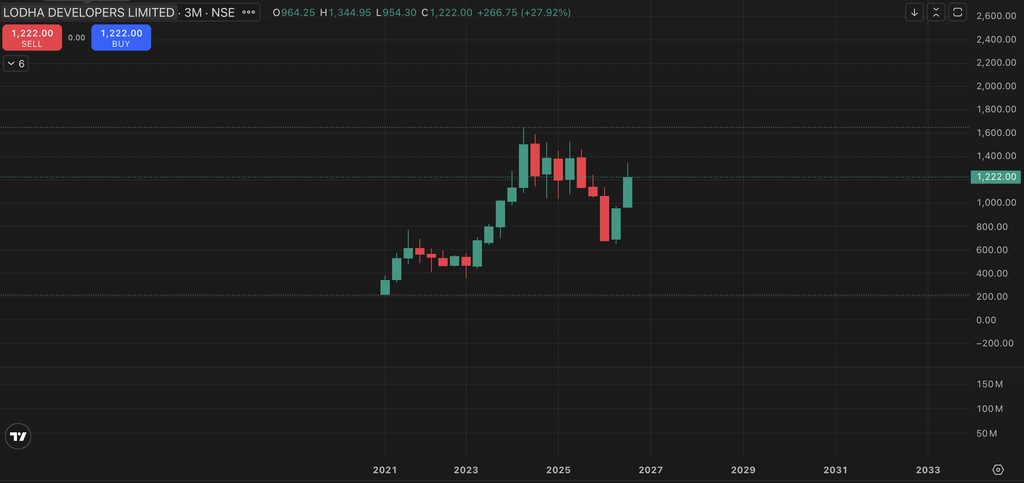
A Strong Start to FY27
Lodha delivered a powerful Q1 FY27 performance. Revenue from operations reached ₹4,996.7 crore, up 43.1% year-on-year. Operating profit increased by more than 95% year-on-year, while profit attributable to owners rose 103.4% to approximately ₹1,372 crore, making it the company’s highest-ever quarterly profit.
The improvement was supported by higher revenue, better operating margins and strong cash generation. For a real estate company, where earnings can fluctuate significantly depending on project completions and accounting recognition, the combination of revenue growth and profitability improvement is particularly important.
Also Read: Vodafone Idea: Can India’s Telecom Challenger Turn Its 5G Expansion Into a Business Comeback?
Lodha has also maintained ambitious FY27 targets, including pre-sales of ₹24,000 crore and PAT of around ₹4,100 crore. Management has further indicated an ambition to grow PAT to more than ₹8,500 crore by FY31.
The Residential Business Remains the Core Engine
Lodha’s biggest strength remains its residential development business. The company operates primarily in Mumbai Metropolitan Region and has developed a portfolio spanning premium, luxury and more mass-market housing segments.
Its established brand gives it an important advantage in markets where customers are increasingly willing to pay a premium for trusted developers. Real estate is also a business where land availability, approvals, execution capabilities and customer trust create significant barriers to entry.
The company has continued to build its future project pipeline through outright land acquisitions and joint-development arrangements. During Q1 FY27, Lodha added a new Pune project with an estimated gross development value of ₹2,300 crore.
Its expansion into Pune and the NCR market is strategically important because it reduces dependence on a single geographic market while allowing Lodha to participate in India’s broader premium housing opportunity.
Palava Could Become a Major Hidden Asset
One of the most interesting parts of the Lodha story is Palava. The company has a substantial landholding in the region, and management believes the value of this land has increased dramatically over the past several years.

The company is now looking beyond conventional residential development for this asset. Palava is becoming an important location for data centres, warehousing, industrial development and other infrastructure-linked opportunities.
Lodha has announced plans around a large data-centre ecosystem near Mumbai, and management has indicated that monetisation of land for data-centre development could become a significant source of capital and value creation.
This is potentially important because land monetisation can generate substantial cash without requiring the same capital intensity and construction cycle associated with residential development.
The Annuity Business Could Change the Story
Another long-term opportunity is Lodha’s annuity business. Unlike residential development, annuity assets can generate recurring income over extended periods.
The company generated around ₹300 crore of annuity income in Q1 FY27 and has outlined an ambitious objective of growing annual annuity income to more than ₹3,000 crore over the next six years. Data centres, warehousing and industrial parks and high-street retail are expected to contribute to this growth.
If successfully executed, this could gradually make Lodha less dependent on the traditional boom-and-bust characteristics of residential real estate.
Also Read: Delhivery Business Analysis: How India’s Technology-Driven Logistics Company Makes Money
Debt Reduction Is an Important Positive
Real estate companies need significant capital, making balance-sheet discipline extremely important. Lodha has been working to reduce leverage while continuing to invest in new projects.
Net debt stood at approximately ₹4,931 crore at the end of Q1 FY27, down ₹446 crore sequentially. Net debt-to-equity was around 0.2x, comfortably below the company’s internally stated ceiling of 0.5x. Its exit cost of debt was around 7.8%.
The company’s long-term objective of making the development business increasingly debt-free could significantly improve financial flexibility if strong cash generation continues.
Growth Is Attractive, But Real Estate Is Cyclical
The biggest risk is that real estate remains a cyclical industry. Demand can be affected by interest rates, economic growth, employment conditions and consumer confidence.
Also Read: VRL Logistics: Inside India’s Road Transport Giant and Its Expanding Logistics Business
Land and construction costs can also rise, putting pressure on project margins. Expansion into new cities creates additional execution risk because the company has to establish its brand and understand local markets.
The company’s growing exposure to data centres and annuity assets is strategically attractive, but these businesses also require significant execution and capital allocation discipline. A large development pipeline is valuable only if projects are launched, sold and monetised at attractive returns.
Valuation is another factor investors need to consider. Strong earnings growth can support a premium valuation, but expectations can also become demanding after a period of strong performance.
The Bigger Investment Story
Lodha Developers is increasingly evolving from a traditional residential real estate developer into a diversified real estate platform.
Also Read: ITC Farm-to-Food Business Model: Sourcing, Brands and Cash Flow
The residential business provides the primary growth engine. The development pipeline offers future visibility. Palava provides a large land-value opportunity, while data centres, industrial assets and other annuity businesses could create recurring income over time.
At the same time, declining leverage strengthens the balance sheet and gives the company more room to invest in future opportunities.
The key question for investors is therefore not simply whether Lodha can sell more homes. It is whether the company can convert its large land bank, development pipeline and new annuity businesses into sustainable cash flows and higher returns on capital.
Disclaimer: This article is for educational and informational purposes only. It is not investment advice or a recommendation to buy or sell any security. Onetrader is not a SEBI-registered investment adviser. Investors should conduct their own research or consult a qualified financial professional before making investment decisions.
Also Read: ServiceNow: From IT Ticketing to the AI Agent Operating System for Enterprises






Keep learning with OneTrader
Explore structured lessons and practical guides to build your market knowledge.