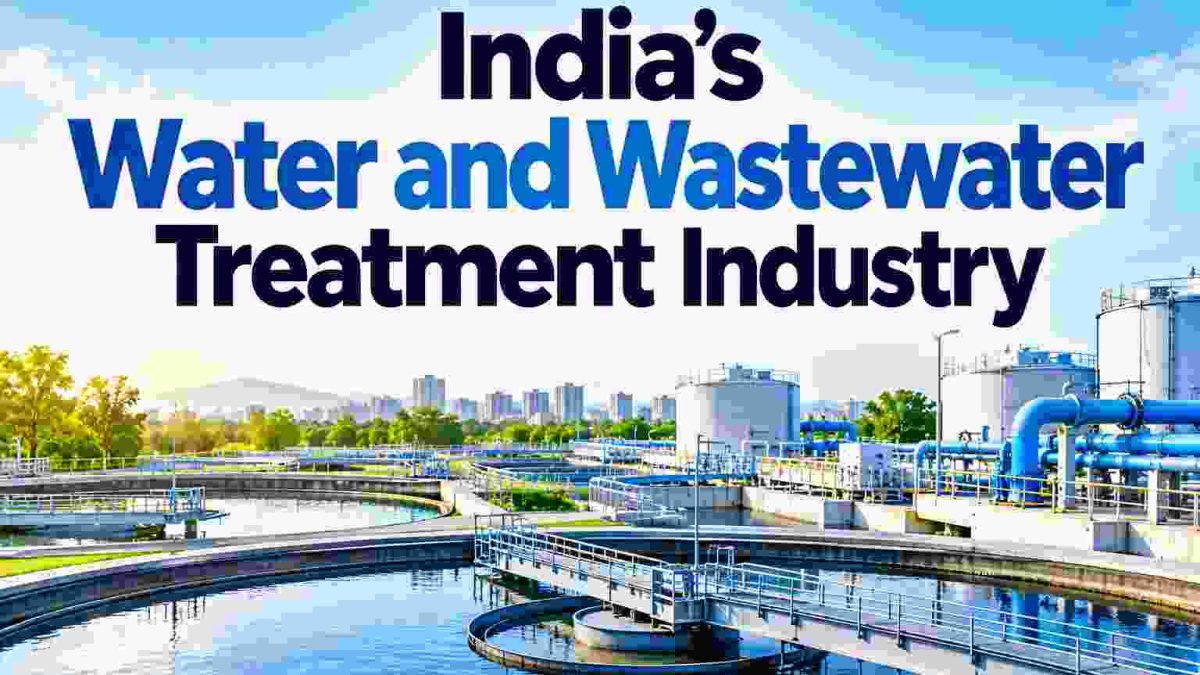
Water rarely receives the attention that electricity, roads or telecommunications attract when India’s infrastructure development is discussed. Yet almost every major industry depends on it. A semiconductor plant needs exceptionally pure water for manufacturing. A pharmaceutical factory requires reliable supplies for production and cleaning. Residential developments need drinking water, while expanding cities must find ways to treat the wastewater generated by millions of households.
India’s water infrastructure industry is therefore becoming increasingly important to economic development. The opportunity extends well beyond supplying drinking water. It includes sewage treatment plants, industrial effluent management, desalination facilities, wastewater recycling, pumps, filtration systems and long-term maintenance services.
For investors, the industry is worth understanding because it combines public infrastructure spending with industrial demand. However, companies operating in this space follow different business models. Some construct large treatment plants, others manufacture specialised equipment, and a few earn recurring income by operating facilities after construction.
Why Water Infrastructure Is Becoming More Important
India’s water challenge is not simply about the total amount of water available. It is also about where water is available, whether it is suitable for use and how efficiently it reaches households and industries.
Also Read: India’s Cold Chain and Refrigeration Industry: Growth, Future Opportunities and Key Stocks
A city may receive sufficient rainfall during the monsoon but still face shortages during summer. An industrial region may have access to water sources but require expensive treatment before the water can be used in manufacturing. Agricultural regions may depend heavily on groundwater, creating pressure on supplies during periods of weak rainfall.
Urban expansion adds another complication. As towns develop into larger cities, their existing water pipelines, pumping stations and sewage networks must serve more people. Without corresponding investment, the quality and reliability of water services can deteriorate.
The requirement is therefore not limited to building new facilities. India also needs to improve existing infrastructure, reduce distribution losses, monitor water quality and maintain treatment systems over many years.
This creates opportunities for engineering contractors, technology providers and equipment manufacturers, although the profitability of each project depends on its commercial terms and execution.
Also Read: AI Agents: The Future of How We Use Computers and the Internet
Government Spending and the Jal Jeevan Mission
Public investment remains an important driver of India’s water infrastructure industry.
The Jal Jeevan Mission was introduced to expand access to household tap-water connections in rural India. According to government figures released in February 2026, approximately 15.69 crore rural households had reported tap-water connections as of February 10, representing about 81% of the country’s rural households.
In March 2026, the Union Cabinet approved an extension of the mission until December 2028. The revised programme carries a total approved outlay of ₹8.69 lakh crore, including ₹3.59 lakh crore in central assistance.
The revised approach places greater emphasis on reliable water services, maintenance and institutional responsibility rather than measuring progress only through the construction of new connections.
Also Read: Why India’s Middle Class Is the Next Big Growth Engine
This distinction matters for companies involved in water infrastructure. Installing pipelines and treatment equipment creates one type of business opportunity. Keeping those systems operational, maintaining water quality and ensuring reliable distribution creates another.
Nevertheless, a government programme’s total outlay should not be confused with the revenue opportunity available to listed companies. Funds cover multiple activities and implementing agencies, while individual contractors must compete for projects and satisfy eligibility requirements.
Wastewater Treatment Could Become a Bigger Business
Supplying water is only half the infrastructure requirement. Once households and industries use that water, it must be collected, treated and, wherever practical, reused.
Sewage treatment plants are designed to remove contaminants from wastewater before it is discharged or reused for appropriate purposes. The process can involve biological treatment, filtration, disinfection and sludge management.
Also Read: Robotics & Industrial Automation in India: The Next Big Manufacturing Opportunity
India’s expanding urban population increases the importance of these facilities. New residential communities, commercial districts and industrial developments generate wastewater that must be managed without damaging surrounding water bodies.
The National Water Mission dashboard reported 3,019 sewage treatment plants as of July 29, 2026, against a target of 3,840 by 2031. However, the number of plants alone does not reveal how effectively they operate. Treatment capacity, utilisation, discharge quality and actual operating performance are equally important.
For companies, wastewater infrastructure can generate revenue through engineering and construction contracts as well as longer-term operation and maintenance agreements.
The commercial attraction of maintenance contracts is that they can provide revenue after a facility has been commissioned. Their profitability, however, depends on contract pricing, operating responsibilities, electricity consumption and performance obligations.
Also Read: Data Centre Infrastructure in India: Growth Opportunities
Industrial Water Treatment and Recycling
Industrial demand is another important part of the water treatment industry.
Chemical plants, textile manufacturers, pharmaceutical companies, refineries, power stations and other industrial facilities use water for different production processes. Depending on the application, water may need to be filtered, softened, purified or treated to meet precise technical specifications.
The wastewater generated by these industries can contain chemicals, dissolved solids and other contaminants that require specialised treatment.
In certain applications, businesses adopt zero liquid discharge systems designed to recover water and minimise liquid waste leaving the facility. Such installations may combine filtration, membrane technologies, evaporation and other treatment processes.
Also Read: Defence & Aerospace Manufacturing: India’s Next Major Industrial Growth Story
These systems can be technically complex and expensive to operate. Their commercial value depends on regulatory requirements, water availability, treatment costs and the feasibility of recovering usable water.
Industrial water recycling is particularly relevant where fresh water is scarce or expensive. A manufacturer that can reuse treated water may reduce its dependence on external supplies while improving operational resilience.
Companies capable of designing, installing and maintaining sophisticated treatment systems may benefit from these requirements. But investors must distinguish between a technology provider with established customer relationships and a contractor that participates in occasional projects.
Desalination and the Opportunity in Coastal India
Desalination is another specialised segment of the industry. It involves removing salts and other impurities from seawater or brackish water to produce water suitable for specific uses.
Also Read: Semiconductor & Electronics Manufacturing: India’s Next Big Industrial Opportunity
For coastal cities and industrial facilities facing pressure on conventional freshwater sources, desalination can provide an additional supply option.
Chennai is an important example of a city where seawater desalination forms part of the water infrastructure system. Such projects involve complex engineering, membrane technology, pumping systems and substantial energy consumption.
The opportunity is not limited to constructing plants. Desalination facilities also require maintenance, membrane replacement, monitoring and operational management.
However, desalination is not automatically the cheapest solution to water scarcity. Capital expenditure, electricity costs, environmental considerations and the management of concentrated saltwater discharge can influence project economics.

Also Read: India’s Power & Renewable Energy Sector: Growth, Demand, Future Scope and Key Stocks
Its usefulness therefore depends on local conditions and the availability of alternatives such as conservation, wastewater reuse and improved distribution efficiency.
Key Listed Companies in India’s Water Treatment Industry
Several Indian listed companies participate in different parts of the water infrastructure value chain. Their business exposure varies considerably, making it important to understand what each company actually provides.
VA Tech Wabag
VA Tech Wabag is one of the more directly focused listed companies in water and wastewater treatment. Its activities include designing, constructing and operating drinking-water treatment plants, sewage treatment facilities, industrial water systems and desalination projects.
The company’s business combines engineering expertise with project execution and operation and maintenance services. Its technological capabilities and international presence distinguish it from companies whose activities are limited mainly to conventional civil construction.
Also Read: AI and Power Demand: Could Utilities Become the Next AI Winners?
For FY2025–26, VA Tech Wabag reported revenue of approximately ₹3,294 crore and profit after tax of approximately ₹311.5 crore in its published financial overview.
Its future performance will depend on the conversion of orders into revenue, project execution, margins, customer payments and the contribution from longer-duration operating contracts.
Ion Exchange (India)
Ion Exchange operates across water treatment equipment, engineering solutions, specialty chemicals and related services.
Its activities extend from industrial water purification to wastewater treatment and process-water applications. This diversified presence gives the company exposure to customers that need both equipment and ongoing treatment-related products or services.
Also Read: AI and Data Centres: Stocks That Could Benefit From the Infrastructure Boom
An important distinction in its business model is that not all revenue depends on constructing large infrastructure projects. Products, chemicals and services can have different demand patterns and financial characteristics.
Investors studying Ion Exchange should examine the profitability and growth of its individual divisions, customer mix, working capital requirements and the contribution from recurring business.
EMS Limited
EMS Limited operates in water and wastewater infrastructure, including sewage treatment and sewerage-related projects.
Its business is closely connected to public infrastructure development, where contracts may involve engineering, construction and, in some cases, subsequent operation and maintenance.
Also Read: AI Adoption Is Spreading: Which Industries Could Benefit Most?
Such projects can provide meaningful revenue opportunities, but they also introduce risks involving approvals, site availability, project schedules and payments from government-related customers.
For EMS, the quality of the order book, execution progress, receivables and operating cash flow deserve particular attention.
Jash Engineering
Jash Engineering participates in the water infrastructure equipment segment, manufacturing products such as gates, screens and other specialised equipment used in water and wastewater management systems.
Its business illustrates an important difference within the sector. While large contractors may build complete treatment plants, equipment manufacturers supply critical components used in those facilities.
Also Read: Indian Defence Stocks in 2026: Growth Opportunity or Valuation Risk?
Product engineering, manufacturing capabilities, export demand and relationships with infrastructure contractors can influence the company’s performance.
Investors should assess order execution, manufacturing margins, customer concentration and the sustainability of demand rather than assuming that every increase in water infrastructure spending will translate directly into higher profits.
Welspun Enterprises
Welspun Enterprises is a diversified infrastructure company with exposure to water-related projects alongside other infrastructure activities.
Its participation in water supply and treatment infrastructure makes it relevant to the broader industry, although it should not be considered a pure water technology business.
Also Read: Top 5 Water Management Stocks in India: Financials, Growth & Future Potential
The company’s financial performance can be influenced by the execution of multiple infrastructure projects, contract structures and capital allocation decisions.
For investors, understanding the contribution of water projects to the overall business is more useful than treating the company as a direct substitute for a specialised water treatment provider.
Why Operations and Maintenance Matter
One of the most interesting aspects of water infrastructure is the potential for long-term operating relationships.
A treatment plant may require significant capital investment during construction, but its useful operating life can extend for many years. Throughout that period, the facility needs trained staff, electricity, chemicals, replacement parts, monitoring and periodic maintenance.
Also Read: Renewable Energy & Clean Tech Stocks in India: Complete List
Companies with the ability to manage these responsibilities may develop longer-lasting customer relationships than contractors involved only during construction.
Recurring revenue is attractive in principle, but investors should examine the actual economics. A long-term contract can become less profitable if operating expenses rise faster than agreed payments or if performance penalties are triggered.
The distinction between construction revenue and maintenance revenue also affects financial analysis. Large engineering projects may generate uneven quarterly revenue, while operating contracts can offer more predictable activity.
Neither model is inherently superior. What matters is whether the company earns an adequate return for the capital and risks involved.
Also Read: Is India’s Real Estate Boom Back? What Investors Need to Know
Technology and the Future of Water Management
Water treatment is increasingly becoming a technology-intensive industry.
Modern treatment facilities use automated monitoring systems, sensors, membrane filtration, chemical dosing equipment and digital controls to maintain water quality and manage operating costs.
Advanced filtration systems can be particularly important in industries requiring high-purity water. Semiconductor manufacturing, pharmaceutical production and certain electronics applications have demanding specifications that ordinary water treatment facilities cannot satisfy.
Technology can also help municipal utilities detect leaks, monitor distribution networks and identify changes in water quality.
Also Read: Water: The Hidden Infrastructure of the Future
For equipment manufacturers and engineering companies, technical expertise can create competitive advantages when customers require reliable performance under complex conditions.
However, technology alone does not guarantee strong financial results. Research expenditure, customer acceptance, equipment reliability and after-sales service all influence whether innovation becomes a profitable business.
Risks Investors Should Understand
The water treatment industry has structural demand drivers, but several financial and operational risks deserve attention.
Government contracts may involve lengthy tender processes, approval delays and payment cycles. A company can report a substantial order book without immediately converting those contracts into revenue or cash.
Also Read: Infrastructure Investment Trusts (InvITs) in India – Complete Beginner Guide | Onetrader
Working capital is especially important for engineering businesses. If payments are delayed while suppliers and employees must be paid on schedule, a growing company may need additional borrowing to finance its operations.
Project execution is another challenge. Land availability, equipment procurement, technical specifications and regulatory clearances can affect completion timelines.
Industrial water treatment companies face different risks, including competition, customer capital expenditure cycles and the cost of developing specialised technologies.
Valuation is also important. A company operating in a promising industry may still deliver disappointing investment returns if its share price already reflects overly optimistic growth expectations.
Also Read: Top Space-Tech Stocks in India – A Hidden Multibagger Opportunity (2025-2045)
What Investors Should Track
The first step in analysing a water infrastructure company is understanding where its revenue comes from. Municipal construction projects, industrial treatment equipment, chemicals and long-term operating services have different margins, cash-flow patterns and risks.
Order-book growth is useful, but it should be studied alongside execution capability. A large order book becomes valuable only when projects are completed profitably and customers make payments.
Operating cash flow is another important indicator. Investors should compare reported profits with actual cash generation, particularly for companies handling large government contracts.
Debt, receivables, return on capital and customer concentration can help reveal financial weaknesses that may not be obvious from revenue growth alone.
Also Read: Green Energy & EV Ecosystem – The Future of Power (2025–2035)
Investors should also examine whether a company has genuine technological capabilities, established operating experience and the financial resources required to handle increasingly complex projects.
Future Outlook for India’s Water Infrastructure Industry
India’s water infrastructure needs are likely to remain important as urbanisation, industrial development and household service requirements continue to evolve.
Government programmes can support drinking-water distribution and municipal treatment facilities, while industrial customers may increase investment in purification, recycling and wastewater management.
Desalination, advanced filtration and water reuse could become more relevant in locations facing significant freshwater constraints.
Also Read: Drone & Anti-Drone – The Futuristic Industry (2025 – 2035)
The industry may also gradually shift toward greater emphasis on maintaining existing infrastructure rather than simply constructing additional facilities.
For listed companies, the central challenge will be converting these opportunities into profitable contracts, dependable cash flow and sustainable returns on invested capital.
Water infrastructure may be an essential long-term development priority, but business quality and financial discipline will determine which companies benefit most effectively.
Conclusion
India’s water and wastewater treatment industry deserves attention because it supports basic public services and a wide range of industrial activities.
Also Read: AI & Cloud – The Complete Future Playbook
Companies such as VA Tech Wabag, Ion Exchange, EMS Limited, Jash Engineering and Welspun Enterprises provide exposure to different parts of the sector, from specialised treatment technologies to equipment manufacturing and infrastructure construction.
Their opportunities are not identical, and neither are their risks. Some businesses depend heavily on government contracts, while others serve industrial customers or generate revenue from equipment, chemicals and services.
For long-term investors studying the industry, the most useful approach is to look beyond the broad water infrastructure theme and examine how individual companies earn money, execute projects, manage capital and generate cash.
Disclaimer: This article is published by Onetrader for educational and informational purposes only. It does not constitute investment advice or a recommendation to buy, sell or hold any security. Company names are included for business and industry analysis. Investors should independently review financial statements, company disclosures, valuations and associated risks before making investment decisions. Onetrader is not registered with SEBI as an investment adviser or research analyst.
Also Read: AMD vs NVIDIA: The AI War That Will Define the Next Decade








Keep learning with OneTrader
Explore structured lessons and practical guides to build your market knowledge.