
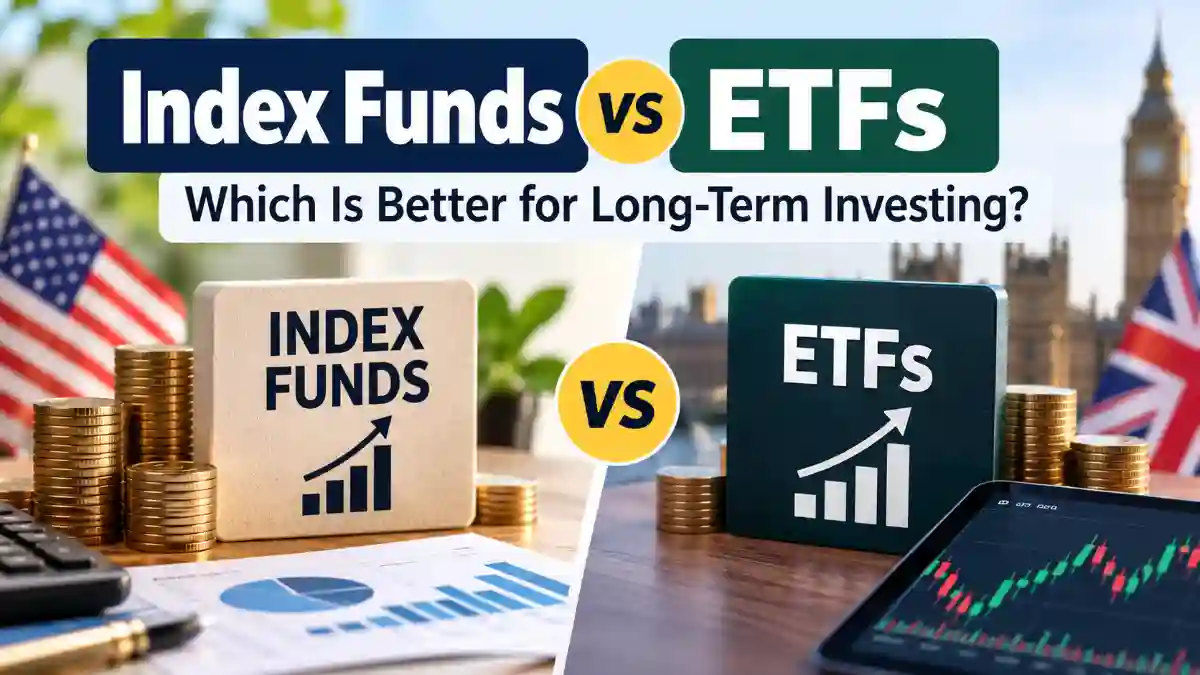
Investors in the United States and United Kingdom increasingly face an important question when building their portfolios: should they invest in index funds or exchange-traded funds (ETFs)? Both investment options offer access to diversified financial markets, relatively low management costs, and opportunities for long-term wealth accumulation. However, understanding their differences can help investors make informed decisions based on financial goals, investment accounts, tax considerations, and personal preferences.
Although index funds and ETFs are often compared as competing investment products, they are not entirely separate categories. An index fund describes an investment strategy, while an ETF describes how an investment fund is structured and traded. An ETF can itself be an index fund, making this distinction particularly important for beginners.
Understanding How Index Funds Work
An index fund is an investment fund designed to track the performance of a specific financial market index rather than attempting to outperform it through active stock selection. Popular benchmarks include the S&P 500, FTSE 100, FTSE All-Share, and MSCI World Index.
For example, an S&P 500 index fund provides exposure to approximately 500 leading US companies. Instead of researching and purchasing individual stocks, investors gain access to a diversified portfolio through a single investment product.
Also Read: How Much SIP Is Needed to Build ₹1 Crore?
Index funds generally follow a passive investment strategy. Fund managers aim to replicate the performance of their chosen benchmark, reducing the need for frequent trading and extensive stock research. This approach can lower operating expenses compared with many actively managed investment funds.
However, index funds cannot eliminate market risk. When the underlying index declines, the fund’s value will generally decline as well.
How Exchange-Traded Funds Differ
Exchange-traded funds are investment vehicles that trade on stock exchanges similarly to individual company shares. Investors can purchase or sell ETFs throughout normal market hours using brokerage platforms.
In the United States, ETFs commonly trade on exchanges such as the New York Stock Exchange and Nasdaq. UK investors can access many ETFs through the London Stock Exchange and investment platforms offering eligible funds.
Also Read: How to Change Mobile Number in Demat Account Online: Step-by-Step Guide
Unlike traditional mutual funds, which generally execute transactions at a calculated daily net asset value, ETF prices fluctuate throughout the trading session according to market activity.
ETFs can track broad market indices, government bonds, international equities, specific industries, or other investment strategies. Some ETFs are actively managed, meaning they do not necessarily follow a passive index-investing approach.
The availability of intraday trading offers flexibility, although frequent trading may introduce additional costs and encourage short-term decisions.

Comparing Investment Costs and Expense Ratios
Investment fees play an important role in determining long-term portfolio performance. Both index mutual funds and index ETFs can offer low expense ratios, but their actual costs vary between providers.
Also Read: Which Investment Is Better, Mutual Funds or Direct Stock Exchange?
Consider an investment portfolio worth $50,000. A fund charging an annual expense ratio of 0.05% would have approximately $25 in annual fund expenses, while a fund charging 0.50% would cost approximately $250, assuming the portfolio value remains unchanged.
For UK investors, a £40,000 portfolio with an ongoing fund charge of 0.20% would incur approximately £80 annually.
Investors should also consider brokerage commissions, platform charges, currency conversion fees, and ETF bid-ask spreads. A fund with a lower headline expense ratio is not automatically the cheapest investment overall.
Tax Considerations for US and UK Investors
Tax treatment can influence the choice between investment products, particularly when investments are held outside tax-advantaged accounts.
Also Read: 80/20 Rule in Stock Market – The Secret Every Trader Must Know
In the United States, ETFs often have structural tax advantages over traditional mutual funds because certain ETF transactions can reduce taxable capital gains distributions. However, dividends, realized gains, and individual circumstances still affect tax liabilities.
Within tax-advantaged retirement accounts such as a Roth IRA, traditional IRA, or 401(k), the distinction between ETFs and mutual funds may be less significant from a tax perspective. The account’s applicable tax rules remain important.
In the United Kingdom, investors can hold eligible funds and ETFs inside a Stocks and Shares ISA or pension arrangements such as a Self-Invested Personal Pension (SIPP). These accounts provide specific tax advantages, subject to applicable rules.
Outside tax-advantaged accounts, UK investors may face Capital Gains Tax and dividend taxation depending on their circumstances. UK reporting-fund status can also matter when investing in offshore funds.
Long-Term Investing and Dollar-Cost Averaging
One popular approach to long-term investing is dollar-cost averaging, where investors contribute a fixed amount at regular intervals regardless of market conditions.
For example, an American investor might invest $300 every month into a diversified fund, while a UK investor might contribute £250 monthly through an investment platform.
Regular investing allows investors to purchase more fund units when prices are lower and fewer when prices are higher. It can also encourage consistency during periods of market volatility.
Many mutual fund platforms support automatic investments, while an increasing number of brokerage services offer recurring ETF purchases. Investors should check whether fractional shares, minimum investment amounts, and automated contributions are supported.
Dollar-cost averaging does not guarantee profits or prevent losses, and investing available money gradually can underperform investing it immediately in a rising market.
Diversification and Portfolio Risk
Both index mutual funds and ETFs can provide exposure to hundreds or thousands of securities through a single holding. Nevertheless, diversification depends on the underlying assets rather than the fund’s label.
An ETF concentrated in technology companies may carry significantly different risks from a global equity index fund. Similarly, owning several funds tracking overlapping indices does not necessarily create meaningful additional diversification.
Investors should examine geographic exposure, sector concentration, asset allocation, and underlying holdings when evaluating funds.
Choosing Between Index Funds and ETFs
The decision between index mutual funds and ETFs depends on how an investor prefers to manage investments. Traditional index mutual funds may appeal to those prioritizing straightforward automatic contributions and end-of-day pricing. ETFs may appeal to investors seeking exchange-based trading flexibility, wider product selection, or particular cost and tax characteristics.
For long-term investors, the underlying index, diversification, total investment costs, tax treatment, and consistency of contributions often matter more than whether the fund trades as an ETF or traditional mutual fund.
Disclaimer: This article is published by Onetrader.in for educational and informational purposes only. It does not constitute financial, investment, tax, or legal advice, or a recommendation to buy or sell any security or financial product. All investments involve risk, including possible loss of principal. Tax rules and investment regulations vary by jurisdiction and individual circumstances. Onetrader is not registered with SEBI and is not an SEC-registered investment adviser or FCA-authorised financial adviser. Readers should consult appropriately qualified professionals before making investment decisions.




Keep learning with OneTrader
Explore structured lessons and practical guides to build your market knowledge.