
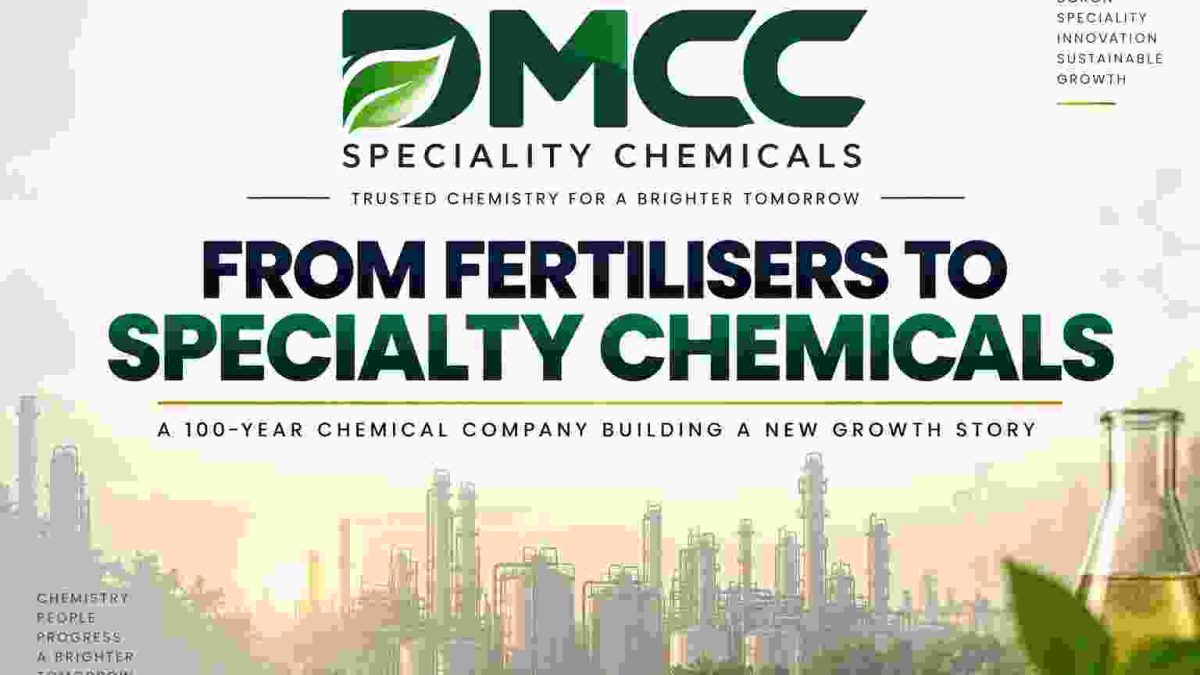
A company established in 1919 may appear like a traditional chemical business, but DMCC Speciality Chemicals is in the middle of a very different transformation. Formerly known as The Dharamsi Morarji Chemical Company, DMCC began with sulphuric acid and phosphate fertilisers and became closely associated with Single Superphosphate. Over time, the company deliberately moved away from its historical dependence on fertilisers and built a business around sulphur chemistry, boron chemistry and downstream speciality chemicals. The result is a chemical platform serving pharmaceuticals, agrochemicals, detergents, dyes, pigments, coatings, polymers, cosmetics and other industrial applications.
From Fertilisers to Speciality Chemistry
The most important part of DMCC’s story is not its age but its change in business model. The company says more than 75% of its revenue historically came from SSP before it began restructuring itself around speciality chemicals. Rather than remaining dependent on a largely commodity-oriented fertiliser business, DMCC invested in downstream sulphur chemistry and developed processes capable of producing more specialised molecules. This transition matters because speciality chemicals are generally driven more by product specifications, process expertise, customer relationships and application requirements than by simple production volume.
DMCC now operates across three broad chemistry layers: base chemicals, speciality chemicals and boron chemicals. Its base-chemical portfolio includes sulphuric acid, oleum, sulphuric anhydride and chlorosulphonic acid, while its speciality portfolio includes sulphur-based intermediates and functional chemicals. The company also manufactures boric acid, borax derivatives, trimethyl borate and zinc borate. This combination gives DMCC an important link between basic chemistry and higher-value downstream products.
Sulphur Chemistry Is the Core Platform
Sulphur chemistry remains central to DMCC’s competitive identity. The company has more than a century of experience in designing, operating and improving sulphuric-acid and related chemical plants, while its technical capabilities include sulphonation, chlorosulphonation, Friedel-Crafts reactions, esterification, methylation and ethylation. These capabilities are important because speciality-chemical manufacturing is not simply about owning a factory; it requires the ability to repeatedly produce a molecule with consistent quality, purity and process economics.
Also Read: Avalon Technologies: The EMS Company Quietly Building India’s Next Manufacturing Engine
This also gives DMCC a potential advantage in moving from commodity chemicals into downstream products. Instead of selling only basic chemical inputs, the company can use its existing chemistry knowledge and manufacturing infrastructure to develop molecules for specific customer applications. Its product portfolio includes pharmaceutical and agrochemical intermediates as well as functional chemicals used in detergents, dyes, pigments, coatings, polymers and other industries.
Boron Creates a Second Growth Platform
Boron chemistry gives DMCC another route to diversification. The company manufactures boron chemicals at its Dahej, Gujarat facility, with products including boric acid, borax, trimethyl borate and zinc borate. These chemicals serve multiple industrial applications, allowing DMCC to build a platform beyond its traditional sulphur base.
The strategic opportunity is not merely to increase volumes of existing boron products. The bigger opportunity is downstream integration: developing additional derivatives and application-specific products where technical capability and customer qualification become more important. This can gradually move the business toward higher-value chemistry while making better use of its manufacturing infrastructure.
Manufacturing Flexibility Matters
DMCC operates manufacturing facilities at Roha in Maharashtra and Dahej in Gujarat, supported by dedicated and multipurpose production capabilities. The company also offers custom manufacturing in kilo-to-tonne quantities for processes such as sulphonation and chlorosulphonation. This flexibility can be valuable because speciality-chemical customers often require customised products, smaller initial production batches or molecules developed specifically for their processes.
Also Read: IREDA: The Green Financing Powerhouse Funding India’s Renewable Energy Boom
Its R&D capability is closely connected with manufacturing, which is important in speciality chemicals. Laboratory chemistry must ultimately be translated into safe, repeatable and commercially viable production. DMCC’s strategy therefore revolves around developing downstream molecules, improving processes and using its existing assets to introduce products without necessarily requiring a completely new factory for every opportunity.
Global Customers Expand the Opportunity
DMCC sells into international markets as well as India, with the company reporting exports to more than 25 countries. Its products serve customers across pharmaceuticals, agrochemicals, detergents, dyes, pigments, cosmetics, coatings and other sectors. The company has also been working to diversify its export markets as chemical demand in parts of Europe has faced prolonged weakness.
This geographic diversification is important because speciality-chemical demand can vary significantly by region and industry. India’s expanding role in global chemical supply chains also creates an opportunity for manufacturers that can combine competitive production with reliable quality and technical support. However, this opportunity depends on DMCC being able to compete on consistency, pricing, regulatory compliance and customer approvals rather than relying simply on the China-plus-one theme.
The Key Risks
DMCC’s transformation also carries meaningful risks. Commodity chemicals remain exposed to raw-material prices and industry cycles, while speciality chemicals can experience demand fluctuations, inventory destocking and long customer-qualification periods. Global chemical oversupply, particularly from China, can create pricing pressure, while export-oriented businesses face currency, tariff and geopolitical risks.
Also Read: Sona BLW: From Auto Components to a Mobility Technology Company
Raw-material security is another important factor, particularly for specialised chemistry where alternative suppliers may not be immediately available. Chemical manufacturing also carries environmental and operational risks because the company handles hazardous substances and operates energy-intensive processes.
DMCC’s Bigger Business Story
DMCC’s business story is ultimately about moving up the chemical value chain. The company is using more than a century of sulphur chemistry expertise, manufacturing infrastructure, R&D capabilities and customer relationships to transition from its historical fertiliser identity toward speciality and downstream chemicals.
The opportunity lies in increasing the contribution of higher-value sulphur and boron products, expanding custom manufacturing, entering new applications and using existing capacity more efficiently. If DMCC can consistently convert its chemistry expertise into differentiated products and long-term customer relationships, its future business profile could look very different from the traditional chemical company it once was.
Financial Disclaimer
This article is intended for educational and informational purposes only. It does not constitute investment advice, a recommendation to buy or sell any security, or a guarantee of future returns. Investors should conduct their own research and consider their financial objectives, risk tolerance and investment horizon before making any investment decision.
Also Read: Anlon Healthcare: The Small Pharma Company Building a Bigger Global Opportunity