

A breakout is one of the most important price-action events in technical trading. When price moves beyond a well-defined resistance or support level, it can signal that the balance between buyers and sellers is changing. But simply seeing price cross a level does not mean a successful trade is guaranteed. Some breakouts continue strongly, while others quickly reverse and trap traders. The real skill is not just identifying a breakout, but understanding the quality of the breakout, the market structure around it, and what price does after breaking the level.
Image 1 – Real Breakout Setup
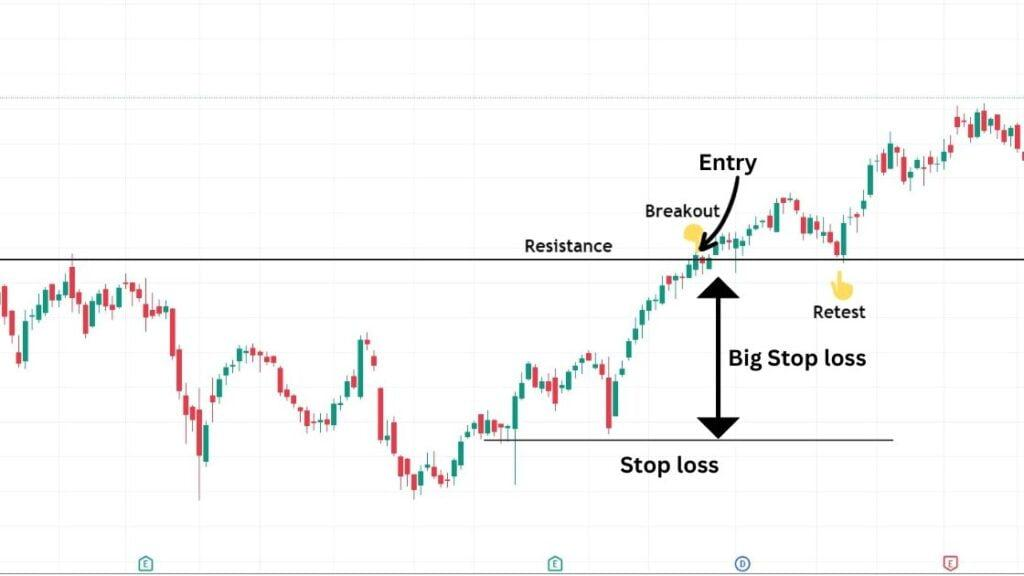
The foundation of breakout trading is identifying an important price level. Resistance becomes meaningful when price repeatedly struggles to move above an area, while support becomes important when buyers repeatedly defend a particular area. When price tests the same level several times, traders naturally begin watching it closely. However, repeatedly testing a level does not guarantee that the next attempt will succeed. Price can continue moving sideways, reject the level again, or produce a temporary breakout before returning to the previous range.
One of the biggest mistakes beginners make is entering before the breakout happens. A trader sees price approaching resistance and buys because they expect the level to break. If sellers defend that area again, the trader is immediately trapped. A more disciplined approach is to allow price to demonstrate strength first. Look for a decisive move through the level, a meaningful candle close, and evidence that buyers or sellers are actually maintaining control. Trading is not about predicting every breakout; it is about responding to confirmed market behavior.
Volume can provide additional context. A breakout accompanied by noticeably stronger volume can suggest greater participation behind the move. However, volume alone should never be treated as confirmation that a breakout must succeed. A high-volume breakout can still fail. Price structure, candle behavior, the importance of the level and what happens after the breakout should all be considered together.
Also Read: Liquidity Sweep Trading Strategy: How to Identify Stop-Loss Hunts and False Breakouts
One of the most useful techniques is the breakout and retest strategy. Instead of immediately chasing price after it breaks resistance, traders can wait for price to return and test the broken level. If previous resistance starts behaving as support and buyers produce a strong reaction, the retest can provide a more structured entry opportunity. The same principle works in a bearish setup, where broken support can become resistance during a retest.

Image 2 – Breakout and Retest
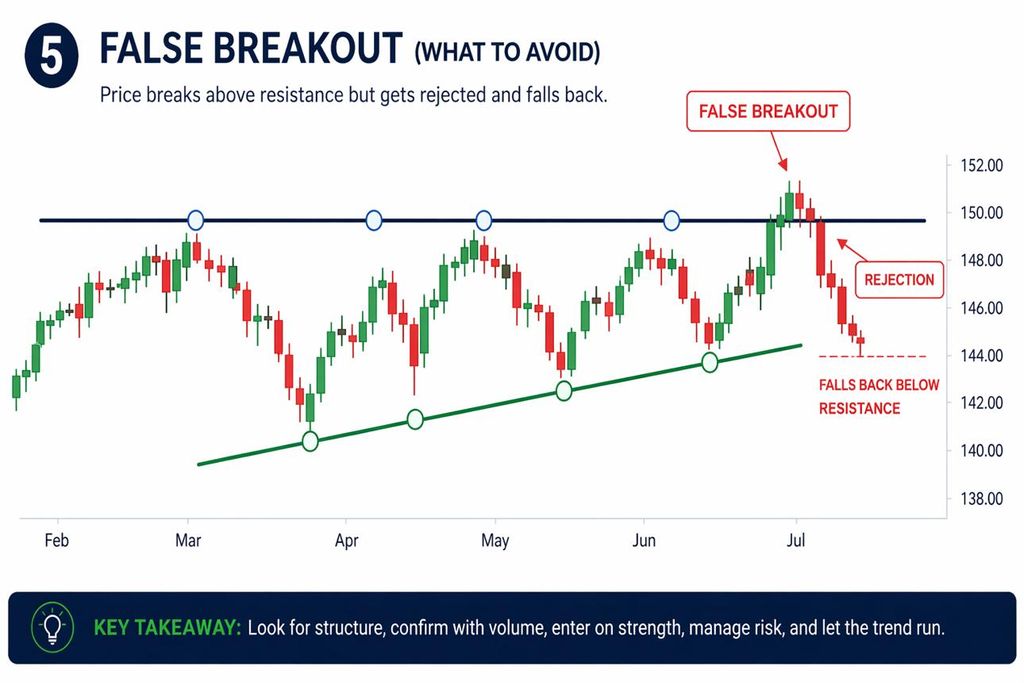
Consider a stock trading between ₹900 and ₹950 for several weeks. ₹950 repeatedly acts as resistance. Eventually, price closes strongly above ₹950 and moves toward ₹970. Instead of immediately chasing the move, a trader can observe whether price returns toward ₹950. If buyers defend the level and price produces a bullish reaction, the market is providing additional evidence that the breakout may be genuine. The trader can then define the entry, stop loss and target around the structure of the setup.
But what happens when price breaks resistance and immediately falls back below it? This is where understanding false breakouts becomes extremely important. A false breakout occurs when price moves beyond an important level but fails to sustain that movement and returns back into the previous range. When this happens above resistance, traders who bought the breakout can become trapped. When it happens below support, traders who sold the breakdown can become trapped.
Image 3 – False Breakout / Bull Trap
.
Also Read: Candlestick Patterns: 7 Powerful Patterns Every Price Action Trader Should Know
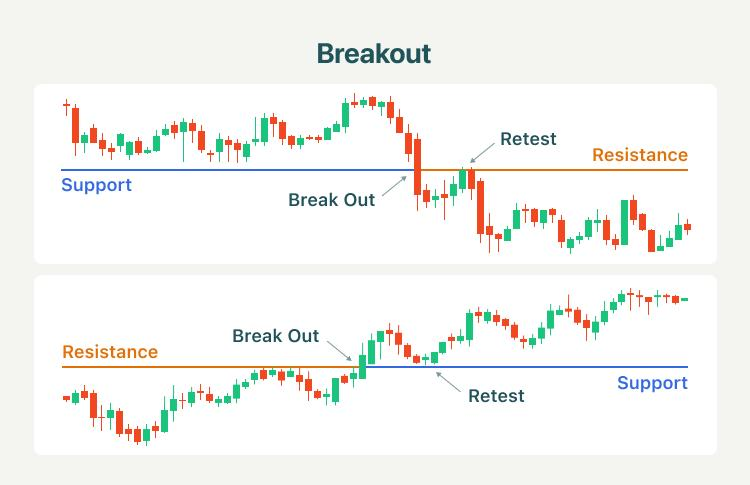
A false breakout is not simply an unfortunate event. It can provide valuable information about market behavior. If price moves above an obvious resistance level, attracts buyers and then quickly returns below that level, it tells us that buyers were unable to maintain control. The failed breakout may therefore become a warning that the market is not ready to continue higher. Traders should not automatically reverse their position based on one failed breakout, but they can use the information together with structure and further confirmation.
The quality of the consolidation before a breakout also matters. A clearly defined range with repeated reactions at support and resistance gives traders a better reference point. When price eventually escapes that range with strong momentum, the move can become significant. However, traders should avoid assuming that every sideways market is preparing for a major breakout. The level, market context and price behavior still matter.
Timeframe is another important consideration. A breakout on a five-minute chart may be insignificant when compared with a major daily resistance level. Swing traders should pay attention to higher-timeframe structure, while intraday traders can use lower timeframes for precise execution. A practical approach is to establish the broader market context first and then use a lower timeframe only when it improves the entry.
Risk management should always accompany breakout trading because no breakout is guaranteed to succeed. The stop loss should be connected to the technical invalidation of the setup rather than placed randomly. Similarly, the target should be based on realistic price structure, previous highs or lows, support, resistance or another logical objective. A trader should never increase risk simply because a breakout candle looks unusually strong.
The most important lesson is simple: do not chase the candle; understand the level. A successful breakout is more than price temporarily crossing resistance or support. It is a change in market behavior that needs to be evaluated through confirmation, retests, structure and momentum.
Breakout trading becomes much more powerful when traders learn to distinguish between breakout, retest and rejection. Instead of trying to predict what will happen next, wait for the market to reveal its intention and then build a trade around that information. The objective is not to capture every move. The objective is to participate in high-quality opportunities while keeping risk under control.
At Onetrader, the focus is on developing practical trading knowledge that helps traders read charts with greater clarity. Understanding real breakouts and false breakouts is one of the most useful skills a price-action trader can develop because it teaches an important principle: price crossing a level is an event; price sustaining beyond that level is confirmation.
Disclaimer: This article is for educational purposes only and should not be considered financial or investment advice. Trading involves market risk. Always conduct your own research and manage risk carefully.


Keep learning with OneTrader
Explore structured lessons and practical guides to build your market knowledge.