
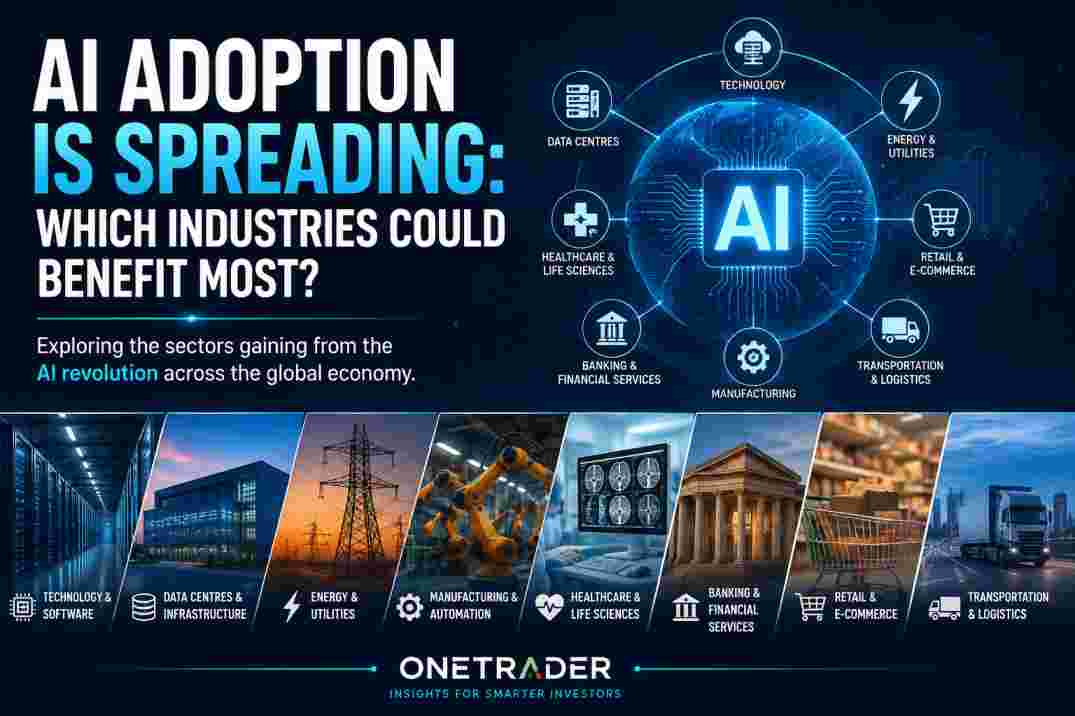
Artificial intelligence is moving beyond the technology sector and becoming a broader business investment theme. Companies across healthcare, financial services, manufacturing, retail, energy, transportation and software are increasingly using AI to automate tasks, improve decision-making, reduce costs and create new products.
The scale of adoption is becoming difficult for investors to ignore. Stanford’s 2026 AI Index reports that 88% of surveyed organizations were using AI in at least some capacity in 2025, while generative AI was being used in at least one business function by 70% of organizations. Global corporate AI investment also more than doubled during 2025.
For investors, however, the important question is not simply which companies are “using AI.” The bigger opportunity may be identifying industries where AI adoption can create measurable changes in revenue, productivity, infrastructure spending or operating margins.
AI Is Becoming a Business Investment
The first phase of the AI boom was dominated by companies building the technology itself, particularly semiconductor and cloud infrastructure businesses. The next phase could be much broader as companies in traditional industries integrate AI into their existing operations.
Also Read: Data Centre Infrastructure in India: Growth Opportunities
McKinsey’s 2026 technology research found that AI had become the top technology investment priority for many companies, ahead of areas such as cybersecurity and infrastructure modernization. At the same time, many businesses are still early in converting AI experiments into meaningful enterprise-wide financial benefits.
That distinction matters for investors. High AI usage does not automatically mean high shareholder returns. Companies need the data, infrastructure, talent and operating models required to turn AI capabilities into actual economic value.
1. Technology and Software
Technology remains the most direct beneficiary of AI adoption, but the opportunity is expanding beyond chipmakers.
Cloud computing companies, enterprise software providers, cybersecurity businesses, database companies and IT-service providers can all benefit as businesses spend more on AI infrastructure and applications.
Also Read: Defence & Aerospace Manufacturing: India’s Next Major Industrial Growth Story
Enterprise software is particularly interesting because AI can either threaten existing products or make them more valuable. Companies that successfully integrate AI agents into important business workflows could potentially increase customer productivity, improve retention and create additional revenue opportunities.
This makes software one of the sectors where investors need to distinguish between companies being disrupted by AI and companies monetising AI.
2. Data Centres and Digital Infrastructure
AI requires enormous computing infrastructure. That creates opportunities well beyond the companies designing AI models.
Data-centre operators, networking companies, semiconductor equipment suppliers, cooling providers, electrical equipment manufacturers and construction companies can benefit from the expansion of AI infrastructure.
Also Read: Semiconductor & Electronics Manufacturing: India’s Next Big Industrial Opportunity
The International Energy Agency expects global data-centre electricity consumption to more than double to around 945 TWh by 2030 in its base case, with AI identified as the most important driver of the increase alongside other digital services.
This means the AI investment cycle is increasingly becoming an infrastructure story.
3. Energy and Utilities
One of the most interesting second-order AI beneficiaries could be the power sector.
Large AI data centres require reliable electricity around the clock. As data-centre capacity expands, electricity generation, transmission, grid equipment, natural gas, renewable energy, nuclear power and energy-storage technologies could all become increasingly important.
Also Read: India’s Power & Renewable Energy Sector: Growth, Demand, Future Scope and Key Stocks
The IEA expects renewables and natural gas to meet much of the additional electricity demand from data centres, while nuclear is also expected to become increasingly important later this decade.
For investors, this creates a potential link between two major themes: the growth of artificial intelligence and the long-term investment required to expand electricity infrastructure.

4. Manufacturing and Industrial Automation
Manufacturing could become another major AI adoption story.
Factories can use AI for predictive maintenance, quality control, robotics, supply-chain optimisation, production planning and industrial automation. Companies selling sensors, automation systems, robotics, industrial software and electrical equipment could therefore benefit from rising AI-related capital expenditure.
Also Read: AI and Power Demand: Could Utilities Become the Next AI Winners?
The current US data-centre boom is already producing spillover demand for industrial companies. Recent reporting has highlighted rising demand for generators, cooling equipment, cables, bearings and other components required to build and operate data centres.
This demonstrates an important investment principle: AI beneficiaries do not necessarily have “AI” as their primary business.
5. Healthcare and Life Sciences
Healthcare could be one of the largest long-term applications for AI.
AI is being developed for medical imaging, diagnostics, drug discovery, clinical research, patient administration and healthcare workflow automation. The potential economic impact is significant because healthcare contains large amounts of data and many repetitive information-intensive processes.
Also Read: AI and Data Centres: Stocks That Could Benefit From the Infrastructure Boom
However, healthcare AI also faces higher regulatory and reliability requirements than many other industries. Companies need to demonstrate that AI systems work safely and consistently before they can become deeply integrated into critical medical workflows.
For investors, this means healthcare AI may represent a longer-term opportunity rather than simply a short-term technology trend.
6. Banking and Financial Services
Financial institutions are among the industries with strong incentives to adopt AI because many banking activities involve large volumes of structured data and repetitive processes.
Banks can use AI for fraud detection, customer service, financial analysis, software development, compliance, risk management and internal productivity.
Also Read: Indian Defence Stocks in 2026: Growth Opportunity or Valuation Risk?
Major US banks are already deploying AI across hundreds of use cases. Recent industry coverage shows banks including JPMorgan Chase, Goldman Sachs, Citi, Bank of America, Wells Fargo and Morgan Stanley expanding their AI programs.
The potential benefit is particularly interesting because even relatively small productivity improvements can have a meaningful impact on the profitability of businesses with large employee bases.
7. Retail and E-Commerce
Retailers can use AI to improve recommendations, pricing, inventory management, advertising, customer service and logistics.
E-commerce companies have access to enormous amounts of customer and transaction data, making AI particularly useful for predicting consumer behaviour and optimising operations.
Also Read: Top 5 Water Management Stocks in India: Financials, Growth & Future Potential
The companies that successfully combine AI with strong distribution networks, customer data and logistics capabilities could potentially improve margins while delivering more personalised customer experiences.
8. Transportation and Logistics
AI adoption is also spreading through transportation and logistics.
Companies can use AI to optimise delivery routes, forecast demand, manage fleets, predict maintenance requirements and improve warehouse operations. Autonomous driving and robotics could eventually create much larger changes, although these areas remain subject to technological, regulatory and safety challenges.
The investment opportunity therefore extends from software to sensors, industrial equipment, logistics platforms and autonomous systems.
Also Read: Renewable Energy & Clean Tech Stocks in India: Complete List
Which Industries Could Benefit the Most?
The biggest AI opportunity may not belong to one industry.
Instead, investors could think about AI through three layers.
The first layer consists of AI infrastructure, including semiconductors, data centres, networking and cloud computing.
The second consists of AI enablers, including power generation, electrical equipment, cooling, industrial automation and cybersecurity.
Also Read: Is India’s Real Estate Boom Back? What Investors Need to Know
The third consists of AI adopters, including banks, healthcare companies, retailers, manufacturers and software businesses that use AI to improve their existing operations.
This broader framework is important because AI spending can move through the economy in stages. A company may benefit even if it never develops an AI model itself.
The Biggest Risk: AI Adoption Does Not Guarantee Profits
Investors should also avoid assuming that every company associated with AI will become a winner.
AI projects can fail to generate sufficient returns, technology can become cheaper faster than expected, competition can reduce pricing power and businesses may discover that AI productivity gains are difficult to convert into higher profits.
Also Read: Water: The Hidden Infrastructure of the Future
McKinsey’s recent research highlights this challenge: many companies have adopted AI tools, but relatively few have achieved meaningful enterprise-wide financial impact so far.
Valuation is another major risk. A good AI business can still be a poor investment if its stock price already assumes unrealistic growth.
The AI Investment Story Is Getting Broader
The AI opportunity is increasingly moving beyond a small group of technology companies.
Data centres need power. Power infrastructure needs equipment. AI infrastructure needs manufacturers. Businesses need software to use AI. Banks, hospitals, retailers and factories need to integrate the technology into their operations.
Also Read: Infrastructure Investment Trusts (InvITs) in India – Complete Beginner Guide | Onetrader
That creates a much wider investment ecosystem.
For investors, the next stage of the AI cycle may therefore be less about simply asking “Which company builds AI?” and more about asking “Which companies provide the infrastructure, tools and services required as AI spreads across the economy?”
The following Onetrader articles in this AI investment series will examine these opportunities in greater detail, starting with companies benefiting from AI adoption beyond the largest technology names.
Also Read: Top Space-Tech Stocks in India – A Hidden Multibagger Opportunity (2025-2045)






Keep learning with OneTrader
Explore structured lessons and practical guides to build your market knowledge.