
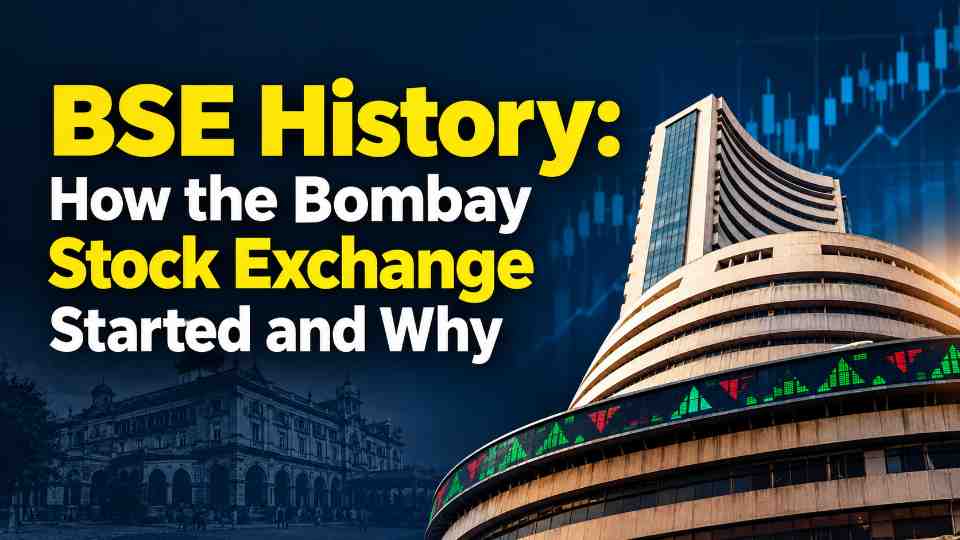
The BSE is the oldest stock exchange in Asia, and its story begins well before India had a stock market law, a regulator or even a proper trading building. It started with a handful of brokers who needed a shared place to do business.
This article explains how the BSE began, why it was formed, and how it changed from a brokers’ club into a listed, electronic exchange.
In Simple Words
The BSE began as an informal gathering of share and cotton brokers under banyan trees in Bombay. In 1875 they formalised it as a brokers’ association. Over the next century it became India’s main exchange, gave the country its first stock index, the Sensex, and later moved to electronic trading and listed its own shares.
1. How Trading Began Under a Banyan Tree
In the mid-1800s, brokers dealing in shares and cotton gathered under banyan trees near the Town Hall in South Bombay. The city was a major trading centre, and the cotton boom of that period brought money and new brokers into the business.
Also Read: NSE History: How the National Stock Exchange Started and Why
As the group grew, informal meetings in the open became hard to manage. Brokers wanted a fixed place to meet and some common rules, so they moved to a street that is now called Dalal Street, a name that still stands for the Indian stock market.
2. When and Why the BSE Was Formed
On 9 July 1875, the brokers formed The Native Share and Stock Brokers’ Association. Premchand Roychand, one of the most influential businessmen in Bombay at the time, is closely associated with its founding. Accounts describe about 25 brokers contributing a rupee each to start the association.

The reason was practical. Brokers needed shared rules, a way to settle disputes and a place where buyers and sellers could trust each other without depending only on personal relationships. The association gave them that structure.
3. Key Milestones in the BSE Story
| Year | What happened |
|---|---|
| 1875 | Native Share and Stock Brokers’ Association formed on 9 July |
| 1921 | A clearing house was set up, improving settlement |
| 1925 | Bombay Securities Contracts Control Act enacted |
| 1957 | BSE recognised as a stock exchange under the Securities Contracts (Regulation) Act |
| 1986 | Sensex launched on 2 January as India’s first equity index |
| 1995 | BOLT (BSE On-Line Trading) replaces open outcry trading |
| 1996 | Dematerialisation of shares begins in India |
| 2000 | Derivatives trading starts using Sensex futures |
| 2012 | SME platform launched for smaller companies |
| 2017 | BSE goes public; shares list on the NSE in February |
4. The Sensex: India’s First Stock Index
The Sensex was launched in 1986 and tracks 30 large, well-established companies. Its base value of 100 relates to the late 1970s, which lets investors measure how the market has grown over decades. For generations of Indian investors, the Sensex has been the headline number that tells them whether the market went up or down.
Also Read: All Wars Happening in the World Right Now (2026): Major Conflicts Explained
5. From the Trading Floor to the Screen
For most of its history, the BSE worked through open outcry, with brokers shouting bids and offers on a floor, and shares moving as paper certificates. This was slow and prone to errors and disputes.
In 1995, with a new national exchange offering screen-based trading, the BSE launched BOLT, its own electronic platform. Dematerialisation followed from 1996, which gradually ended paper certificates and the risk of lost or forged shares.
6. The BSE Goes Public
The BSE completed its IPO in January 2017. SEBI rules do not allow an exchange to list its own shares on its own platform, so BSE shares were listed on the NSE. This made the BSE India’s first listed stock exchange.
7. What the BSE Is Known For Today
Heritage and benchmark: It is the oldest exchange in Asia and the home of the Sensex.
Also Read: CEO vs CFO vs COO: Who Runs What in a Business and How the Three Roles Work Together
Wide listing base: It lists a very large number of companies, including many small and mid-sized ones, along with an SME platform.
Many products: Beyond shares, it offers derivatives, mutual fund and debt platforms, and other market services.
Disclaimer: This article is intended for education and general information. It does not constitute investment advice or a recommendation to buy or sell any security. Dates and figures are based on publicly available information and may be updated by the exchanges.
Also Read: Understanding Different Types of Costs: How Businesses Calculate, Manage and Control Their Expenses

Keep learning with OneTrader
Explore structured lessons and practical guides to build your market knowledge.

Need a laugh after all that money talk?
Paisa LOL: India's funniest finance page, with memes, comics, jokes and long funny stories.
