
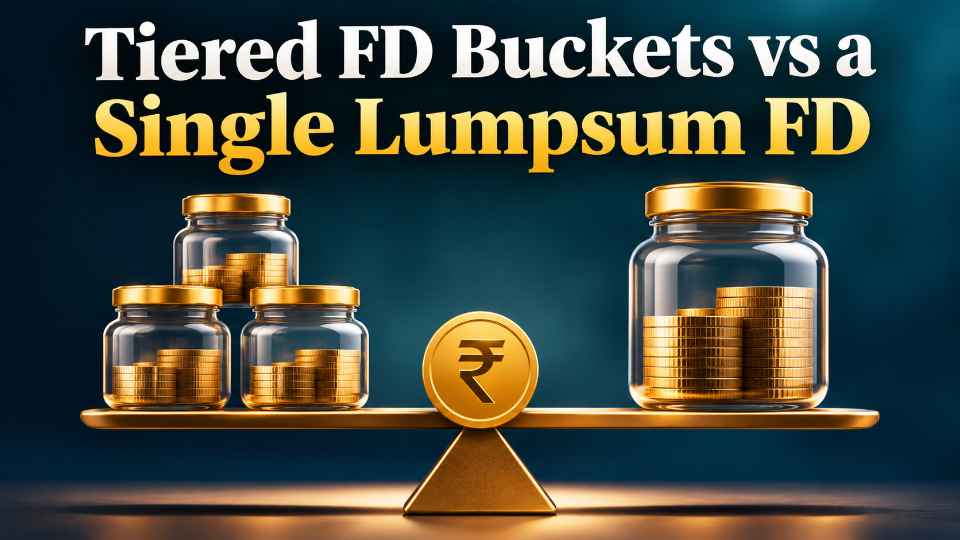
An emergency fund is meant to provide financial security when income stops, an unexpected medical expense arises or an urgent financial commitment cannot be postponed. But keeping the entire reserve in a savings account may reduce its earning potential, while locking everything into a fixed deposit can make access more complicated when money is needed immediately.
A practical solution is to divide the emergency reserve across savings accounts, sweep-in facilities and fixed deposits with different maturity dates. The real question is whether multiple FD buckets offer a meaningful advantage over keeping the entire amount in a single deposit. The answer depends on liquidity requirements, deposit size, banking arrangements and the possibility of premature withdrawal.
In Simple Words
A tiered FD structure generally offers better control over emergency money because smaller deposits can be accessed independently. A single lumpsum FD is simpler, but it may create unnecessary withdrawal complications when only part of the money is required. The strongest structure combines immediate bank liquidity with staggered deposits and adequate deposit protection.
1. How Much Money Should an Emergency Fund Hold?
An emergency fund should be calculated using essential monthly expenses rather than monthly salary. Rent, groceries, utilities, insurance premiums, loan EMIs, school fees and necessary household expenses should form the foundation of the calculation. Discretionary spending and investments should not be included.
Also Read: Is Your Bank Deposit Safe? How the ₹5 Lakh DICGC Deposit Insurance Cover Works
Employees with stable income may prefer a smaller reserve, while self-employed individuals, people with dependants, variable income or substantial financial commitments may need a larger cushion. The objective is to maintain enough accessible money to manage an extended income disruption without selling long-term investments.
| Financial situation | Emergency fund target |
|---|---|
| Stable salaried income | 6 months of essential expenses |
| Single-income household | 9 months |
| Variable income or self-employed | 9–12 months |
| Higher financial responsibilities | 12 months |
Illustrative calculation
| Essential monthly expenses | 6-month reserve | 9-month reserve | 12-month reserve |
|---|---|---|---|
| ₹30,000 | ₹1.80 lakh | ₹2.70 lakh | ₹3.60 lakh |
| ₹50,000 | ₹3 lakh | ₹4.50 lakh | ₹6 lakh |
| ₹75,000 | ₹4.50 lakh | ₹6.75 lakh | ₹9 lakh |
2. Understanding Tiered FD Buckets
A tiered FD structure divides the emergency fund into smaller deposits instead of locking the entire amount into one fixed deposit. Each deposit can have a different maturity date, allowing savers to access money in stages without disturbing the entire reserve.
For example, a household maintaining a ₹3 lakh emergency fund could keep an immediate cash layer, another portion in a sweep-in FD and the remaining amount in separate fixed deposits. The structure balances accessibility with interest earnings, provided the deposit tenures are chosen carefully.
Also Read: Personal Loan vs Credit Card EMI: Which Costs More and Why?
Illustrative allocation for a ₹3 lakh emergency fund
| Layer | Allocation | Amount | Purpose |
|---|---|---|---|
| Savings account | 10% | ₹30,000 | Immediate expenses |
| Sweep-in FD | 20% | ₹60,000 | Quick access to additional cash |
| Short-term FD buckets | 70% | ₹2,10,000 | Reserve for extended emergencies |
| Total | 100% | ₹3,00,000 |
The FD portion can be divided further into smaller deposits with staggered maturity dates rather than one large deposit. This makes it possible to break only the amount required during an emergency, while the remaining deposits continue earning their contracted interest.
3. Single Lumpsum FD vs Multiple FD Buckets
A single lumpsum FD is straightforward. The entire surplus is placed into one deposit, reducing account-management work and potentially securing a competitive interest rate for the selected tenure. However, accessing part of the money may require partial withdrawal facilities or breaking the deposit, depending on the bank’s terms.
Multiple FD buckets provide greater control over liquidity. A saver can close one smaller deposit when required instead of disturbing the entire reserve. This becomes particularly useful when emergency expenses arrive in stages rather than as a single large payment.

Also Read: Best Credit Cards in India in 2026: Cashback, Rewards, Fees and Eligibility
| Comparison | Tiered FD buckets | Single lumpsum FD |
|---|---|---|
| Liquidity | More flexible | Depends on withdrawal facility |
| Premature withdrawal | Only the required bucket may need closure | May affect a larger deposit |
| Interest management | Different maturity dates possible | One maturity date |
| Administration | More deposits to track | Simpler |
| Reinvestment flexibility | Higher | Lower |
| Emergency suitability | Better for varied cash requirements | Suitable for predictable liquidity needs |
| Interest rate | Depends on each FD’s tenure | Depends on selected tenure |
The tiered structure generally wins when liquidity is important and emergency withdrawals may be partial. A single FD can work well when the depositor has another readily accessible cash reserve, the bank permits partial withdrawal and simplicity is the main priority.
4. Savings Account, Sweep-in FD and Liquid Funds
The emergency fund should not be entirely dependent on fixed deposits. A savings account provides immediate access through banking channels, while a sweep-in FD automatically transfers money from the linked deposit when the savings balance is insufficient, subject to the bank’s facility rules.
Liquid mutual funds offer another layer for money that does not need to remain immediately available in a bank account. However, they are mutual fund investments rather than bank deposits. Their returns are market-linked, their value is not guaranteed and redemption processing may take time. They should not replace the immediate cash component.
| Instrument | Liquidity | Important consideration |
|---|---|---|
| Savings account | Immediate banking access | Lower interest potential |
| Sweep-in FD | Automatic transfer as per bank rules | Minimum balance and sweep conditions |
| Liquid mutual fund | Redemption subject to scheme settlement | Market and redemption risks |
| Fixed deposit | Maturity or premature closure | Withdrawal conditions and applicable penalty |
A sensible structure keeps immediate spending money in a savings account, uses sweep-in facilities for the next layer and reserves longer-term emergency money in smaller FDs. Liquid funds can be considered for an additional layer where the saver understands settlement timelines and investment risks.
Also Read: CRR, SLR, Repo Rate & Reverse Repo Explained | Chapter 3 – Onetrader
5. FD Laddering, Premature Withdrawal and Deposit Safety
FD laddering means splitting deposits across different maturity dates instead of selecting the same tenure for the entire amount. When one deposit matures, the money can be retained for liquidity or renewed depending on the household’s cash requirements. This reduces dependence on a single maturity date and makes the reserve easier to manage.
Premature withdrawal is an important consideration. Banks can apply a penalty according to their board-approved deposit policy. The interest payable may be recalculated using the rate applicable to the actual period the deposit remained with the bank, with the applicable penalty deducted. There is no universal premature withdrawal penalty percentage across Indian banks.
| FD consideration | Applicable position |
|---|---|
| Illustrative ladder | 3, 6 and 12-month maturity buckets |
| Premature withdrawal penalty | Bank-specific; no uniform percentage |
| Interest calculation | Actual deposit period and applicable bank terms |
| Partial withdrawal | Subject to the bank’s deposit facility |
| Very short deposits | Minimum interest eligibility depends on bank rules |
Understanding DICGC deposit insurance
Deposit safety is equally important when structuring a large emergency reserve. The Deposit Insurance and Credit Guarantee Corporation (DICGC) provides insurance cover of ₹5 lakh per depositor per insured bank, including principal and accrued interest, for deposits held in the same right and capacity.
Also Read: How Banks Create Money (Loan Cycle Explained) | Chapter 2 – Banking & Loan Series by Onetrader
| Deposit insurance rule | Coverage |
|---|---|
| Maximum cover per depositor per bank | ₹5 lakh |
| Principal and interest | Combined within the limit |
| Multiple branches of the same bank | Aggregated |
| Different insured banks | Separate coverage for each bank |
| Savings, current, FD and RD | Covered deposit categories |
A common mistake is opening multiple FDs in different branches of the same bank and assuming each deposit receives separate insurance protection. Deposits held in the same capacity and right are aggregated across branches. For larger emergency reserves, spreading eligible deposits across separate insured banks can help manage concentration risk, while keeping the total insured balance within the applicable limit at each bank.
6. FD Interest Rates, Taxation and TDS
Fixed deposit interest rates vary across banks, deposit tenures, customer categories and special schemes. As of November 2026, published regular-customer rates across selected Indian banks show a broad range, with small finance banks sometimes offering higher rates than larger banks. However, the highest advertised rate should not automatically determine where emergency money is deposited.
| FD tenure | Indicative regular-customer rate range |
|---|---|
| 1 year | Approximately 5.00%–7.50% |
| 3 years | Approximately 5.25%–8.00% |
| 5 years | Approximately 5.00%–8.25% |
Indicative market ranges based on published bank rates around November 11, 2026. Actual rates depend on the bank, deposit amount, eligibility and scheme. Rates can change.
FD interest is taxable under the applicable income-tax rules, according to the depositor’s tax position. It is generally included in taxable income and taxed at the applicable slab rate, even when the bank does not deduct TDS. TDS is only a tax collection mechanism; it does not represent the final tax liability.
Also Read: What Is a Bank & How It Works | Chapter 1 – Banking & Loan Series by Onetrader
| Tax consideration | Applicable rule for bank deposits |
|---|---|
| Standard TDS rate | 10% |
| Annual interest threshold for regular customers | ₹50,000 |
| Annual interest threshold for senior citizens | ₹1,00,000 |
| Tax treatment of FD interest | Applicable income-tax slab |
| TDS provision from April 2026 | Section 393, Income-tax Act, 2025 |
The threshold applies to aggregate eligible interest from the relevant bank, not separately to every FD or branch where core banking conditions apply. If the depositor’s final tax liability is higher or lower than the TDS collected, the difference is settled through the income-tax return. A valid PAN and correct tax details are important to avoid higher withholding where applicable.
Themes to Watch
Interest rate changes: Banks may revise deposit rates as monetary conditions change. Existing deposits generally retain their contracted rate until maturity, subject to their terms.
Bank concentration: Large emergency reserves should be evaluated against the DICGC insurance ceiling, rather than simply the number of FD receipts.
Premature withdrawal conditions: Partial closure, minimum deposit periods and penalty calculations differ between banks.
Also Read: Why Banks Are Strict With Common People and Easy With the Rich | Onetrader View
Automatic sweep facilities: Savers should understand the linked savings balance, sweep thresholds and withdrawal mechanics before relying on them.
Tax efficiency: FD interest should be evaluated after considering the applicable tax slab, not just the advertised interest rate.
Emergency access: Digital banking access, nomination details and the ability to retrieve funds during holidays or technical disruptions also matter.
Disclaimer: This article is intended for financial education and general information. Bank interest rates, deposit terms, premature withdrawal conditions and taxation rules are subject to change. Readers should verify applicable terms with their banks and consult a qualified tax professional for individual tax matters. OneTrader does not guarantee returns or the availability of funds under specific banking conditions.
Also Read: Banking & Loan Series by Onetrader | How Banks and Loans Work Explained Simply






Keep learning with OneTrader
Explore structured lessons and practical guides to build your market knowledge.

Need a laugh after all that money talk?
Paisa LOL: India's funniest finance page, with memes, comics, jokes and long funny stories.
