

🏦 What Is a Bank & How It Works | Chapter 1 – Banking & Loan Series by Onetrader
💡 Introduction
We all use banks — we deposit money, take loans, use ATMs, and make UPI payments.
But have you ever thought about what a bank actually does behind the scenes?
How does your deposited money grow?
How can a bank pay interest and still earn profits?
Let’s understand the real engine of the financial system — the Bank.
This is Chapter 1 of the Banking & Loan Series by Onetrader —
a step-by-step guide to how the entire banking system works.
Banking & Loan Series by Onetrader | How Banks and Loans Work Explained Simply – click here
Also Read: Best Credit Cards in India in 2026: Cashback, Rewards, Fees and Eligibility
🔹 1. What Is a Bank?
A bank is a financial institution that acts as a bridge between savers and borrowers.
It collects money from people who have extra (savers) and lends it to people who need money (borrowers).
In simple terms:
Banks take money from “those who have” and give it to “those who need,” while keeping a margin as profit.
🔹 2. How a Bank Makes Money
A bank earns money mainly from the difference between deposit interest and loan interest.
Also Read: CRR, SLR, Repo Rate & Reverse Repo Explained | Chapter 3 – Onetrader
Example 👇
- You deposit ₹1 lakh → bank pays you 3.5% interest.
- Bank lends the same money to someone else at 10% interest.
- The 6.5% difference (minus costs) is the bank’s profit margin.
This is called the Net Interest Margin (NIM) — the heart of banking profits.
🔹 3. The Core Functions of a Bank
| Function | Explanation |
|---|---|
| 1. Accepting Deposits | Savings, Current, Fixed, or Recurring Deposits. |
| 2. Lending Loans | Personal, Home, Business, Education, Vehicle Loans. |
| 3. Payment & Settlement | UPI, NEFT, RTGS, Debit/Credit Cards. |
| 4. Investment & Treasury | Banks invest in Government Bonds and Securities. |
| 5. Customer Services | Locker facility, cheque clearing, drafts, etc. |
🔹 4. The Banking Cycle
Here’s how your ₹1000 travels inside the system 👇
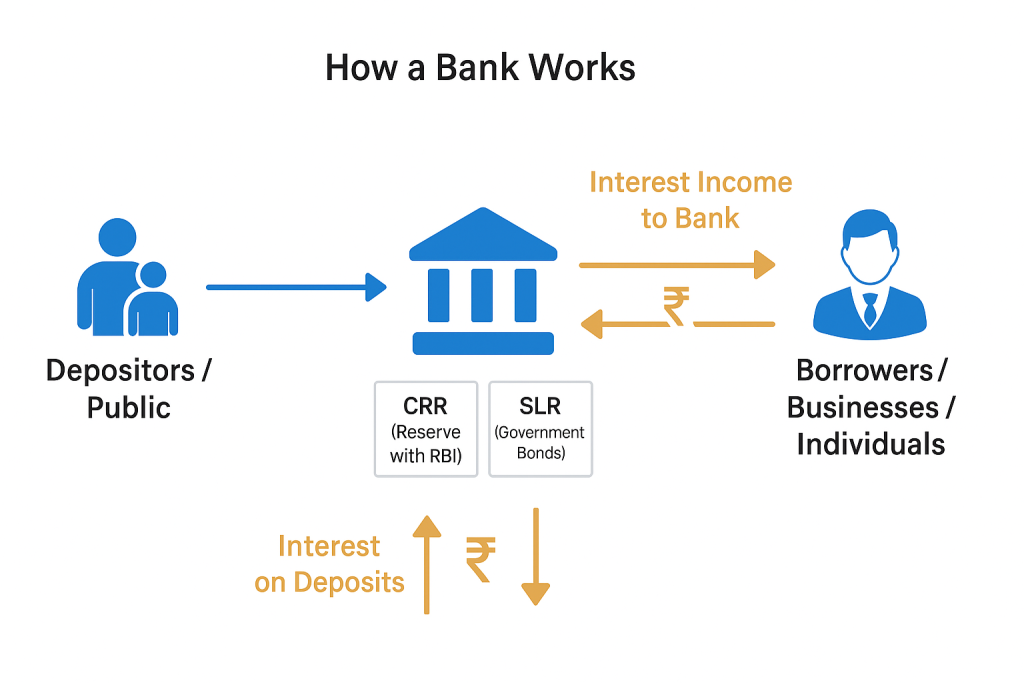
1️⃣ You deposit ₹1000 → Bank keeps a small portion with RBI as CRR (Cash Reserve Ratio).
2️⃣ The remaining money is lent out as loans to earn higher returns.
3️⃣ Borrowers pay interest → bank earns income.
4️⃣ You get a small portion of that income as deposit interest.
Also Read: How Banks Create Money (Loan Cycle Explained) | Chapter 2 – Banking & Loan Series by Onetrader
So, your money never just “sits” in the bank — it’s constantly working in the economy.
🔹 5. RBI’s Role – The Bank of Banks
In India, the Reserve Bank of India (RBI) is the head controller.
It ensures:
- Banks don’t misuse deposits
- Inflation stays stable
- Money supply remains balanced
RBI uses tools like CRR, SLR, Repo Rate, and Reverse Repo Rate to control liquidity —
we’ll cover those deeply in Chapter 2.
🔹 6. Types of Banks in India
| Type | Examples | Key Role |
|---|---|---|
| Public Sector Banks | SBI, PNB, Bank of Baroda | Government-owned, large networks. |
| Private Sector Banks | HDFC, ICICI, Axis Bank | Profit-driven, faster service. |
| Cooperative Banks | Local societies, rural banks | Serve small towns & villages. |
| Foreign Banks | HSBC, Citibank | Serve global customers. |
Each type works under RBI supervision but with different ownership and goals.
Also Read: Why Banks Are Strict With Common People and Easy With the Rich | Onetrader View
🔹 7. How Digital Banking Changed Everything
Today, banking isn’t just about branches.
You can open accounts, transfer funds, invest, and take loans — all digitally.
UPI, internet banking, and AI-based lending have made banking real-time and borderless.
But behind every digital click, the same old engine runs — money from deposits, loans, and margins.
💬 Onetrader View
A bank is not just a place to store money — it’s a money multiplier machine.
Every rupee you deposit starts a chain reaction in the economy.
That’s why understanding how banks work is the first step to mastering finance.
At Onetrader, we don’t just use banks — we learn how to think like a bank. 💡
Also Read: Banking & Loan Series by Onetrader | How Banks and Loans Work Explained Simply
❓ Frequently Asked Questions (FAQs)
1️⃣ What is a Bank?
A bank is a financial institution that accepts deposits from the public and provides loans to individuals, businesses, and governments. It acts as a link between savers and borrowers to keep money flowing in the economy.
2️⃣ How do Banks Make Money?
Banks earn money mainly from the interest rate difference between what they pay depositors and what they charge borrowers. This is called the Net Interest Margin (NIM).
3️⃣ What is the Role of the RBI in Banking?
The Reserve Bank of India (RBI) regulates and supervises all banks in India. It ensures stability in the financial system using tools like CRR, SLR, Repo Rate, and Reverse Repo Rate.
4️⃣ What are the Different Types of Banks in India?
The main types of banks are:
- Public Sector Banks (SBI, PNB)
- Private Sector Banks (HDFC, ICICI)
- Cooperative Banks (for rural & small-town customers)
- Foreign Banks (HSBC, Citi)
5️⃣ How Does a Bank Help the Economy?
Banks keep money circulating — they collect idle savings and lend them to businesses and individuals. This drives growth, creates jobs, and helps the economy expand.
⚡ Next Chapter Preview
📘 Chapter 2: How Banks Create Money (Loan Cycle Explained)
We’ll uncover how banks literally create money from loans — not by printing, but by smart accounting.