
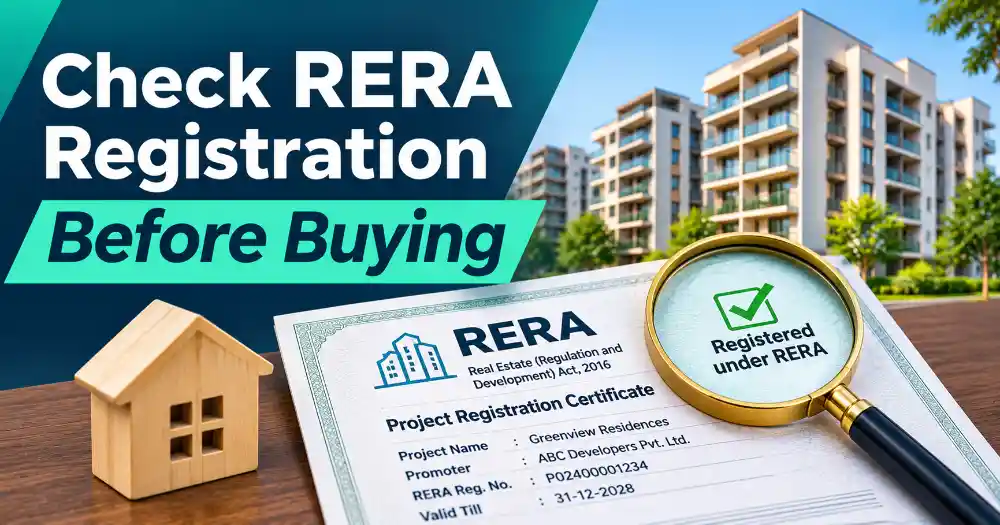
Buying an apartment or residential plot involves more than checking the location, price and construction quality. Before paying a booking amount, buyers must establish whether the project has the necessary regulatory registration and whether the information provided by the developer matches official records. The Real Estate (Regulation and Development) Act, 2016, commonly known as RERA, gives home buyers access to important project information and establishes responsibilities for developers.
However, many buyers simply ask the builder for a RERA registration number without checking what it actually represents. A registration number alone does not establish that the property’s title is clear, every approval is valid or the construction matches the sanctioned plan. Understanding how to examine the registration details can help buyers identify discrepancies before committing their money.
1. What Is RERA and Why Does It Matter to Home Buyers?
The Real Estate (Regulation and Development) Act, 2016, established a regulatory framework for residential and commercial real estate projects across India. Each state and union territory has its own Real Estate Regulatory Authority responsible for implementing the Act and maintaining project-related information. The framework aims to protect buyers from misleading advertisements, undisclosed project changes, delays and other unfair practices.
Under Section 3 of the Act, promoters of projects covered by the registration requirement must obtain RERA registration before advertising, marketing, booking or selling units. This allows prospective buyers to examine important project information through the relevant state authority’s website. Developers are also required to disclose specified project details and update relevant information according to the applicable provisions.
Also Read: Home Loan Basics in India: EMI, Interest Rate, Tenure and Eligibility Explained
For a home buyer, RERA provides a way to check whether the project is registered, who the promoter is, what completion timeline has been declared and which approvals and plans have been submitted. It also provides a regulatory mechanism through which eligible buyers can raise complaints when developers fail to meet their obligations. <Cite refs={[“turn482457search24″,”turn482457search15”]}/>
2. Which Projects Must Have RERA Registration?
RERA registration generally applies to real estate projects that meet the requirements under Section 3 of the Act. However, not every property transaction or construction activity automatically requires registration. Understanding the exemptions is necessary before deciding whether a developer’s lack of a registration number indicates a violation.
The Act provides an exemption for projects where the land proposed to be developed does not exceed 500 square metres or the number of apartments does not exceed eight, inclusive of all phases. State governments can reduce these thresholds within the framework permitted by the Act. Projects that received a completion certificate before the commencement of the Act are also covered by an exemption. Certain renovation, repair or redevelopment projects that do not involve marketing, advertising, selling or new allotment may also be exempt.
| Project condition | General RERA position |
|---|---|
| Land area not exceeding 500 sq. metres | Exempt under the central threshold, subject to applicable state rules |
| Number of apartments not exceeding eight, inclusive of all phases | Exempt under the central threshold, subject to applicable state rules |
| Project with a completion certificate before the Act commenced | Generally exempt |
| Certain repair or redevelopment projects without new marketing or allotment | Generally exempt |
| Eligible ongoing project without the required completion certificate when the Act commenced | Registration requirements apply |
The exemption conditions should be examined together with the applicable state rules and project circumstances. A builder should not simply claim that a project is exempt without providing a clear explanation of the relevant provision.
Also Read: First-Time Home Buyer Checklist in India: Everything to Check Before Buying a House
For projects developed in multiple phases, each phase is treated as a separate real estate project for registration purposes. Therefore, registration of the first phase does not automatically cover subsequent towers or phases. Buyers should verify the registration number of the exact phase in which their apartment or plot is located. <Cite refs={[“turn482457search24″,”turn482457search25”]}/>
3. Find the Official RERA Website for Your State
RERA registration is administered through the respective state or union territory authority. Buyers should use the official government portal rather than relying on third-party property websites or registration screenshots shared by sales representatives.
For example, someone purchasing an apartment in Hyderabad should use the Telangana Real Estate Regulatory Authority (TG-RERA) website. A buyer considering a property in Mumbai should use Maharashtra RERA, while a property in Bengaluru requires verification through Karnataka’s RERA authority.
Some of the official portals include:
| State | RERA authority |
|---|---|
| Telangana | TG-RERA |
| Andhra Pradesh | Andhra Pradesh RERA |
| Maharashtra | MahaRERA |
| Karnataka | Karnataka RERA |
| Tamil Nadu | Tamil Nadu RERA |
| Uttar Pradesh | UP-RERA |
| Haryana | Haryana RERA |
| Rajasthan | Rajasthan RERA |
| Gujarat | Gujarat RERA |
The Ministry of Housing and Urban Affairs also provides a directory of state and union territory RERA authorities. Buyers can use it to locate the appropriate regulatory website rather than searching through unofficial registration services. <Cite refs={[“turn482457search12″,”turn482457search16”]}/>
4. How to Search for a Project’s RERA Registration Number
The first step is to obtain the registration number from the developer’s official brochure, project website, advertisement or booking documents. Ask the sales representative to provide the complete number in writing. Do not rely on a verbal confirmation that the project is registered or that the registration application has been submitted.
Open the official state RERA website and locate the section for searching registered projects. Depending on the portal, buyers may be able to search using the project name, promoter name, registration number or other identifying details. Searching by the complete registration number is generally the most direct way to locate the relevant record.
Once the result appears, open the project details and compare the information with the documents supplied by the developer. The project name, promoter, location and phase should correspond to the property being advertised. If the registration details refer to a different phase, company or location, ask the developer for an explanation before making any payment.
For example, a buyer considering a residential project in Hyderabad should visit the official TG-RERA portal and use its registered project search facility. The portal provides access to project details and registration information, allowing buyers to examine the official record rather than depending entirely on the builder’s claims. <Cite refs={[“turn482457search0″,”turn482457search2”]}/>

5. Verify the Project Name, Promoter and Registration Details
Finding a matching registration number is only the beginning of the verification process. Buyers should examine whether the registered promoter is the same legal entity responsible for developing and selling the property. In large projects, the marketing brand, landowner, development company and selling entity may have different names.
Compare the registered project name with the name used in the brochure and booking form. Check the project’s registered address, survey numbers, village, mandal or locality, and other available land identification details. These details help establish whether the registration actually relates to the property being offered.
Pay attention to the promoter’s legal name and business structure. If the brochure mentions one company but the registration identifies another, ask how the entities are connected and which company is responsible for the agreement and delivery. Your property lawyer should examine the relevant development agreements, ownership documents and authorisations before proceeding.
A mismatch does not automatically establish fraud, since legitimate projects may involve landowners, joint development arrangements or special-purpose companies. However, the relationship between the entities must be properly documented and understood before the transaction.
6. Check the Approved Building Plans and Project Layout
One of the most useful aspects of RERA registration is the availability of project-related documents and disclosures. Buyers can examine sanctioned plans, layout details and specifications submitted by the promoter, subject to the information made available through the relevant authority. These records help compare what the developer is advertising with what has actually been approved.
Suppose a builder advertises a residential community with several apartment towers, a clubhouse and additional recreational facilities. The buyer should examine whether the registered project details and sanctioned plans cover the towers and facilities being promised. If the sales team is advertising additional floors or amenities that do not appear in the relevant approved documents, request clarification.
For plotted developments, the approved layout deserves particular attention. Check the plot numbers, dimensions, road access, open spaces and designated areas shown in the approved layout. A marketing brochure may display a more attractive arrangement than the legally sanctioned plan.
RERA registration does not replace the need to verify permissions issued by the competent planning authority. Buyers should independently examine land-use permission, layout approval, building permission and other applicable clearances. The registered documents and government approvals should support the same project description. <Cite refs={[“turn482457search11″,”turn482457search24”]}/>
7. Examine the Project Completion Date and Construction Progress
The declared completion date gives buyers an indication of when the developer has committed to completing the project. Compare this date with the possession timeline mentioned in the brochure, agreement for sale and booking documents. Differences between these documents should be clarified before signing.
A project may also have an approved extension or revised completion timeline. Buyers should examine the available extension details and relevant regulatory orders rather than assuming that the original date remains unchanged. A delayed project does not necessarily mean that the developer has violated the law, but the reasons and regulatory status deserve examination.
Look at the project’s quarterly progress updates wherever available. These disclosures can provide information about construction progress, apartments or plots booked, approvals received and approvals still pending. If the project record has not been updated for a considerable period, ask the promoter for an explanation and verify the current position through the authority.
A declared completion date should not be treated as an unconditional guarantee of possession on that exact day. The agreement for sale, applicable RERA provisions and any valid regulatory extension must be considered together when assessing the developer’s obligations.
8. Check Whether the Project Has Complaints or Regulatory Orders
A project can be registered and still have disputes or regulatory proceedings. Buyers should examine the authority’s available orders, notices and complaint-related information before making a purchase decision. This is particularly useful when the developer has a history of delayed projects or disagreements with existing customers.
Search the RERA website for available regulatory orders involving the promoter or project. Examine whether the authority has issued directions relating to construction, possession, refunds, compensation or compliance. If the portal provides information about revoked or lapsed registrations, verify the current status and the reasons behind it.
For example, if a developer has faced repeated complaints about delayed possession in earlier projects, examine whether those matters were resolved and whether similar issues affect the project being considered. A single complaint does not automatically establish that a developer is unreliable, but a pattern of unresolved disputes deserves attention.
Where the authority’s website does not provide enough information, ask your lawyer to examine relevant orders and proceedings. Also check court records and other legal sources where appropriate. RERA registration and complaint history should form part of a wider assessment of the developer.
9. Understand the Builder’s Financial and Disclosure Obligations
RERA introduced financial safeguards intended to prevent developers from freely diverting funds collected from buyers for unrelated purposes. Under Section 4 of the Act, promoters are generally required to deposit 70% of the amounts realised from allottees in a separate account maintained for the project, subject to the statutory framework and applicable requirements.
Withdrawals from this account are linked to the percentage of completion and must follow the prescribed certification process involving an engineer, architect and chartered accountant. The mechanism is intended to ensure that project collections are used for land and construction costs associated with that project.
Buyers should examine the financial disclosures and certifications available on the state RERA portal. These records can provide useful information about project compliance, although they do not independently establish that the developer has sufficient overall financial strength to complete the development. A project may still face financial or execution difficulties for reasons outside the information shown in its registration record.
Ask the builder how payments are collected and obtain written payment instructions. Ensure that the payment beneficiary matches the authorised entity and the project-related documentation. Do not transfer money into an unrelated personal account simply because a sales representative requests it. <Cite refs={[“turn482457search24″,”turn482457search7”]}/>
10. Know Your Rights Before Paying the Booking Amount
RERA provides specific protections for home buyers, including provisions relating to advance payments and agreements for sale. Under Section 13 of the Act, a promoter cannot accept more than 10% of the cost of an apartment, plot or building as an advance or application fee without first entering into a written agreement for sale and registering that agreement as required by law.
This provision matters because some buyers make substantial payments based on booking forms or informal commitments without examining the complete agreement. Before paying a significant amount, understand the property’s specifications, payment schedule, possession obligations and cancellation provisions. The agreement should clearly reflect the terms of the transaction.
The Act also establishes provisions relating to delays, refunds and compensation. If a promoter fails to complete or give possession in accordance with the agreement, an allottee may have remedies under the applicable provisions. The appropriate remedy depends on the facts, the nature of the violation and the applicable legal process.
Buyers should preserve payment receipts, signed agreements, advertisements and written communications with the developer. These records can become relevant if a dispute arises later. <Cite refs={[“turn482457search24″,”turn482457search3”]}/>
11. What Should You Do If a Project Is Not RERA Registered?
If a project appears to require registration but the developer cannot provide a valid registration number, do not proceed with a booking payment until the issue is resolved. Ask the developer to explain the registration position in writing and provide the legal basis if an exemption is being claimed. Verify that explanation with the relevant state authority or an independent property lawyer.
A statement that the registration application is under process is not the same as an approved registration. For projects covered by Section 3, the promoter is generally required to obtain registration before advertising, marketing or selling units. Buyers should not treat an application receipt or an informal assurance as a substitute for the required registration.
If you suspect that a developer is marketing an unregistered project in violation of the Act, you can approach the relevant state RERA authority. The authority has powers to investigate violations and take action under the applicable provisions. Avoid making additional payments while the registration and approval questions remain unresolved.
Also remember that an unregistered project is not automatically illegal in every circumstance because statutory exemptions exist. The correct approach is to establish whether the particular project falls within an exemption or is required to be registered.
12. Does RERA Registration Guarantee a Safe Property Purchase?
RERA registration improves transparency, but it should never be treated as a complete guarantee of a property’s legal or financial safety. Registration establishes that the project has been entered into the regulatory system after the prescribed application process. It does not remove the need for independent verification of ownership, land records, construction permissions and other legal matters.
For example, a registered apartment project may still have a land-title dispute or an issue involving an earlier mortgage. Similarly, the builder may have obtained project registration but subsequently constructed something that differs from the sanctioned plan. Buyers must therefore examine the registered disclosures alongside the actual title documents and approvals.
A bank’s home loan approval is not a substitute for this verification either. The lender conducts its own legal and technical assessment for lending purposes, while the buyer must independently establish that the property is suitable for purchase. A property lawyer should review the title, approvals, agreement and other transaction documents before the final commitment.
The strongest approach is to use RERA as one part of a wider due diligence process. Combine regulatory verification with legal examination, physical inspection and financial assessment before purchasing the property.
Final Thoughts
Checking RERA registration should be one of the first steps when purchasing an apartment, villa or eligible plotted development in India. Buyers should obtain the exact registration number, visit the official state portal and compare the registered project details with the builder’s advertisements and agreement documents.
Examine the promoter’s identity, project phase, sanctioned plans, completion timeline, progress updates and available regulatory orders. Do not assume that registration alone establishes clear land ownership or guarantees possession without delays. Independent legal verification remains essential.
A property purchase involves a substantial financial commitment, often supported by a home loan that lasts for many years. Spending time checking the RERA record before paying a booking amount can help identify discrepancies early and give buyers a stronger understanding of what they are actually purchasing.
Disclaimer: This article is for educational purposes only and does not constitute investment, legal or tax advice. Consult a qualified property lawyer and verify applicable requirements with the relevant RERA authority before making a property purchase.


Keep learning with OneTrader
Explore structured lessons and practical guides to build your market knowledge.

Need a laugh after all that money talk?
Paisa LOL: India's funniest finance page, with memes, comics, jokes and long funny stories.
