By Onetrader Global
Introduction
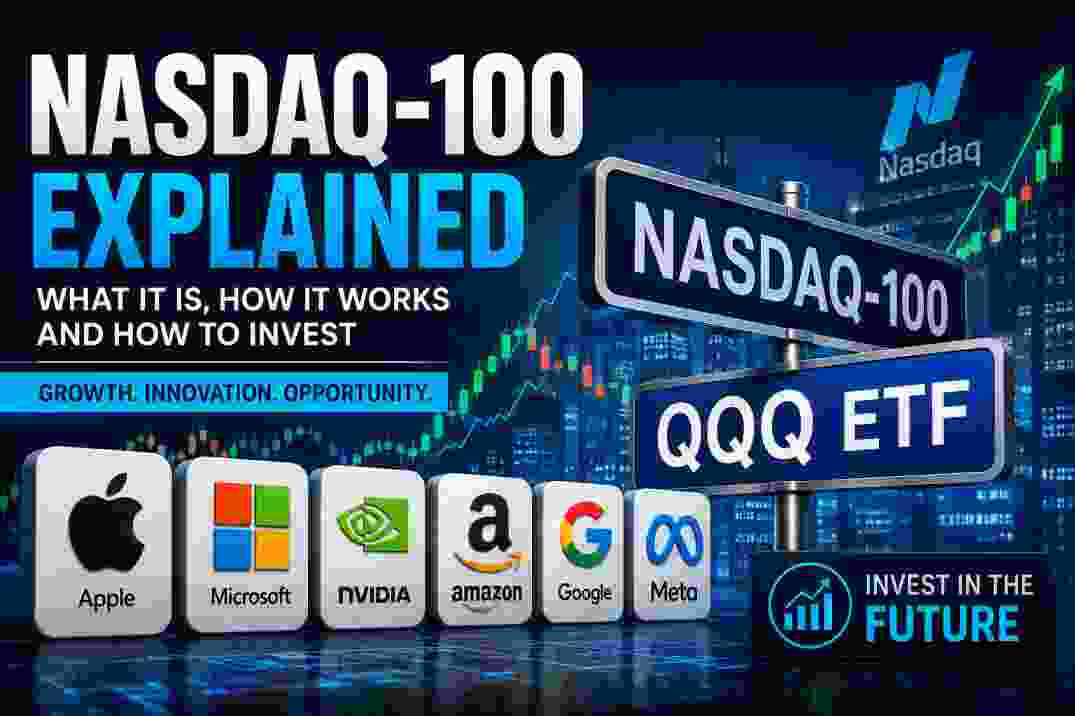
After learning about the S&P 500 and S&P 500 ETFs, the next major U.S. market index every global investor should understand is the Nasdaq-100.
The Nasdaq-100 is closely associated with technology, innovation and high-growth companies. It gives investors exposure to some of the world’s most influential businesses, including companies involved in artificial intelligence, cloud computing, software, semiconductors, e-commerce and digital services.
But there is an important distinction: the Nasdaq-100 is not simply a technology index. It tracks 100 of the largest Nasdaq-listed non-financial companies and uses a modified market-capitalization weighting methodology.
Also Read: Why Do Stock Markets Crash? The Real Reasons Behind Market Crashes
What Is the Nasdaq-100?
The Nasdaq-100 Index, commonly represented by the ticker NDX, was launched in 1985. It is designed to measure the performance of 100 of the largest non-financial companies listed on the Nasdaq Stock Market.
Its holdings span several industries, including technology, consumer services, healthcare, telecommunications and biotechnology. However, technology companies have historically represented a large portion of the index, which is why investors often view the Nasdaq-100 as a growth and innovation benchmark.
This makes the Nasdaq-100 different from the S&P 500. The S&P 500 provides broad exposure to large U.S. companies across the economy, while the Nasdaq-100 has a stronger concentration in growth-oriented businesses.
Why Does the Nasdaq-100 Matter to Global Traders?
The Nasdaq-100 has become one of the most important benchmarks for global investors because many of its companies operate internationally.
Also Read: Mortgage rates 2026 guide for US homebuyers
When investors discuss U.S. technology stocks, artificial intelligence, semiconductor growth or large-cap innovation, the Nasdaq-100 is often one of the first indexes they watch.
Movements in companies such as NVIDIA, Apple and Microsoft can have a significant effect on the index because larger companies receive larger weights under its modified market-capitalization methodology.
For global traders, the Nasdaq-100 can therefore provide a quick indication of investor sentiment toward U.S. growth stocks.
Nasdaq-100 vs S&P 500
The simplest way to understand the difference is this: S&P 500 = broader U.S. large-cap market exposure, while Nasdaq-100 = greater exposure to large Nasdaq-listed growth and innovation companies.
Also Read: AI Investing in 2026: Why Investors Are Looking Beyond AI Companies
The S&P 500 includes financial companies and companies listed on different U.S. exchanges. The Nasdaq-100 excludes financial companies and focuses specifically on eligible Nasdaq-listed companies.
Neither index is automatically “better.” They serve different purposes. An investor seeking broad U.S. diversification may prefer an S&P 500 ETF, while someone looking for greater exposure to technology and growth companies may consider a Nasdaq-100 ETF.
How Can You Invest in the Nasdaq-100?
You cannot directly buy an index because an index is simply a measurement. Instead, investors use exchange-traded funds (ETFs) designed to track the Nasdaq-100.
One of the best-known options is Invesco QQQ, which tracks the Nasdaq-100. Its current total expense ratio is 0.18%. Invesco also offers QQQM, another Nasdaq-100 ETF with a 0.15% expense ratio.
Also Read: US Tech Stocks in 2026: Should Indian Investors Invest After the Recent Correction?
For long-term investors, the difference between ETF expense ratios can matter over many years. For active traders, liquidity, spreads and trading volume may also become important considerations.
Can Indian Investors Invest in the Nasdaq-100?
Indian investors can obtain Nasdaq-100 exposure through different routes, depending on the investment product and current regulatory availability.
One route is investing directly in U.S.-listed ETFs such as QQQ or QQQM through a permitted international investment platform. Another route is using Indian investment products that provide exposure to U.S. equities or the Nasdaq-100, subject to availability, applicable regulations and fund restrictions.
Before investing, Indian investors should check the current product availability, taxation, foreign-exchange costs and applicable regulatory requirements rather than assuming that every U.S.-listed ETF is directly available through every Indian broker.
Also Read: Marvell Technology Stock: AI Data Center Growth Outlook
What Are the Risks?
The Nasdaq-100 can provide powerful exposure to innovative companies, but higher growth exposure can also mean higher volatility.
Technology and growth stocks can react strongly to interest rates, earnings expectations, economic data and changes in investor sentiment. A sharp rise in U.S. Treasury yields, for example, can put pressure on high-growth valuations.
There is also concentration risk. Although the index contains 100 companies, the largest companies can represent a significant portion of its overall weight.
For international investors, currency movements create another layer of risk. An investor outside the United States is exposed not only to the performance of the Nasdaq-100 but also to movements between the U.S. dollar and the investor’s home currency.
Also Read: Top 5 US AI Data Center Stocks to Watch in 2026
Onetrader Global Insight
The Nasdaq-100 should not be viewed simply as a “technology ETF.” It is better understood as an important benchmark for large, innovative, non-financial companies listed on Nasdaq.
The key lesson for beginners is simple: understand the index before choosing the ETF.
The S&P 500 can provide broad U.S. exposure. The Nasdaq-100 can provide a stronger tilt toward growth and innovation. Understanding this difference helps global investors build portfolios based on their objectives rather than simply buying whichever ETF is trending.
Conclusion
The Nasdaq-100 has become one of the world’s most followed stock indexes because it brings together many of the companies driving the modern digital economy.
Also Read: “History of Crude Oil: From Ancient Civilizations to the Modern Oil Industry (2026)
For global investors, learning how the Nasdaq-100 works is an important step after understanding the S&P 500. ETFs such as QQQ and QQQM make it possible to gain exposure to the index through a single investment, but investors should always consider diversification, valuation, volatility, costs, taxes and currency risk before investing.
Onetrader Global: Learn the market. Understand the index. Then make the investment decision.