
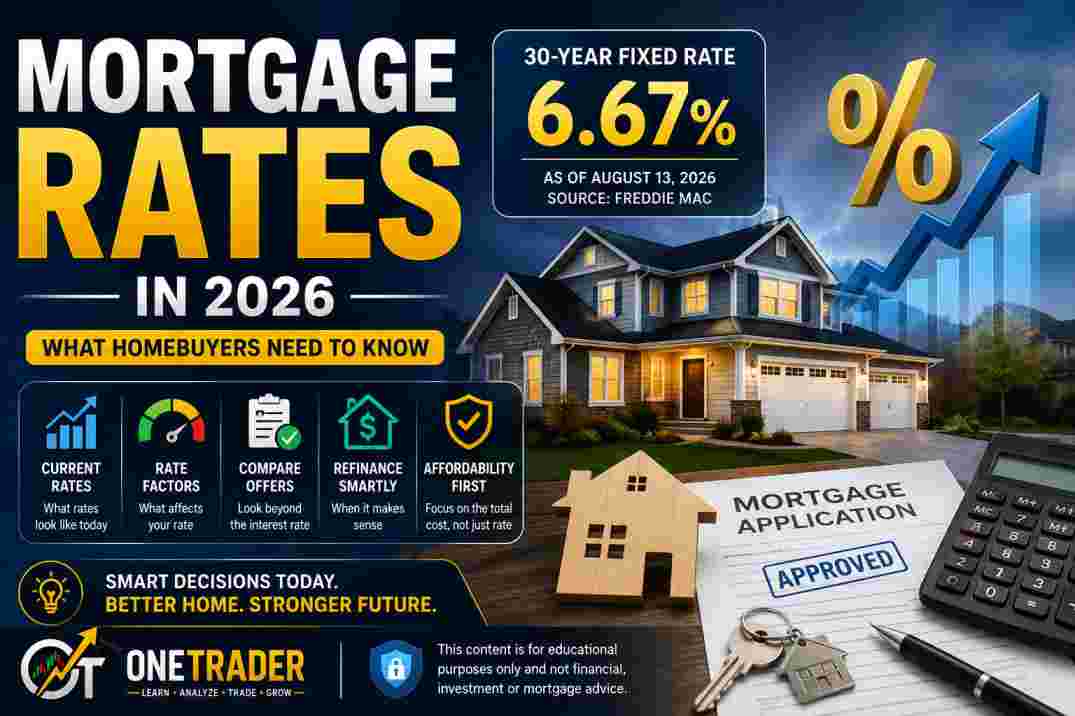
Mortgage rates remain a major decision point for US homebuyers. As of August 13, 2026, Freddie Mac’s weekly survey showed the average 30-year fixed mortgage rate at 6.67%, while the 15-year fixed rate averaged 5.96%.
Why Mortgage Rates Matter So Much
A mortgage rate affects much more than the advertised percentage. It directly influences the monthly principal-and-interest payment and the total interest paid over the life of a loan.
For example, even a relatively small change in the rate can materially change the cost of a large 30-year mortgage. This is why buyers should compare the complete loan offer rather than focusing only on the headline rate.
Current rates are also considerably higher than the unusually low rates available during the pandemic-era housing market. Freddie Mac’s historical data shows the 30-year fixed rate reached a record low around 2.65% in 2021.
Also Read: Why Do Stock Markets Crash? The Real Reasons Behind Market Crashes
What Is the Mortgage Rate Today?
There isn’t one mortgage rate available to every borrower.
The rate offered by a lender can depend on factors such as credit profile, loan type, down payment, property type, loan amount, location and whether the borrower pays discount points.
Freddie Mac’s national survey is useful for understanding the broader market, but it should not be treated as a guaranteed personal quote. Bankrate’s August 20 survey, for example, showed a national average 30-year fixed mortgage rate around 6.68%, illustrating that published averages can differ depending on the survey methodology and timing.
Should You Wait for Lower Mortgage Rates?
This is one of the most difficult questions for homebuyers.
Also Read: AI Investing in 2026: Why Investors Are Looking Beyond AI Companies
Waiting can make sense if your finances are not ready or if buying today would stretch your budget too far. But trying to perfectly predict the next move in mortgage rates can be difficult.
A lower future rate would potentially reduce borrowing costs, but home prices could also change while you wait. In addition, competition among buyers may increase if financing becomes cheaper.
The better question is often whether the home is affordable at today’s payment, rather than trying to predict the exact lowest mortgage rate of the year.
Your Credit Score Can Make a Difference
Borrowers with stronger credit profiles generally have access to more competitive mortgage offers, although the exact pricing depends on the lender and loan characteristics.
Also Read: US Tech Stocks in 2026: Should Indian Investors Invest After the Recent Correction?
Before applying, prospective buyers should review their credit reports and address errors if they find them. Paying bills on time, controlling outstanding debt and avoiding unnecessary new credit applications can also help maintain a stronger credit profile.
A small improvement in the rate can matter substantially when applied to a large mortgage balance over many years.
Compare APR, Not Just the Interest Rate
The advertised interest rate isn’t the entire cost of borrowing.
The annual percentage rate, or APR, incorporates the interest rate plus certain loan costs and can provide a broader basis for comparing mortgage offers. However, buyers should still examine the detailed fee disclosure because the way costs are presented can vary.
Also Read: Marvell Technology Stock: AI Data Center Growth Outlook
Two lenders might advertise similar interest rates while offering different total borrowing costs.
When Does Refinancing Make Sense?
Existing homeowners may also be watching mortgage rates.
Refinancing replaces an existing mortgage with a new one, potentially reducing the interest rate or changing the loan term. But refinancing comes with closing costs, so a lower rate does not automatically mean refinancing is worthwhile.
Freddie Mac notes that even relatively small mortgage-rate differences can affect monthly payments and lifetime interest costs.
Also Read: Top 5 US AI Data Center Stocks to Watch in 2026
Homeowners should calculate the break-even period — how long it takes for monthly savings to recover refinancing costs — before making a decision.
Don’t Forget the Total Cost of Buying
Mortgage payments are only one part of homeownership.
Buyers also need to consider property taxes, homeowners insurance, maintenance, potential HOA fees and closing costs. A mortgage payment that looks affordable on its own can become much more expensive once these additional costs are included.
This is particularly important when home prices are high and buyers are tempted to use the maximum loan amount offered by a lender.
Also Read: Nasdaq-100 Explained: What It Is, How It Works and How to Invest Through ETFs
The Bottom Line
Mortgage rates are an important part of the homebuying equation, but they shouldn’t be the only factor determining whether you buy a home.
With the 30-year fixed rate currently around the mid-6% range, US buyers should focus on affordability, credit quality, loan costs and the total monthly housing expense rather than trying to perfectly time the mortgage market.
The smartest mortgage decision is usually the one that remains comfortable even if rates, home prices or other household expenses move in an unexpected direction.
Onetrader Note: This article is for educational and informational purposes only and does not constitute mortgage, financial or investment advice. Mortgage rates and lending conditions change frequently. Always compare current offers and review the complete loan terms before making a borrowing decision.
Also Read: “History of Crude Oil: From Ancient Civilizations to the Modern Oil Industry (2026)